






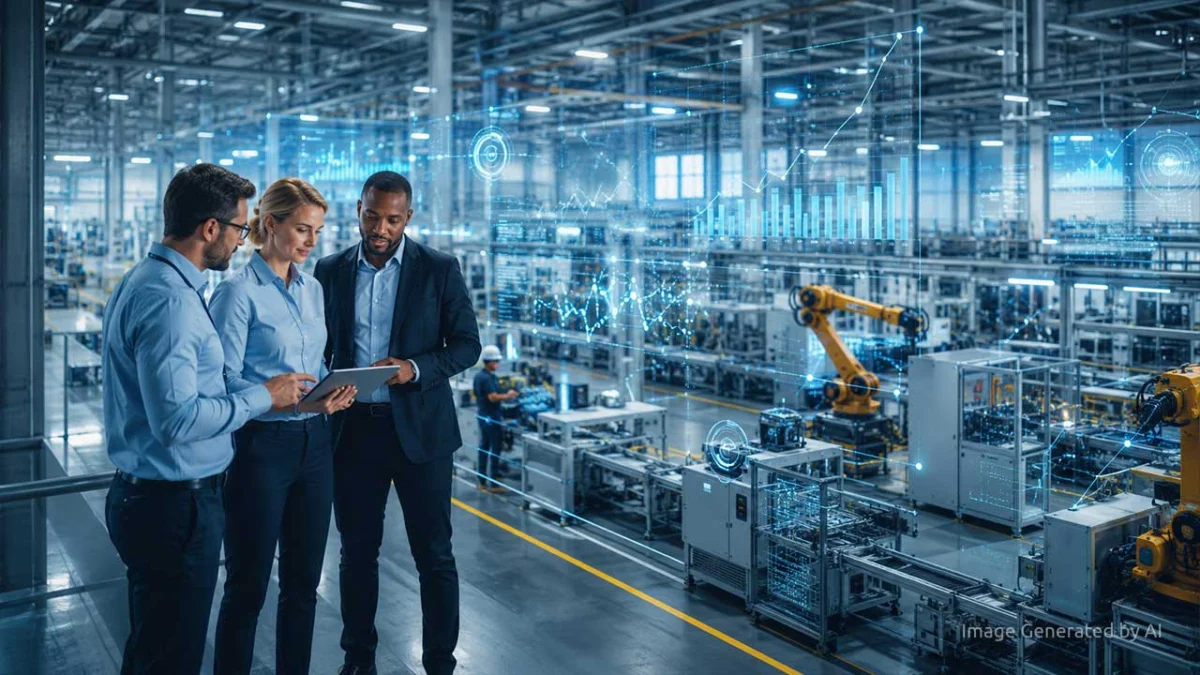
In the high-stakes theater of modern manufacturing, the narrative surrounding Artificial Intelligence has become dangerously narrow. Executives are frequently preoccupied with the "AI arms race"—the hunt for the most sophisticated large language models, the most efficient predictive maintenance algorithms, and the most robust cloud platforms. However, according to industry experts who gathered at the recent IIoT World Manufacturing Day, this singular focus on the "what" of AI is masking a critical blind spot: the "how" of organizational structure.
The consensus from leaders representing Cybus, MaibornWolff, SCHUNK, and Schwarz Digits is clear: the competitive divide in manufacturing is not being determined by who launches an AI pilot first. Instead, the winners are separating themselves from the pack through a rigorous, often unglamorous process known as "AI Readiness."
The Core Thesis: Competitive Advantage Precedes Deployment
For many industrial organizations, the strategy is one of "wait and see." Leaders are biding their time, waiting for the technology to mature, for clear winners in the vendor space to emerge, or for the costs of implementation to stabilize. While this cautious approach may seem fiscally responsible, it is, in reality, a strategic error.
The competitive advantage in manufacturing is forming well before a single line of AI code is deployed. The factories that are "AI-ready" today are not necessarily the ones with the most advanced algorithms; they are the ones that have built the internal architecture required to absorb and scale change. When AI capabilities eventually arrive at these facilities, they act as an accelerator rather than a disruption. For those who remain unprepared, the eventual arrival of AI will not be an evolution, but a traumatic, high-risk overhaul.
Chronology of a Transformation: From Data Silos to AI Fluency
The journey toward AI readiness is not a switch that can be flipped; it is a chronological evolution of operational maturity.
Phase 1: The Foundation of Transparency
Before AI can optimize a process, that process must be visible. In the initial phase, factories must move away from tribal knowledge and undocumented workflows. This requires building a common operational language—a shared set of metrics and definitions that span the shop floor to the executive suite.
Phase 2: Standardizing the Decision Loop
Once transparency is achieved, the focus shifts to the "signal-to-action" loop. Many traditional factories suffer from fragmented decision-making: a sensor detects an anomaly, but the information must pass through multiple layers of bureaucracy, manual approval, and disjointed software systems before a human can intervene. AI-ready factories standardize these loops, ensuring that the path from insight to action is as short as possible.
Phase 3: Cultivating Data-Driven Talent
The third phase involves talent alignment. This is where operations, engineering, and digital teams are brought into a shared sandbox. By working with data-driven workflows before advanced AI is introduced, these teams lose their fear of the "black box." They learn to trust data, understand its limitations, and, most importantly, identify exactly which problems actually require AI solutions.
The Operational Mechanics of AI Readiness
Why does this groundwork matter so much? The answer lies in the velocity of learning.
Standardizing Decision-Making
In an AI-ready facility, the framework for a decision is fixed. When an AI tool eventually suggests an adjustment to production parameters, the organization does not need to debate who has the authority to implement that change or how the data should be interpreted. The governance is already in place. This clarity eliminates the "bottleneck of execution" that plagues most legacy manufacturing operations.
Diagnosing Issues with Precision
When a factory operates with repeatable workflows, every deviation from the norm becomes a data point rather than a mystery. Issues become easier to diagnose because the process is standardized. When an improvement is identified, it can be replicated across other lines or facilities with high fidelity. Conversely, organizations that skip this step often "automate confusion." They apply sophisticated AI to broken or non-standard processes, effectively accelerating chaos rather than productivity.
Perspectives from the Frontlines: Official Insights
The IIoT World Manufacturing Day panel, moderated by Lara Ludwigs of Cybus, provided a masterclass in why leadership buy-in is the final component of the puzzle.
Peter Sorowka of Cybus emphasized that AI is not a magic bullet that fixes broken operations. "Factories that skip the readiness step often find that AI tools simply highlight their existing inefficiencies in higher resolution," he noted.
Marc Jäckle (MaibornWolff), Martin May (SCHUNK), and Aleksandar Hudic (Schwarz Digits) echoed this sentiment, arguing that the most successful companies are those that view AI as an extension of their existing, well-oiled practices. By the time these companies reach the point of deploying advanced production planning or AI-driven optimization, the "heavy lifting" of cultural and structural change has already been done.
The High Cost of Procrastination: The "Compression Risk"
Manufacturers who choose to postpone AI readiness face a perilous future. When competitive pressures, customer demands, or margin erosion eventually force their hand, they will be left with no choice but to undertake a "Big Bang" implementation.
This leads to a phenomenon known as Timeline Compression. In this scenario, a company must simultaneously:
- Redesign their organizational structure.
- Cleanse and unify their data architecture.
- Upskill their entire workforce.
- Implement complex AI software.
The risk profile here is catastrophic. Rushed projects lead to misaligned expectations; when the first AI project fails to deliver immediate, massive ROI, leadership confidence evaporates, and the entire digital transformation effort is derailed. In contrast, the AI-ready factory experiences AI as a natural evolution. The risk is minimized because the "newness" of the technology is mitigated by the stability of the processes it supports.
Summary: The AI-Ready Factory vs. The Late Adopter
| Dimension | AI-Ready Factory | Late Adopter |
|---|---|---|
| Decision Speed | High; standardized and clear. | Low; fragmented and bureaucratic. |
| Learning Velocity | High; issues are transparent and replicable. | Low; confusion is often automated. |
| Talent Alignment | Teams are already data-literate. | Teams resist due to abrupt change. |
| Integration | AI is an extension of existing practice. | AI is a disruptive, high-risk project. |
| Risk Profile | Incremental, controlled growth. | High; "Big Bang" failure potential. |
Implications for the Future of Manufacturing
The implications of this shift are profound. We are moving toward a manufacturing landscape where the "algorithm" is no longer the primary differentiator—algorithms are increasingly commoditized and accessible. The real differentiator is the organizational "OS" (Operating System).
The companies that will dominate the next decade are not necessarily the ones with the most expensive data scientists. They are the ones that have democratized data, clarified accountability, and built a culture where the organization itself is a learning machine.
Final Takeaways for Leadership
If you are an executive in the manufacturing sector, the mandate is clear:
- Stop searching for the "perfect" AI vendor. Start by perfecting your data governance and process transparency.
- Focus on the human element. Break down the silos between your engineering and operational teams today. Build the habit of data-driven decision-making now, before the tools become complex.
- Audit your execution speed. If it takes weeks to change a production parameter, AI won’t help you; it will only make your slow processes more frustrating.
- Prioritize structural health. The best AI will always be limited by the organizational structure it operates within.
By the time AI systems fully take center stage in production planning and autonomous optimization, the market winners will have already been determined. They will be the companies that required the least amount of organizational change to adopt the new technology—the companies that were, in every sense of the word, ready.
This report is based on the expert insights shared during the IIoT World Manufacturing Day panel. The full discussion on data sovereignty and industrial AI is available for viewing at the IIoT World video archives.