





The automotive industry is currently witnessing a tectonic shift in power. For decades, the global stage was dominated by legacy manufacturers from Germany, Japan, and the United States. However, the rise of the electric vehicle (EV) era has facilitated the ascent of a new, formidable challenger: BYD. Recent data from April 2026 reveals that the Chinese manufacturing powerhouse has reached a milestone that underscores its rapid transition from a regional player to a dominant global force, sending shockwaves through the corridors of traditional automakers.
Main Facts: A Statistical Powerhouse
In April 2026, BYD achieved an export figure of 135,098 vehicles. To put this into perspective, this number—representing only the vehicles shipped outside of China—surpasses the estimated total worldwide sales of Tesla for the same period. While Tesla remains a benchmark for the industry, the sheer scale of BYD’s international reach is now undeniable.
BYD’s total passenger vehicle sales for April reached a staggering 314,100 units. When broken down, this figure includes 179,002 vehicles sold within the Chinese domestic market and the aforementioned 135,098 exports. This duality demonstrates a two-pronged growth strategy: maintaining a firm grip on the world’s largest EV market while aggressively expanding its footprint across Europe, Southeast Asia, Latin America, and Australia. By capturing the top spot globally for plug-in vehicle sales, BYD is no longer just "competing"; it is setting the pace for the industry.
Chronology of the Surge
The climb to these numbers was not overnight. To understand how BYD reached this export volume, one must look at the strategic timeline of the company’s expansion:
- 2021–2022: Consolidation of the Battery Supply Chain. BYD spent these years perfecting its "Blade Battery" technology and vertical integration, ensuring that it was not as susceptible to the supply chain volatility that crippled other manufacturers during the post-pandemic recovery.
- 2023: The Global Pivot. Recognizing that domestic saturation was an inevitability, BYD accelerated its export strategy. It began securing shipping capacity—commissioning its own fleet of car carriers to bypass the global maritime logistics bottlenecks.
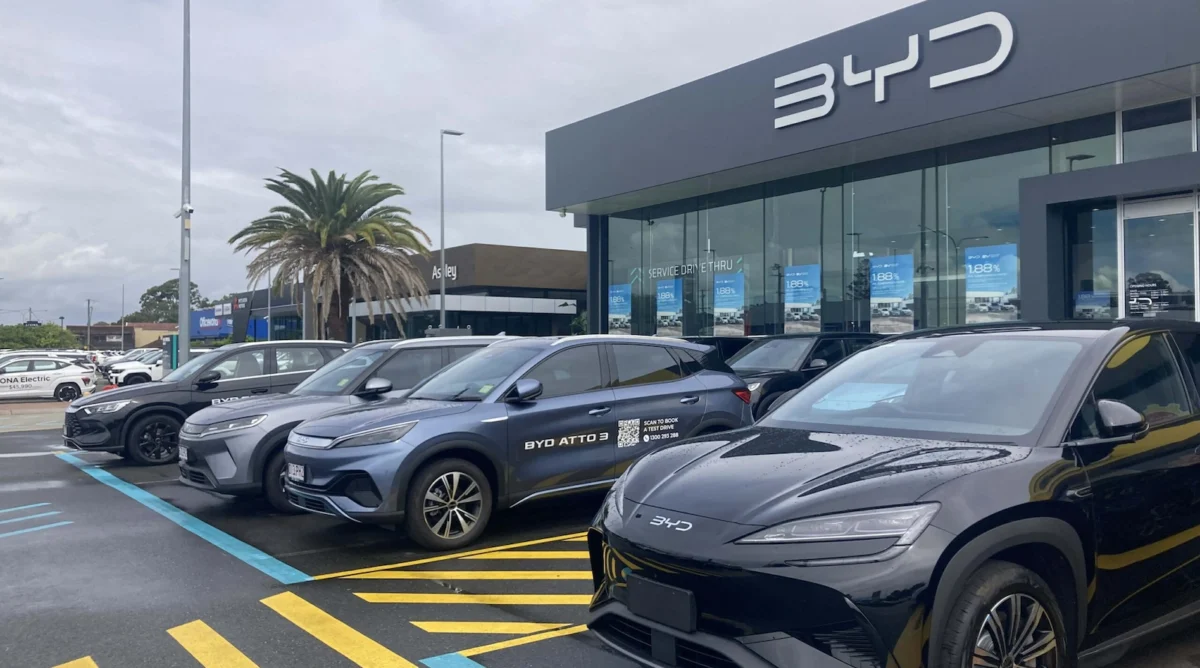
- 2024–2025: Market Penetration. The company focused on aggressive pricing and high-value feature sets, particularly with models like the Atto 3 and the Dolphin. These vehicles were designed to compete directly with legacy internal combustion engine (ICE) hatchbacks, often undercutting them on price while offering superior technology.
- April 2026: The Inflection Point. This month marked a critical juncture where export volume achieved such velocity that it eclipsed the monthly output of high-profile Western competitors, signaling that the company’s international distribution networks have finally reached full maturity.
Supporting Data and Comparative Analysis
The comparison between BYD and Tesla, while complex due to reporting differences, provides essential context. Tesla publishes sales figures on a quarterly basis, making monthly estimates necessary. In Q1 2026, Tesla recorded 358,023 global deliveries. If we take one-third of that as a baseline for a single month, we arrive at roughly 119,341 units.
BYD’s export-only figure of 135,098 exceeds this benchmark by a significant margin. Furthermore, Tesla’s delivery schedule is traditionally back-loaded, with the final month of a quarter seeing significantly higher volumes than the first. Given that April is the first month of the second quarter, it is highly improbable that Tesla’s global monthly sales matched or exceeded BYD’s export numbers.
Furthermore, observers have noted that BYD’s export volume is roughly double the total worldwide sales of luxury brands like Lexus. While Lexus operates in a different price segment, the sheer volume of BYD’s reach suggests that the brand is successfully transitioning from an "affordable EV" option to a volume-driven global powerhouse that can challenge even the most established marques in terms of unit movement.
Official Responses and Market Sentiment
While BYD has remained relatively understated in its official corporate communications, the implications of these numbers have not gone unnoticed by global trade bodies and regulatory agencies.
The European Union and the United States have both voiced concerns regarding the competitive advantage enjoyed by Chinese manufacturers, citing state subsidies and lower manufacturing costs as potential sources of market distortion. However, from the perspective of the consumer, the sentiment is overwhelmingly positive. BYD’s ability to deliver high-quality, tech-forward vehicles at prices that make electrification accessible to the mass market has made them a preferred choice in emerging markets.
Industry analysts suggest that BYD’s strength lies in its "vertical integration." By manufacturing its own batteries, semiconductors, and software systems, BYD minimizes the "middleman" costs that inflate the price tags of its competitors. This has allowed the company to maintain healthy profit margins even while engaging in aggressive price wars that have forced other EV startups to the brink of insolvency.
Implications for the Future of Automotive
The rise of BYD has profound implications for the global automotive landscape, which can be categorized into three key areas:
1. The Death of the "ICE" Advantage
For years, legacy automakers relied on the complexity of internal combustion engines to act as a barrier to entry for new competitors. With EVs, the barrier to entry has effectively been lowered, and the focus has shifted to battery chemistry and software. BYD’s success proves that a manufacturer with a superior battery supply chain can dictate the terms of the market, rendering the historical advantage of legacy firms obsolete.
2. Supply Chain Sovereignty
BYD’s investment in its own fleet of massive vehicle-carrying ships is a masterclass in logistics. By controlling the shipping process, the company has bypassed the logistical nightmares that have plagued the automotive sector since 2020. Other manufacturers, currently reliant on third-party shipping, are now scrambling to emulate this model, realizing that in the modern era, you must control the distribution to ensure the sale.
3. The Geopolitics of Mobility
As BYD continues to export, the geopolitical landscape of the auto industry will likely grow more strained. Expect to see increased pressure for "local content" requirements, where governments mandate that a certain percentage of the vehicle be manufactured within their borders to qualify for tax incentives. BYD is already anticipating this, with plans for manufacturing hubs in Brazil, Hungary, and Thailand, signaling a transition from an "export-only" strategy to a "local production" strategy.
Conclusion
The data from April 2026 is not merely a collection of impressive numbers; it is a signal of the end of an era. The global automotive hierarchy is being rewritten, and the pen is being held by companies that have mastered the transition to electrification.
While Tesla continues to be a leader in brand prestige and software innovation, BYD has demonstrated a level of operational scale and logistical mastery that is unmatched. As the company continues to penetrate new markets and refine its global production capacity, the rest of the world’s automakers face a stark reality: the future of the automobile is not just electric—it is increasingly being defined by those who can manufacture at scale, control their supply chains, and deliver at a price point that the global middle class finds impossible to ignore.
The road ahead for the automotive industry will be defined by how incumbents adapt to the "BYD Effect." Those who fail to innovate, optimize, and streamline their operations will likely find themselves as footnotes in a history book that is currently being written in real-time. For now, the world watches as BYD turns the tide, transforming from a Chinese manufacturer into the primary architect of the global electric vehicle revolution.