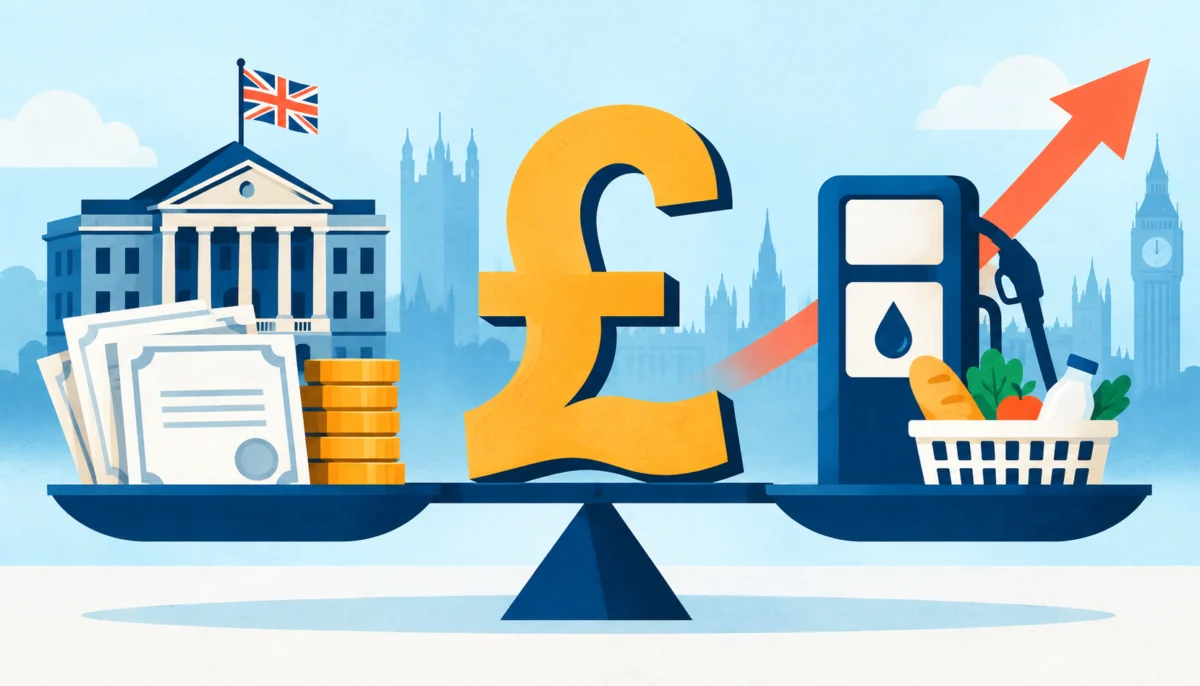
The United Kingdom is navigating a precarious economic corridor as new data reveals a convergence of rising price pressures and fiscal overruns. According to the Office for National Statistics (ONS) figures released on October 21, the UK’s annual consumer-price inflation (CPI) accelerated to 3.5% in September, up from 3.1% in August. Simultaneously, public sector borrowing reached £24.5 billion for the month—an overshoot of £1.9 billion against the projections set by the Office for Budget Responsibility (OBR).
This dual pressure creates a complex environment for both the Treasury and the Bank of England. As households struggle with the rising cost of living and businesses grapple with narrowing margins, policymakers are being forced to calibrate fiscal and monetary levers in an atmosphere of heightened uncertainty.
The Chronology of an Economic Tightening
The trajectory of the current economic strain became apparent throughout the third quarter of 2026. The summer months saw an initial optimism regarding the cooling of energy-related inflation, but the onset of autumn brought a reversal.
- August: Annual CPI stood at 3.1%, providing a baseline that many analysts hoped would be the peak of a downward trend.
- September Meeting: The Bank of England’s Monetary Policy Committee (MPC) voted 6-3 to hold the Bank Rate at 3.75%. Even then, the three dissenters—who advocated for a 4% rate—signaled growing concern over the persistence of inflationary shocks.
- October 21 Data Release: The ONS published the September bulletin, confirming that headline inflation had accelerated to 3.5%. The public finance release confirmed that fiscal borrowing had hit £97.8 billion for the financial year-to-date, putting it £6.0 billion ahead of the OBR’s forecasted path.
- November 5 Outlook: Markets are now bracing for the upcoming Bank of England policy decision, which will be the first to formally account for the October 21 data.
Supporting Data: A Closer Look at the Metrics
The inflationary surge in September was primarily driven by the transport sector, with motor fuels acting as the most significant contributor. While restaurants and hotels provided a marginal downward offset, the core inflationary indicators suggest that price pressure is broadening.
Inflationary Breakdown
The ONS reported a 0.4% monthly increase in the CPI. Beyond the headline figures, the "Core CPI"—which strips out volatile energy, food, alcohol, and tobacco prices—climbed from 2.6% to 2.8%. Perhaps more concerning to the Bank of England is the rise in services inflation, which ticked up to 3.7% from 3.4%.
Furthermore, the CPIH—the broadest measure of inflation, which includes the costs associated with owner-occupiers—reached 3.6%. While these figures do not yet confirm an entrenched wage-price spiral, they indicate that the "second-round effects" previously feared by the MPC are beginning to manifest in the services sector.
Fiscal Realities
Public sector net debt has reached a symbolic and economic milestone: £3,005 billion, representing 94% of GDP. While the deficit is technically lower than this time last year, the fact that it has significantly outpaced the OBR’s projections creates a credibility gap. The government’s debt interest payments hit £10.9 billion in September alone, £2.0 billion above what had been budgeted. This suggests that the cost of servicing the national debt is becoming increasingly sensitive to the volatility in global interest rates.
Official Responses and Strategic Challenges
The government and the central bank are currently operating under different mandates but are facing the same fundamental constraint: a lack of fiscal and monetary "headroom."
The Bank of England’s Dilemma
The Bank is in a classic "persistence test." While higher interest rates are effective at cooling demand, they are blunt instruments against supply-side shocks like energy price hikes. The MPC must decide whether the 3.5% inflation reading is a temporary spike caused by geopolitical energy disruptions or a sign that domestic inflation expectations have become unanchored.
If the Bank raises rates too aggressively, it risks stifling an already fragile economic recovery. If it acts too timidly, it risks allowing inflation to become a permanent feature of the economy, which would necessitate even more painful interventions in the future.
The Treasury’s Balancing Act
The Treasury faces the challenge of managing the "Budget" in a high-inflation environment. The OBR’s modeling indicates that inflation affects government finances in non-linear ways. While higher prices can boost nominal tax receipts, they also trigger automatic increases in welfare uprating and debt interest costs.
For the government, the temptation to use borrowing to plug the gap is high, but the market’s reaction to increased debt issuance could drive gilt yields higher, further exacerbating the interest-servicing costs. The challenge for the Chancellor is to provide support for the most vulnerable without signaling a long-term shift toward expansionary fiscal policy, which would undermine the Bank of England’s anti-inflationary stance.
Implications for Businesses and Households
The economic climate is creating distinct winners and losers based on structural resilience and contractual flexibility.
Business Resilience
For the corporate sector, the interaction between inflation and debt is critical. Companies with high floating-rate debt are seeing their cash flows squeezed as interest costs rise. Those unable to pass on increased costs to consumers via price-adjustment clauses are seeing their profit margins erode rapidly.
Analysts are currently looking at "debt maturity profiles." A company that locked in low, long-term fixed-rate debt before the current cycle began is in a significantly better position than a competitor facing a refinancing cliff in the coming year. Consequently, credit risk assessments have become more granular, focusing on liquidity buffers rather than just headline profitability.
Household Impact
For the average household, the distinction between core and headline inflation is academic. The rising cost of fuel—a non-discretionary essential for many commuters—is effectively acting as a tax, reducing the purchasing power available for other sectors of the economy. Retailers and hospitality providers are already reporting early signs of a shift in consumer behavior, as households prioritize essentials over discretionary spending.
Analyst’s Perspective: A Narrow Margin for Error
The current situation calls for a high level of vigilance from both investors and policymakers. The primary concern regarding sovereign risk is whether the government can present a sustainable fiscal path. If the government’s planning remains overly dependent on optimistic growth projections or favorable interest rate environments, it leaves the public finances exposed to further shocks.
For market participants, the outlook is equally murky. Sterling’s performance remains tethered to the perceived resolve of the Bank of England. A signal of "hawkish" intent to combat inflation may support the currency in the short term, but it simultaneously increases the risk of a domestic growth slowdown.
Bond markets (gilts) are currently reflecting a high risk premium. Investors are demanding higher yields to compensate for the uncertainty regarding inflation and the government’s capacity to manage its debt-to-GDP trajectory.
Ultimately, the confluence of rising inflation and fiscal overruns has left policymakers with a significantly narrowed margin for error. The upcoming November 5th decision from the Bank of England, coupled with the government’s next fiscal update, will be the decisive factors in determining whether the UK economy can return to a stable growth path or if it is destined to remain in a period of protracted volatility. The next few months will be characterized by a "wait-and-see" approach from institutional investors, as they look for concrete evidence that inflation is being contained and that the public finances are being brought under control.