NEW YORK — In an era defined by economic volatility, supply chain disruptions, and persistent labor shortages, manufacturing leaders face a daily barrage of high-stakes decisions. Are executives making the right operational choices that directly correlate to improved financial outcomes? Can emerging technologies like artificial intelligence (AI) and advanced manufacturing software genuinely move the needle, or are they merely expensive distractions?
To answer these critical questions, premier research firm Tech-Clarity has conducted an exhaustive survey of more than 400 manufacturing professionals, cutting through the hype to examine the tangible value of plant-floor technology. The findings reveal a compelling narrative: modern manufacturing operations software and AI solutions are no longer just nice-to-have tools for tech-forward enterprises. Instead, they are vital financial engines capable of delivering concrete ROI—frequently within twelve months, and occasionally in as little as three.
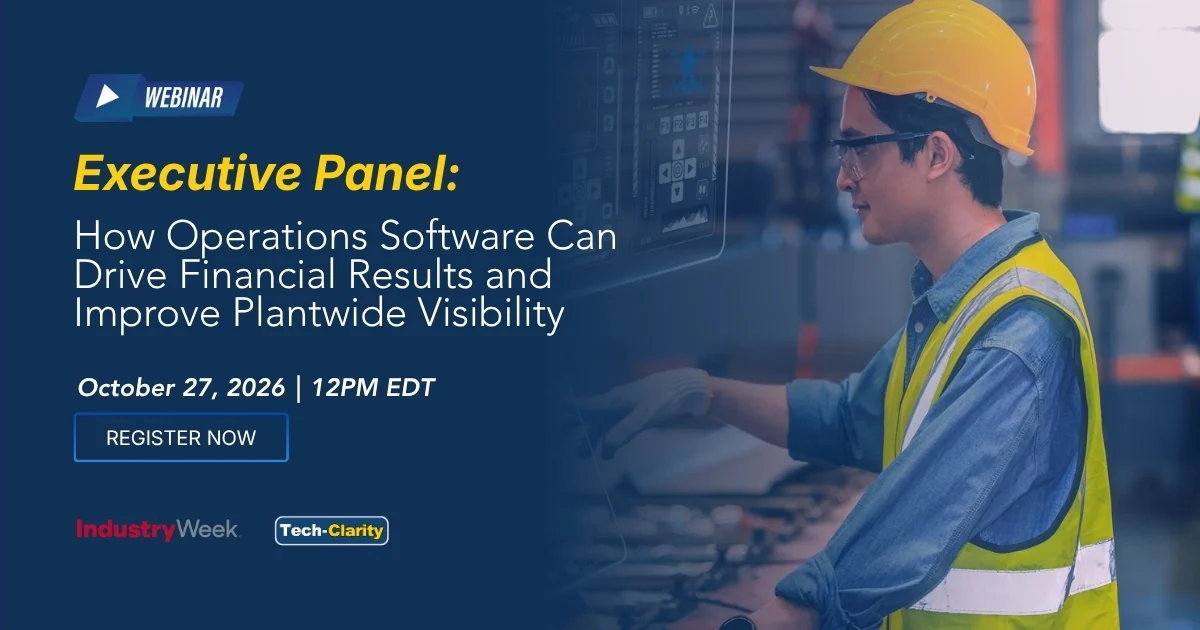
For industry professionals eager to unpack these findings, IndustryWeek is hosting an exclusive, panel-style webinar on October 27, 2026, at Noon Eastern Time. Titled "How Operations Software Can Drive Financial Results and Improve Plantwide Visibility," the session brings together seasoned manufacturing executives from companies of varying sizes to discuss how software investments are reshaping plantwide visibility, decision-making, and profitability.
Main Facts: The Intersection of Technology and Bottom-Line Performance
The upcoming IndustryWeek executive panel and the underlying Tech-Clarity research highlight several foundational truths about the modern industrial landscape:
- Rapid Return on Investment: Data from Tech-Clarity’s survey of over 400 industry professionals indicates that organizations deploying manufacturing operations and AI software typically realize measurable business benefits within one year. A subset of high-performing adopters reports seeing positive financial impacts in as few as three months.
- Holistic Operational Scope: The technologies driving these rapid results encompass a broad spectrum of plant functions, including production execution, predictive and preventative maintenance, quality assurance, and real-time inventory management.
- The Visibility Deficit: Despite the proliferation of enterprise resource planning (ERP) systems, many manufacturers continue to suffer from data silos between the shop floor and the corporate office. Bridging this gap is the primary mechanism through which software translates into superior financial performance.
- Actionable Peer Insights: The October 27 webinar bridges raw data with real-world execution, featuring a panel of industrial leaders who have successfully rolled out plantwide or operations-wide software and AI architectures. They will openly discuss whether their software investments have lived up to expectations and share field-tested best practices.
Chronology: The Evolution of Plant-Floor Software and the Path to the 2026 Survey
To understand the significance of Tech-Clarity’s latest research, it is helpful to examine how manufacturing software has evolved over the past few decades and how the industry arrived at this critical juncture.
Phase 1: The Siloed Era (Late 20th Century to Early 2000s)
Historically, manufacturing software was fragmented. Plant floors relied on rudimentary control systems and localized SCADA (Supervisory Control and Data Acquisition) setups, while corporate headquarters ran isolated financial and accounting tools. Communication between the shop floor and the boardroom was manual, delayed, and often inaccurate. Decisions were made using lagging indicators—meaning leaders reacted to problems long after they had already impacted the bottom line.
Phase 2: The Rise of MES and Early Integration (2010s)
As competition intensified, the Manufacturing Execution System (MES) emerged as a bridge between automation systems and enterprise planning tools. Companies began to recognize the value of tracking work-in-progress (WIP), monitoring machine utilization, and digitizing basic quality checks. However, these implementations were often costly, complex, and restricted to large enterprises with massive IT budgets. Mid-market manufacturers frequently found themselves priced out of advanced operational visibility.
Phase 3: The Cloud, IoT, and AI Revolution (2020 to Present)
The maturation of cloud computing, the Industrial Internet of Things (IIOT), and, most recently, artificial intelligence has completely democratized operational software. Modern solutions are modular, highly scalable, and capable of processing vast streams of real-time data from disparate legacy and modern equipment.

Recognizing that adoption was accelerating but that executive skepticism remained regarding true financial payback, research firm Tech-Clarity initiated its comprehensive study. Polling over 400 manufacturing professionals across diverse sectors and organization sizes, the firm sought to quantify the actual business impact of these digital transformations. The results of this study serve as the cornerstone for the upcoming IndustryWeek webinar on October 27, 2026, marking a new milestone in how the industry evaluates technology investments.
Supporting Data: What the Tech-Clarity Survey Reveals
The Tech-Clarity research goes beyond anecdotal success stories, offering hard data on how operations software influences organizational performance. While the full scope of the study will be dissected during the webinar, several key data points underscore the urgency of digital adoption:
1. Accelerated Payback Periods
One of the most persistent myths surrounding enterprise and operational software is that it requires a multi-year deployment cycle before yielding any financial return. Tech-Clarity’s survey shatters this assumption. The vast majority of respondents reported seeing tangible operational improvements within 12 months of go-live. Even more striking, a notable percentage of agile organizations achieved positive ROI in 3 months or less, largely driven by targeted AI applications that resolved chronic bottlenecks or optimized maintenance schedules instantly.
2. The Multi-Dimensional Impact on Plant Functions
Manufacturing operations software is rarely a single-point solution. The survey highlights that organizations leveraging integrated software suites experience improvements across multiple operational pillars simultaneously:
- Production Execution: Minimizing cycle times, reducing scrap, and increasing overall equipment effectiveness (OEE).
- Maintenance: Transitioning from reactive firefighting to predictive maintenance, thereby slashing costly unplanned downtime.
- Quality Management: Capturing defects at the source, automating compliance reporting, and reducing costly product recalls or rework loops.
- Inventory Control: Optimizing stock levels, reducing carrying costs, and improving on-time delivery rates to customers.
3. Scaling Across Enterprise Sizes
A common critique of industry surveys is that they only reflect the multi-billion-dollar budgets of Fortune 500 conglomerates. Tech-Clarity deliberately cast a wide net, surveying professionals from small, medium, and large manufacturing enterprises. The data demonstrates that modern, cloud-based operations software and AI tools have leveled the playing field, allowing smaller operations to scale their visibility and financial performance rapidly without prohibitive capital expenditures.
Official Perspectives: Industry Leaders Speak Out
The upcoming IndustryWeek executive panel features operational leaders who have walked the path of digital transformation. Rather than relying on vendor pitches, the webinar is designed to offer unvarnished, peer-to-peer insights into what works, what fails, and how to navigate the human and technical hurdles of software deployment.
While preparing for the event, several recurring themes have emerged from executive discussions regarding the philosophy of plantwide visibility:
- Closing the Data-to-Decision Gap: Industry veterans emphasize that data collection alone is worthless. The true power of modern operations software lies in its ability to filter out noise, surface actionable insights, and present them directly to the operators and managers who can make immediate corrections.
- Managing Cultural Change: Technology implementation is rarely just an IT project; it is an organizational change management initiative. Panelists frequently stress that securing buy-in from plant-floor operators—by demonstrating how software makes their jobs easier rather than simply monitoring them—is the single most important factor in achieving long-term financial results.
- Aligning Plant Metrics with Financial Goals: Too often, plant managers are judged on local metrics (like machine utilization) that do not necessarily align with corporate financial goals (like cash flow and inventory velocity). Modern operations software serves as the translator, helping operational leaders see how micro-level efficiencies compound into macro-level profitability.
Implications: What This Means for Manufacturers Moving Forward
The convergence of rigorous research from Tech-Clarity and practical guidance from IndustryWeek points to profound implications for the manufacturing sector at large.

1. The Cost of Inaction is Escalating
In past decades, delaying software upgrades meant settling for incremental inefficiencies. Today, in an environment marked by aggressive global competition, tight margins, and labor scarcity, operating in the dark is a recipe for obsolescence. Manufacturers that continue to rely on manual spreadsheets, fragmented legacy systems, and gut-feel decision-making will find themselves outpaced by competitors who can optimize production and pivot operations in real-time.
2. AI is Transitioning from Theory to Execution
The manufacturing sector has spent the last few years discussing the theoretical potential of artificial intelligence. The Tech-Clarity survey signals a critical inflection point: AI is now actively delivering concrete benefits on the shop floor. Whether predicting equipment failures before they happen, dynamically rescheduling production jobs around supply chain hiccups, or detecting microscopic quality flaws, AI has proven its worth as a financial driver.
3. The Imperative for Continuous Learning
For executives, plant managers, and IT directors navigating these choices, the path forward requires intentional education and peer collaboration. Understanding how to select the right software architecture, measure the correct KPIs, and avoid common pitfalls is essential for maximizing ROI.
Join the Discussion
Are you looking to tie your plant-floor operations more directly to your balance sheet? Do you want to understand how your peers are successfully leveraging AI and manufacturing software to outmaneuver market uncertainties?
Don’t miss the opportunity to learn directly from the research and the experts.
- Event: IndustryWeek Executive Panel Webinar
- How Operations Software Can Drive Financial Results and Improve Plantwide Visibility
- Date: October 27, 2026
- Time: Noon Eastern Time
- Registration: Secure your spot by visiting the official registration page linked through IndustryWeek Webinars.
Equip your leadership team with the insights, data, and strategies needed to transform your operations software from an IT expense into your organization’s greatest financial asset.