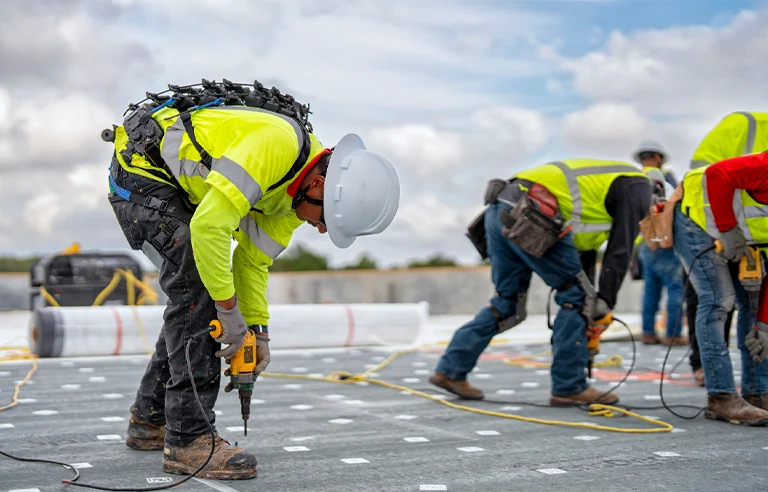
COLLEGE STATION, TX — In the high-stakes, physically demanding world of modern construction, safety has long been viewed through a dual lens: the physical protection of the worker’s body against musculoskeletal strain and the cognitive awareness needed to navigate a constantly changing, hazard-laden job site. For decades, these two domains—biomechanical ergonomics and cognitive psychology—have largely been treated as separate pillars of occupational health.
However, groundbreaking new research originating from Texas A&M University is bridging this gap in a profound way. A recent study investigating the real-world application of lower-back exoskeletons among construction laborers has revealed a compelling secondary benefit to wearable robotics. While these devices were primarily engineered to alleviate physical strain, the study discovered that workers utilizing them also exhibited a dramatic improvement in hazard recognition.
According to the findings, construction workers equipped with passive lower-back exoskeletons experienced 37% less physical fatigue. Simultaneously, these same workers demonstrated a 29% improvement in their ability to identify and assess job-site hazards.
Published in the ASCE Open: Multidisciplinary Journal of Civil Engineering, this study challenges the traditional boundaries of workplace safety engineering. It suggests that by unburdening the physical body, employers can simultaneously sharpen the cognitive faculties of their workforce, paving the way for a holistic approach to occupational safety that treats the human body and mind as an interconnected system.
Main Facts: The Intersection of Ergonomics and Cognitive Performance
At its core, the Texas A&M study investigates a critical question that has puzzled occupational safety experts for years: How does physical exhaustion directly impact mental acuity on the job?
Construction is among the most physically taxing industries in the world. Laborers routinely engage in heavy lifting, repetitive bending, twisting, and prolonged awkward postures, all of which place immense stress on the lumbar spine. This chronic physical exertion inevitably leads to musculoskeletal disorders (MSDs), which account for a significant percentage of workplace injuries, lost workdays, and long-term disabilities.
To combat this, the industry has increasingly turned to wearable technology, specifically lower-back exoskeletons. These wearable devices—often mechanical or spring-loaded frameworks worn externally on the body—are designed to store and release energy, effectively reducing the compressive forces exerted on a worker’s lower spine during lifting tasks.
While previous research has extensively documented the biomechanical efficacy of these devices, the Texas A&M research team sought to explore the cognitive downstream effects. When a worker expends significantly less energy fighting off physical fatigue, what happens to their situational awareness? Can an unburdened back lead to an uncluttered mind?
The study’s headline statistics provide an affirmative and resounding answer:
- 37% Reduction in Physical Fatigue: Workers wearing the exoskeleton reported and exhibited substantially lower levels of physical exhaustion following rigorous work sessions.
- 29% Increase in Hazard Recognition: When tested on their ability to spot workplace dangers, exoskeleton-equipped workers performed nearly a third better than their unassisted counterparts.
- Real-World Methodology: The study stepped out of the controlled, sterile environment of a laboratory and directly onto an active construction site, ensuring that the data reflects true operational conditions.
Chronology: How the Study Was Conducted
To arrive at these striking conclusions, the research team, spearheaded by doctoral students and faculty in Texas A&M’s Department of Construction Science, designed a rigorous, multi-phased field experiment. Understanding the nuances of construction work required a methodology that could measure both physical output and cognitive processing in real time.
Phase 1: Site Selection and Participant Recruitment
The researchers partnered with an active construction site located in Louisiana, providing a authentic backdrop characterized by unpredictable environmental factors, ambient noise, and genuine physical labor demands. A cohort of 16 professional construction workers was recruited for the study. These participants represented the target demographic for exoskeleton deployment: individuals whose daily routines involve routine heavy lifting and bending.
Phase 2: Baseline and Comparative Work Sessions
To accurately measure the impact of the exoskeletons, the 16 workers were asked to complete two distinct three-hour work sessions.
- In one session, the workers performed their normal, everyday construction duties without any assistive technology.
- In the other session, the workers were equipped with commercially available passive lower-back exoskeletons designed to support lumbar movement.
Throughout these sessions, researchers monitored the physical exertion and fatigue levels of the participants, capturing data on how much bodily strain was alleviated by the wearable technology.
Phase 3: Cognitive Testing (Pre- and Post-Session)
The most innovative aspect of the study’s timeline involved the integration of cognitive assessments. Before and after each three-hour work session, the participating workers were shown a series of standardized images depicting various construction site hazards—such as unsecured scaffolding, electrical risks, trip hazards, and improper material stacking.
The workers were tasked with two cognitive responsibilities:
- Identification: Spotting and pointing out the specific hazards hidden within the visual stimuli.
- Risk Assessment: Evaluating the severity and probability of harm associated with those identified hazards.
By comparing the pre- and post-session hazard recognition scores across both the unassisted and exoskeleton-assisted conditions, the researchers were able to isolate the impact of the wearable technology on cognitive function.
Supporting Data: Unpacking the Numbers
The quantitative results gathered from the Louisiana construction site offer a compelling statistical narrative. In occupational health research, achieving a double-digit percentage shift in performance metrics is notable; achieving simultaneous, significant gains in both physical and cognitive domains is groundbreaking.
The Biomechanical Relief
Lower-back exoskeletons function by transferring torque and load away from the lumbar region, redistributing weight to the thighs and hips. In the Texas A&M study, this mechanical assistance translated directly into a 37% reduction in fatigue.
In practical terms, this means that after three hours of rigorous physical labor, the workers’ bodies had metabolized less energy, accumulated less lactic acid-related strain, and experienced significantly lower micro-trauma in the spinal muscles. For a construction worker, this reduction in fatigue is the difference between maintaining steady productivity throughout a grueling shift and succumbing to the "end-of-day slump," a period historically associated with a spike in human-error accidents.
The Cognitive Dividend
The 29% improvement in hazard recognition is arguably the study’s most disruptive finding. For decades, safety managers have attempted to improve hazard recognition through increased training, safety meetings, and visual reminders. However, this study suggests that cognitive failures—failing to see a hazard or underestimating a risk—are frequently physiological in origin.
When a worker’s brain is forced to allocate significant neural resources to managing physical pain, discomfort, and exhaustion, its capacity for environmental scanning diminishes. This phenomenon, often referred to in cognitive psychology as cognitive load theory, demonstrates that human attentional capacity is finite. By using an exoskeleton to shoulder the physical burden, the workers’ brains were freed from processing acute physical distress, allowing those cognitive resources to be redirected toward situational awareness and hazard identification.
Official Responses: Insights from the Research Team
The implications of these findings have resonated strongly within the academic community and are beginning to turn heads in the commercial construction sector. Prosper Gbiengu, a graduate research assistant and doctoral student in Texas A&M’s Department of Construction Science, served as the lead author of the study.
Reflecting on the psychological and physical synergy observed during the project, Gbiengu emphasized the holistic nature of workplace safety.
"Construction safety involves both your body and your mind," Gbiengu stated in the official study report. "If you reduce fatigue, that helps keep the worker more attentive, and you’re able to identify more hazards."
Gbiengu’s insights underscore a paradigm shift in how safety equipment is evaluated. Historically, a piece of safety gear—such as a hard hat, steel-toed boots, or a fall-arrest harness—is judged solely on its ability to protect the body from a specific type of trauma. Exoskeletons, however, are operating in a new category of wearable tech that actively augments human capability. By demonstrating that physical preservation yields cognitive enhancement, Gbiengu and his colleagues have provided a robust framework for viewing ergonomics as an active component of cognitive safety engineering.
Implications: The Future of Construction Safety and Exoskeleton Adoption
The publication of this study in the ASCE Open: Multidisciplinary Journal of Civil Engineering arrives at a pivotal moment for the construction industry. As companies grapple with chronic labor shortages, an aging workforce, and escalating workers’ compensation claims, the integration of wearable robotics is transitioning from a futuristic novelty into an economic and operational necessity.
Transforming Risk Management Strategies
Safety directors and project managers can no longer view physical ergonomics and cognitive behavioral safety as two separate silos. Training programs that focus solely on hazard recognition may yield limited results if the workforce is chronically exhausted. Conversely, providing ergonomic aids without considering their mental benefits leaves half of the safety equation unfulfilled. Future risk management strategies will likely incorporate wearable technology as a dual-action intervention designed to protect physical health while simultaneously sharpening cognitive alertness.
Overcoming Barriers to Adoption
Despite the clear benefits outlined in the Texas A&M study, widespread adoption of lower-back exoskeletons across the construction industry still faces hurdles. Cost, worker comfort, durability in harsh weather conditions, and cultural resistance on traditional job sites remain challenges. However, findings like those from Texas A&M provide strong ROI (Return on Investment) arguments for general contractors and subcontractors. If an investment in exoskeletons not only reduces costly back injuries and medical leave (addressing the 37% fatigue reduction) but also prevents catastrophic accidents through enhanced hazard spotting (addressing the 29% cognitive boost), the financial and humanitarian justification becomes undeniable.
Broader Applications Beyond Construction
While the study focused exclusively on a Louisiana construction site, the underlying physiological and psychological principles extend far beyond the building trades. Industries such as warehousing, logistics, manufacturing, agriculture, and healthcare—sectors similarly plagued by heavy lifting and high cognitive demands—stand to benefit immensely from these insights. As automation and robotics continue to reshape the modern labor landscape, human-centric technologies like exoskeletons represent a harmonious integration of machine assistance and human capability.
Conclusion
The Texas A&M University study serves as a powerful reminder that human beings are integrated systems. You cannot isolate the physical body from the mind that guides it. By proving that mechanical assistance to the lower back can unlock superior cognitive performance and hazard recognition, the researchers have opened a new frontier in occupational health and safety. As the construction industry looks toward a safer, more technologically advanced future, the wearable exoskeleton is proving to be much more than just a back-saver—it is becoming a mind-sharpener, protecting workers from the hazards they can see, and the dangers they might otherwise miss.