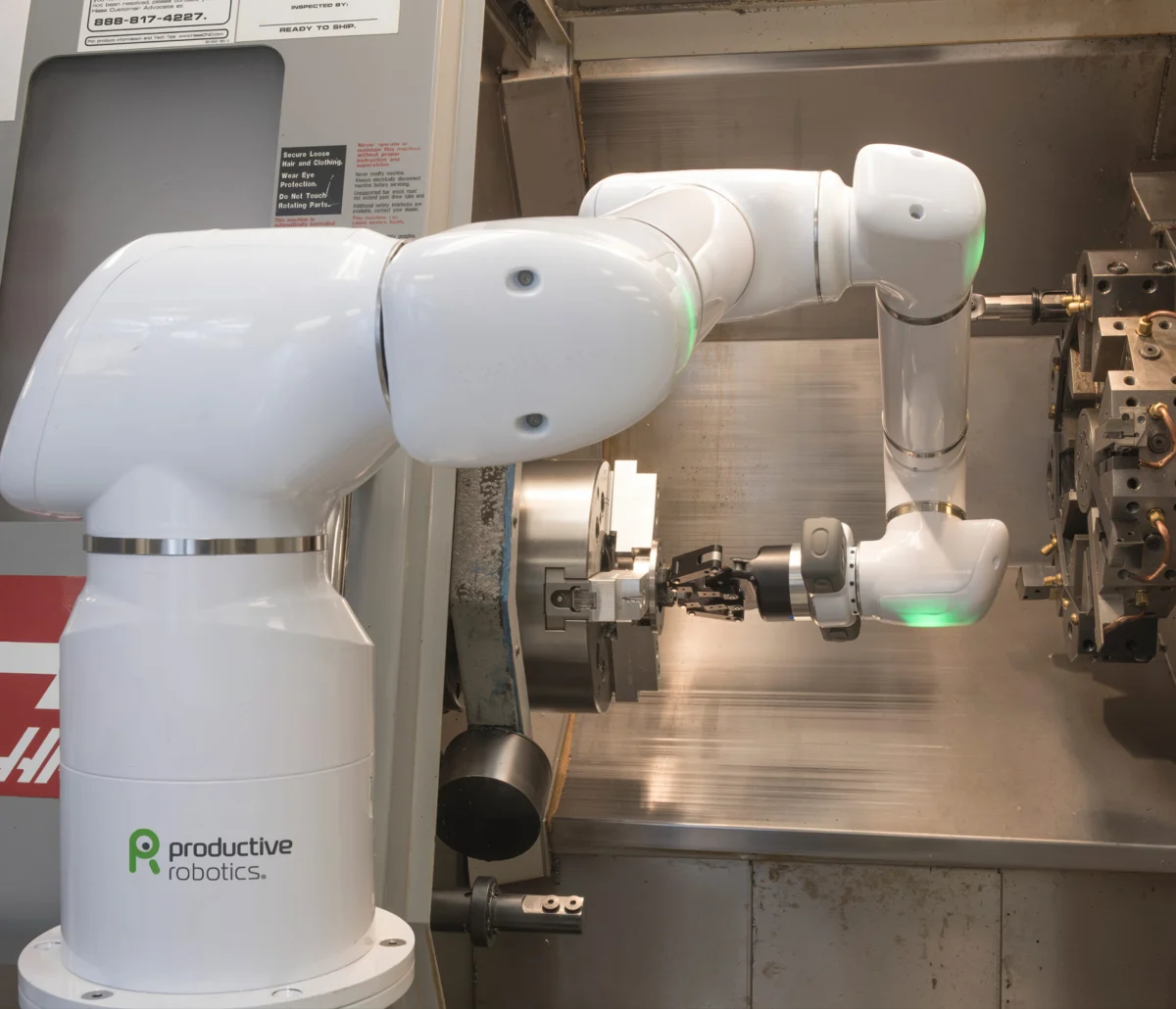
The landscape of industrial automation underwent a significant paradigm shift at IMTS 2026 as Productive Robotics introduced the OB7-AI. By integrating advanced artificial intelligence into its proven 7-axis collaborative robot (cobot) architecture, the company has effectively eliminated the last remaining barrier to entry for many job shops: the time-consuming process of manual teaching. This evolution marks a transition from execution-based programming to a model of adaptive, autonomous partnership between human operators and robotic hardware.
Main Facts: The OB7-AI Breakthrough
The OB7-AI is designed to address the "high-mix, low-volume" challenge that plagues small to mid-sized enterprises (SMEs). Historically, cobots required a human operator to physically guide the arm through every movement of a job—a process that, while intuitive, still required a non-trivial amount of setup time per part.
The OB7-AI removes this requirement through a sophisticated integration of machine vision and physical AI. The system autonomously scans the machine’s workspace, identifying the location of blanks and the configuration of the CNC machinery. It does not require precise, rigid fixture placement; as long as the workpieces are presented with sufficient "finger room" for the gripper to maneuver, the robot calculates its own paths.
Key Technical Capabilities:
- Zero-Training AI: Unlike machine learning models that require thousands of iterations to "learn" a task, the OB7-AI is functional immediately upon deployment.
- Visual Cycle Monitoring: The cobot possesses the capability to "read" CNC control screens, allowing it to autonomously determine when a machining cycle has concluded.
- End-to-End Automation: The cobot manages the entire workflow—opening doors, loading raw blanks into the vise, initiating the cycle, monitoring for completion, and unloading finished goods.
- 7-Axis Dexterity: Maintaining the signature Productive Robotics 7-axis design, the unit can maneuver around complex machine obstacles that would stop a traditional 6-axis robot in its tracks.
A Chronology of Innovation: From Teaching to Intelligence
For over a decade, Productive Robotics has been a pioneer in the "no-code" robotics movement. To understand the gravity of the OB7-AI launch, one must look at the progression of the company’s technological trajectory:

- 2015–2020: The Era of "Teach-by-Touch." Productive Robotics disrupted the market by introducing robots that didn’t require complex software coding. Operators simply grabbed the robotic arm and moved it to the desired waypoints. This democratized robotics, allowing shops without specialized programming departments to enter the automation space.
- 2021–2025: Scaling and Refinement. The company expanded its lineup to include the OB7 Stretch, the MAX series, and the Blaze welding systems. These models focused on reach and payload, catering to heavy-duty industrial applications while maintaining the core "no-code" philosophy.
- 2026: The AI Inflection Point. At IMTS 2026, the company moved beyond "teaching" the robot to "guiding" it. By adding AI, the robot is no longer just a repetitive execution machine; it is a vision-aware system capable of interpreting its environment in real-time.
Supporting Data: Why "Physical AI" Matters
The integration of Physical AI—the convergence of AI software with physical, mobile hardware—is the primary driver of the next industrial revolution. In a typical CNC job shop environment, an operator might manage several machines. If every machine requires a unique, manually taught routine that takes 30 minutes to set up, the aggregate downtime across a shift is substantial.
Efficiency Metrics in Modern Manufacturing
The shift toward AI-driven cobots is supported by several industry-wide data points:
- Reduced Set-up Times: With the OB7-AI, the time-to-production for a new job is slashed by an estimated 70–80% compared to traditional teach-by-touch methods, as the robot performs the "mapping" of the environment autonomously.
- Increased "Lights-Out" Capability: By reading the machine’s control screen and managing door interaction, the cobot enables true autonomous operation, allowing shops to extend production hours beyond a single shift without human oversight.
- Human Capital Optimization: By automating the mundane, repetitive tasks of loading and unloading, skilled CNC machinists are liberated to focus on higher-level programming, quality control, and machine maintenance.
Official Perspectives: Zac Bogart on the Future of the Shop Floor
During the unveiling at IMTS, Zac Bogart, President of Productive Robotics, emphasized that the goal of the OB7-AI was not to replace the human element, but to provide a tool that behaves more like a smart coworker than a rigid machine.
"Our collaborative robots and robotic welding systems operate in nearly every industry, including small to mid-sized enterprises that run high-mix, low-volume parts," Bogart stated. "Teaching the original OB7 was exceptionally simple and only had to be performed once per job, but it was still a task that took time. Now, operators can recoup that time because the OB7-AI scans and finds its own way around a shop’s machine. And crucially, there are no AI training cycles required for new parts or tasks."
Bogart addressed the misconception that AI-driven robotics is only for high-tech, massive-scale automotive manufacturers. "The automotive and CNC machining industries are the key markets for cobots with physical AI," he noted. "The difference is that our OB7-AI is designed to work on a production floor now without training. The added capability also opens the door to non-factory sectors such as laboratory research and healthcare, where precision and adaptability are paramount."

Implications for the Industry
The introduction of the OB7-AI carries profound implications for both the manufacturing sector and beyond.
1. The Death of the "Expert Operator" Bottleneck
For years, the manufacturing industry has faced a severe labor shortage, struggling to find workers with the specialized skills needed to program complex robotic systems. The OB7-AI effectively lowers the barrier to entry. When a robot can "see" the machine and understand its own environment, the level of expertise required to operate the system drops significantly. This allows shop owners to redeploy their existing staff to more complex tasks, effectively increasing the productivity of every employee.
2. The Expansion of High-Mix/Low-Volume Production
Contract manufacturers are frequently forced to turn away small-batch jobs because the setup time for traditional automation exceeds the profit margin of the job itself. By automating the setup phase through AI, the OB7-AI makes short-run production runs economically viable. This will likely lead to a resurgence in local, on-demand manufacturing, as it becomes cheaper to produce small batches locally than to import large volumes of parts.
3. Cross-Industry Applications
While the initial focus is on CNC machine tending, the architecture of the OB7-AI is inherently portable. The same vision-based autonomy could easily be applied to:
- Laboratory Automation: Moving vials, managing test tubes, and automating sample preparation in medical research facilities.
- Logistics and Warehousing: Performing pick-and-place tasks where object orientation is inconsistent or random.
- Quality Inspection: Using the robot’s onboard camera system to perform automated visual inspections of parts before they are even removed from the machine.
Conclusion: The Path Ahead
Productive Robotics has clearly positioned itself as a leader in the next phase of the robotics evolution. The OB7-AI is not merely an incremental update; it is a fundamental shift in how machines interact with their environment. As these systems become more prevalent, the standard for what constitutes "automation" will rise.

The company’s commitment to keeping their systems "no-code" while layering on advanced intelligence ensures that they remain accessible to the very shops that need them most. By removing the friction of manual teaching and allowing for immediate, intuitive deployment, Productive Robotics is empowering the next generation of manufacturers to compete in an increasingly complex and demanding global economy.
As manufacturers begin to integrate these AI-driven cobots into their workflows, the focus will undoubtedly shift from "how do we program the robot" to "how do we maximize the productivity of our automated team." In that transition, the OB7-AI is set to be the catalyst that turns the shop floor into a truly dynamic, intelligent ecosystem.