As the manufacturing sector converges on the exhibition floors for FABTECH 2026, the theme of "Innovation without Limits" has shifted from a marketing slogan to a tangible operational mandate. This year’s event marks a pivotal departure from traditional mechanical exhibition norms, signaling the arrival of the "Intelligent Factory" era. While heavy machinery and welding torches remain the backbone of the industry, the spotlight has firmly shifted toward the software-defined shop floor, where Artificial Intelligence (AI) is no longer a buzzword but a core driver of efficiency, procurement, and production agility.
The New Frontier: Why FABTECH 2026 is Different
For decades, FABTECH has been the premier stage for showcasing physical hardware—press brakes, lasers, and robotics. In 2026, however, the most significant breakthroughs are occurring in the digital realm. The introduction of the AI Pavilion highlights a critical evolution in how metal fabricators and manufacturers operate. Companies are moving away from disconnected spreadsheets and legacy ERP (Enterprise Resource Planning) systems, opting instead for integrated, AI-driven platforms that provide real-time visibility into the "cost-to-serve."
This transition is driven by the industry’s struggle with complexity. Managing inventory, procurement, shipping, and quality documentation across fragmented tools has historically been a massive drain on resources. This year’s exhibitors are providing the solution: systems that don’t just store data, but actively make decisions to optimize workflows and reduce human error.
Key Innovators: Bridging the Digital-Physical Divide
1. ianAI Systems: The Rise of the AI Employee
At Booth C-2648, ianAI Systems is showcasing the integration of AI-powered ERPs with what they term the "AI Employee." The core challenge for modern fabricators is the "manual handoff"—that inefficient period where data is moved from one system to another, often leading to errors and delays.

ianAI’s approach is two-fold:
- Configurable ERP: A platform designed to bridge the gap between procurement, finance, and production.
- The AI Employee: An automation layer that handles repetitive business workflows, effectively acting as a force multiplier for existing staff.
By automating the mundane aspects of order intake and customer documentation, ianAI is helping businesses move toward a model where employees focus on high-value problem-solving rather than administrative data entry.
2. Katalyst Software Services: Transforming Procurement with SourceBy
Procurement has long been the "black box" of the manufacturing world. At Booth C-2649, Katalyst Software Services is tackling this with "SourceBy," a platform that aims to eliminate the cycle of endless searching and email-based quote management.
The traditional procurement process is riddled with inefficiencies: comparing capabilities across dozens of suppliers, validating partners, and waiting for quotes. SourceBy centralizes this entire ecosystem. By creating a unified portal for discovery and comparison, it enables manufacturers to make data-backed sourcing decisions. This isn’t just a directory; it is a strategic tool designed to streamline the supply chain and reduce the time-to-market for complex fabricated parts.

3. Kinetech’s MACH: Real-Time Operational Intelligence
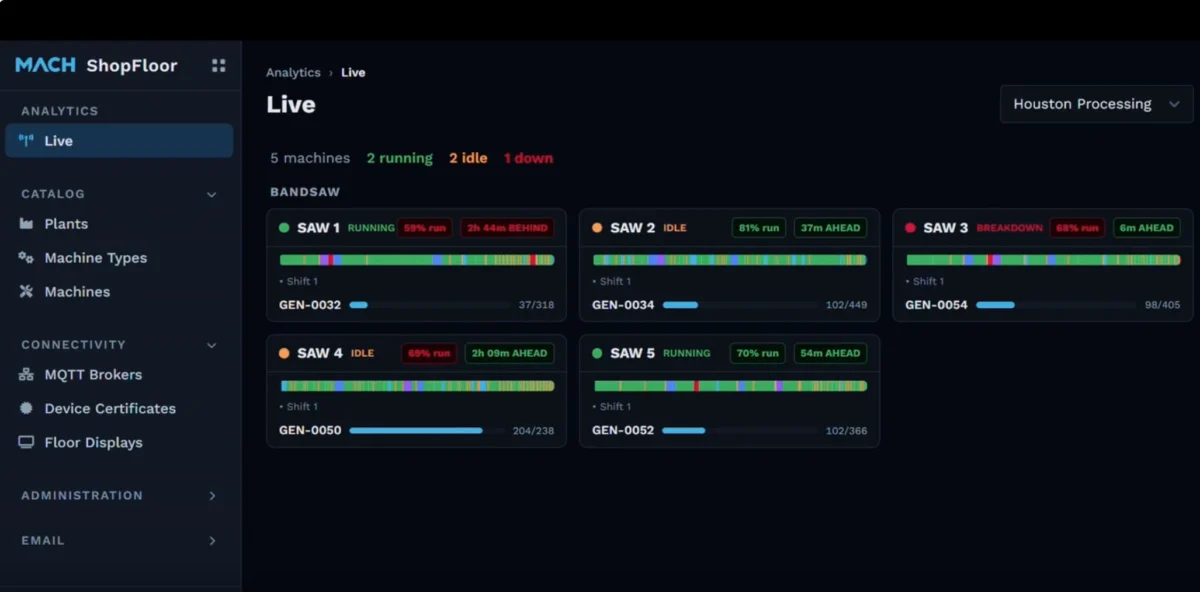
Moving away from the traditional MES (Manufacturing Execution System) aisle, Kinetech (Booth C-2545) has deliberately positioned itself in the AI Pavilion. Their platform, MACH, offers a departure from the "green-light/red-light" monitoring tools that have cluttered the industry for years.
Kinetech is providing a live, working platform that captures machine state, operator-logged downtime, and actual production results in real time. The key differentiator here is "operational intelligence." MACH doesn’t just show what happened; it calculates the cost of the status quo. By providing a clear window into the cost-to-serve, Kinetech is forcing shop floor managers to confront the financial impact of their current inefficiencies, offering a path to modernization that avoids the typical, agonizing 12-month software rollout cycle.
4. Shot Works: Pipe-Shot and the "Fitter’s Perspective"
At Booth S-20049, Shot Works is challenging the status quo of pipe fabrication. Pipe-Shot is a tool built by fitters, for fitters, recognizing that the most effective AI is that which is intuitive to the user on the floor.
The process is remarkably simple: a user sketches a pipe run on a tablet, and the AI immediately generates the cut list and material order. By removing the need for complex detailing software, Shot Works has reduced the "four-step" fabrication process to a singular, streamlined workflow. This is a prime example of AI serving as a tool for craftsmanship, rather than an impediment to it.

Chronology of the Shift: From Hardware to Intelligence
The evolution observed at FABTECH 2026 did not happen overnight. To understand the current climate, one must look at the recent history of manufacturing technology:
- 2022-2023: The "Connectivity Phase." Manufacturers focused on IoT sensors, ensuring that machines could talk to each other and that data was being captured.
- 2024-2025: The "Data Overload Phase." Shops found themselves with massive amounts of raw data but lacked the tools to synthesize it into actionable insights.
- 2026: The "Intelligence Phase." We have reached the point where AI algorithms are processing that data, autonomously suggesting scheduling changes, procurement options, and production adjustments.
Supporting Data: The Cost of the Status Quo
Industry analysts at FABTECH have pointed to a recurring trend: the "invisible cost" of legacy systems. Studies suggest that mid-sized fabricators spend an average of 15-20% of their annual revenue on administrative "overhead" related to procurement, manual scheduling, and quality documentation.
The companies showcasing at FABTECH this year claim that by moving to AI-driven workflows, businesses can:
- Reduce administrative labor by 30-40% through workflow automation.
- Shorten procurement cycles by 50% using centralized discovery platforms.
- Improve machine utilization by 15% through real-time operational intelligence.
These figures represent a significant competitive advantage. In a market where labor shortages remain a critical concern, the ability to do more with the same headcount—or less—is the difference between surviving and scaling.

Official Responses and Industry Sentiment
The consensus among the exhibitors at this year’s show is clear: the industry is at a breaking point regarding manual complexity.
"We didn’t build MACH to be another MES," says the development team at Kinetech. "We built it to be a bridge between the physical reality of the machine and the financial goals of the business. If you aren’t capturing data in real-time, you are flying blind."
Similarly, the team behind SourceBy emphasizes the shift in the buyer’s journey. "Manufacturers are tired of managing supplier lists in Excel," a spokesperson noted. "They want the ‘Amazon experience’ for industrial sourcing—fast, transparent, and trusted."
Implications: The Future of the Shop Floor
What do these developments mean for the average fabricator?

First, the role of the "operator" is changing. As AI takes over data entry, scheduling, and material ordering, the operator becomes more of a "process supervisor." This shift necessitates a new approach to training and recruitment, focusing on digital literacy alongside mechanical expertise.
Second, the barrier to entry for high-end digital manufacturing is falling. The modular, cloud-based, and highly configurable nature of the products on display—from ianAI to Pipe-Shot—means that even smaller job shops can adopt "enterprise-grade" technology without the massive upfront investment that defined the last generation of ERP systems.
Finally, the geographical concentration of supply chains is shifting. As tools like SourceBy make it easier to discover and vet local, reliable partners, we may see a resurgence in domestic manufacturing capacity, as the "difficulty of finding suppliers" is no longer a valid excuse for off-shoring.
Conclusion: Embracing the "Limitless"
FABTECH 2026 will be remembered as the event where the "AI Pavilion" stopped being a niche corner of the show and started being the roadmap for the entire industry. Whether through the automated workflows of ianAI, the procurement transparency of SourceBy, the real-time analytics of Kinetech, or the intuitive design of Pipe-Shot, the message is the same: the future of metal fabrication is not just faster lasers or stronger welds—it is smarter processes.

For attendees, the mandate is clear: identify the "invisible costs" in your shop, engage with these new digital platforms, and begin the transition toward a more connected, intelligent, and profitable operation. Innovation without limits is no longer a future goal; it is the current reality for those ready to adopt it.