October 2026 — Shippers resetting their truckload transportation contracts are confronting a stark economic reality: new contract base rates are coming in approximately 13% higher than the agreements they replace.
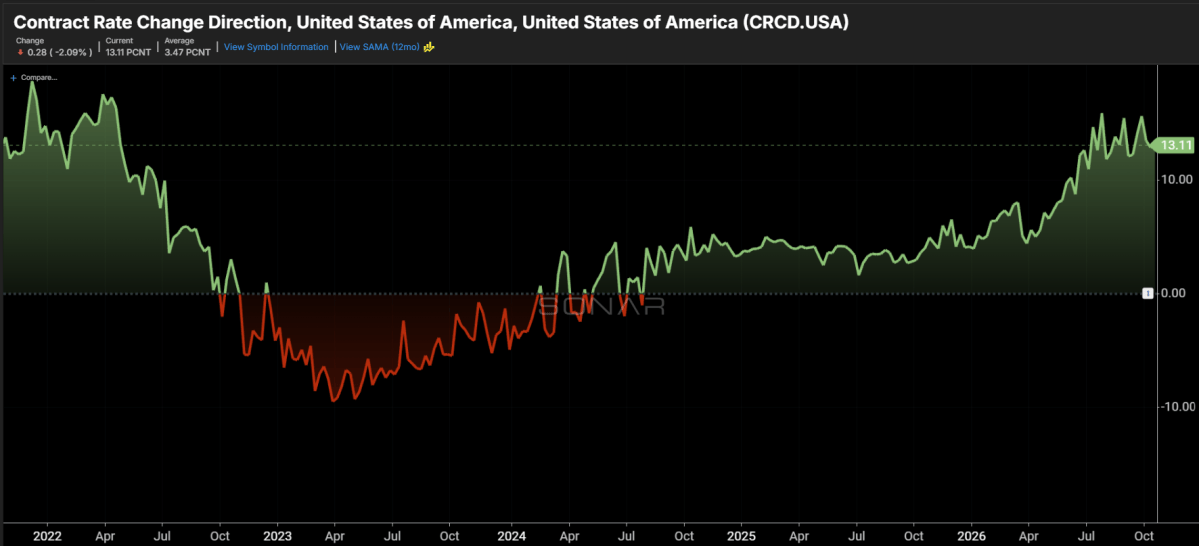
According to fresh data from FreightWaves SONAR, the newly introduced Contract Rate Change Direction Index (CRCD.USA) stood at 13.11% in late October. This marks a dramatic acceleration from the 3.53% recorded during the same period a year prior, signaling a profound shift in the balance of pricing power between shippers and motor carriers.
As capacity tightens and operational costs remain elevated, the data underscores a prolonged period of aggressive rate repricing across the United States freight market. Industry stakeholders are forced to adapt to a landscape where double-digit contract increases have become the norm rather than the exception.
Main Facts: Dissecting the CRCD.USA Index
The CRCD.USA index is designed to offer a clear, unvarnished look at pricing dynamics within established shipper-carrier relationships. Unlike broader invoice averages or volatile spot market metrics, the index isolates genuine bid-cycle repricing by measuring the average percentage difference between a newly negotiated contract base rate and the previous rate it replaced.
To ensure accuracy and filter out short-term market noise, the index incorporates strict calculation criteria:
- Stability Threshold: It counts a rate change only if the preceding old rate held steady for more than 90 days. This eliminates transient adjustments and temporary accessorial tweaks.
- Rolling Average: The metric operates as a seven-day rolling average, updated daily to capture rapid shifts in market sentiment.
- Volume Agnosticism: Because the index measures only contracts that are actively changing, it is largely agnostic to overall freight volumes. Readings can thin out during periods when few contracts are up for renewal.
Crucially, the index strips away the distortion of temporary route guide waterfalling and spot-market-adjacent contract-plus pricing. While route guide failures offer valuable clues about immediate market pressure, the spot rates they generate often overstate what eventually translates into sustainable, long-term costs. The CRCD measures durable, contractual commitments.

Chronology: The Path to Double-Digit Rate Inflation
To understand how the freight market arrived at a 13.11% contract rate change index, it is necessary to examine the chronological progression of recent market cycles.
Late 2024 to Early 2025: The Quiet Divergence
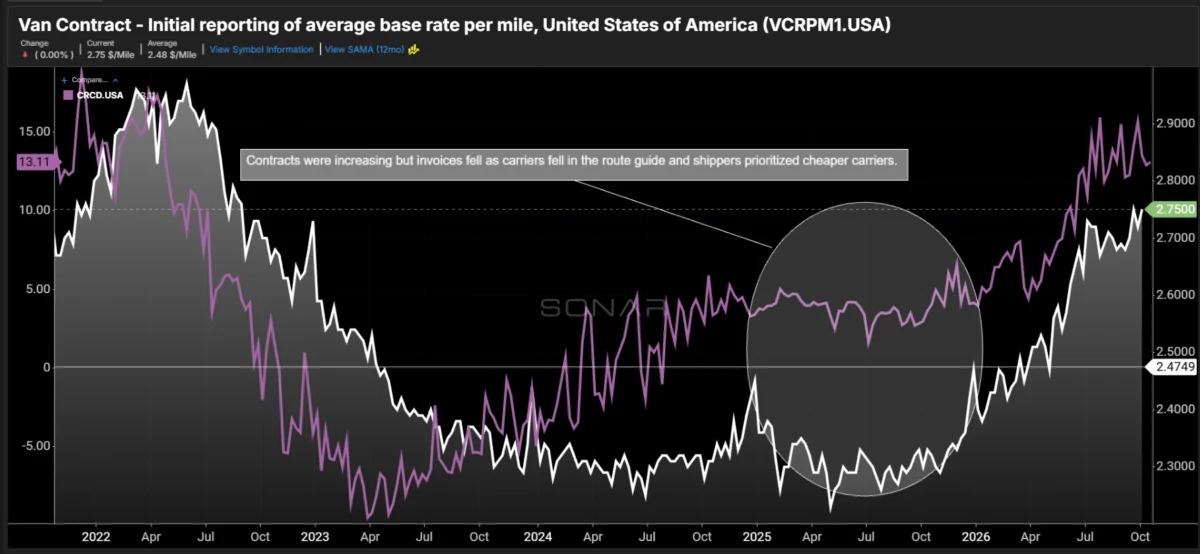
Starting in late 2024, early indicators of carrier pushback began to emerge. Contract resets were quietly running at roughly 3% to 4% higher. However, these increases were not immediately reflected in broader economic ledgers. The average contract rate index (VCRPM1) showed remarkably flat to slightly lower invoiced rates through most of 2025. This gap occurred because the CRCD does not track whether a carrier successfully moves up or down in a shipper’s routing guide after a rate adjustment—it simply measures the magnitude of the change when it happens.
Mid-2025: Tender Rejections Spike
As the freight market churned through 2025, capacity began to contract under the weight of persistent operational expenses, insurance spikes, and regulatory compliance pressures. Tender rejection rates—a leading indicator of market tightness—began a steady climb, eventually jumping above 9% and later averaging close to 13% over subsequent months.
Late 2026: The Lagged Contract Response
Historical logistics data demonstrates that contract rates notoriously lag behind tender rejection spikes. It typically requires a sustained period of elevated rejections before shippers concede to substantial contract base rate increases. By October 2026, that historical lag caught up with the market. With tender rejections sustaining elevated levels, newly implemented contract renewals began landing well into the double digits, pushing the CRCD index to 13.11%.
Supporting Data: Connecting CRCD and VCRPM1
The relationship between the Contract Rate Change Direction index and the broader Contract Rate Index (VCRPM1) offers vital insight into market health.
While the CRCD acts as a leading indicator for the direction of invoice data, it does not inherently predict whether individual increases will successfully stick across an entire shipping network. Yet, current data from VCRPM1 confirms that these double-digit increases are indeed holding. Shippers are absorbing the higher costs because alternative capacity on the spot market remains constrained or prohibitively expensive.
Furthermore, Federal Motor Carrier Safety Administration (FMCSA) safety filings and national tender data reveal a sobering reality: carrier capacity has not grown meaningfully over the past 12 months, despite these elevated rates. Normally, high freight rates act as a beacon for new market entrants, driving a surge in new carrier registrations and fleet expansions. In the current economic climate, however, high barriers to entry—including exorbitant equipment costs, steep insurance premiums, and stringent regulatory enforcement—have kept supply heavily restricted.
Official Responses and Market Expert Perspectives
Freight market analysts and logistics economists point to this cycle as a critical cautionary tale.
Industry experts emphasize that carriers began aggressively pushing for rate corrections nearly a year before the market cycle fully turned in their favor. Shippers who failed to read the early warning signs embedded in the CRCD index found themselves unprepared for the intense rate inflation that followed.
"The current 13% reading demonstrates that carriers are successfully securing robust pricing corrections as legacy agreements expire," notes market analysis from the FreightWaves SONAR research team. "Because capacity growth remains virtually flat, the runway for these increases has been extended, making it difficult for shippers to force a rapid flattening of the pricing curve."
Logistics procurement teams are being advised to abandon traditional cost-cutting expectations and instead focus on carrier retention, network optimization, and collaborative forecasting. In a capacity-constrained environment, securing service reliability has taken precedence over securing the absolute lowest price point.
Implications for Shippers and Carriers
The implications of a 13.11% contract rate change index ripple across every tier of the supply chain:
1. For Shippers: Budgetary Pressure and Strategic Procurement
Shippers must recalibrate their freight budgets for sustained higher baseline transportation costs. Relying on historical pricing benchmarks will lead to chronic routing guide failures and costly reliance on spot market surges. Procurement strategies must pivot toward strategic partnerships, multi-year capacity guarantees, and advanced freight procurement technologies that provide real-time market visibility.
2. For Carriers: Margin Recovery vs. Cost Pressures
While double-digit rate increases offer much-needed financial relief, carriers are not out of the woods. Margins continue to be squeezed by non-rate operational headwinds, including escalating costs for diesel fuel, replacement parts, qualified driver wages, and commercial vehicle insurance. Carriers must use this revenue window to fortify their balance sheets rather than rush into uncalculated fleet expansions.
3. For the Broader Economy: Sticky Freight Costs
Because transportation costs form the foundational layer of consumer goods pricing, sustained double-digit truckload contract increases ensure that logistics-driven inflationary pressures will remain "sticky." As these higher transportation expenses flow through manufacturing, distribution, and retail supply chains, downstream consumer goods pricing may continue to feel the upward pull.
Ultimately, until macroeconomic signals trigger a substantial expansion in qualified truckload capacity or a dramatic softening in freight demand, the pricing pendulum remains firmly in the hands of carriers. Shippers navigating upcoming bid cycles must approach negotiations with flexibility, transparency, and a deep respect for real-time market intelligence.