





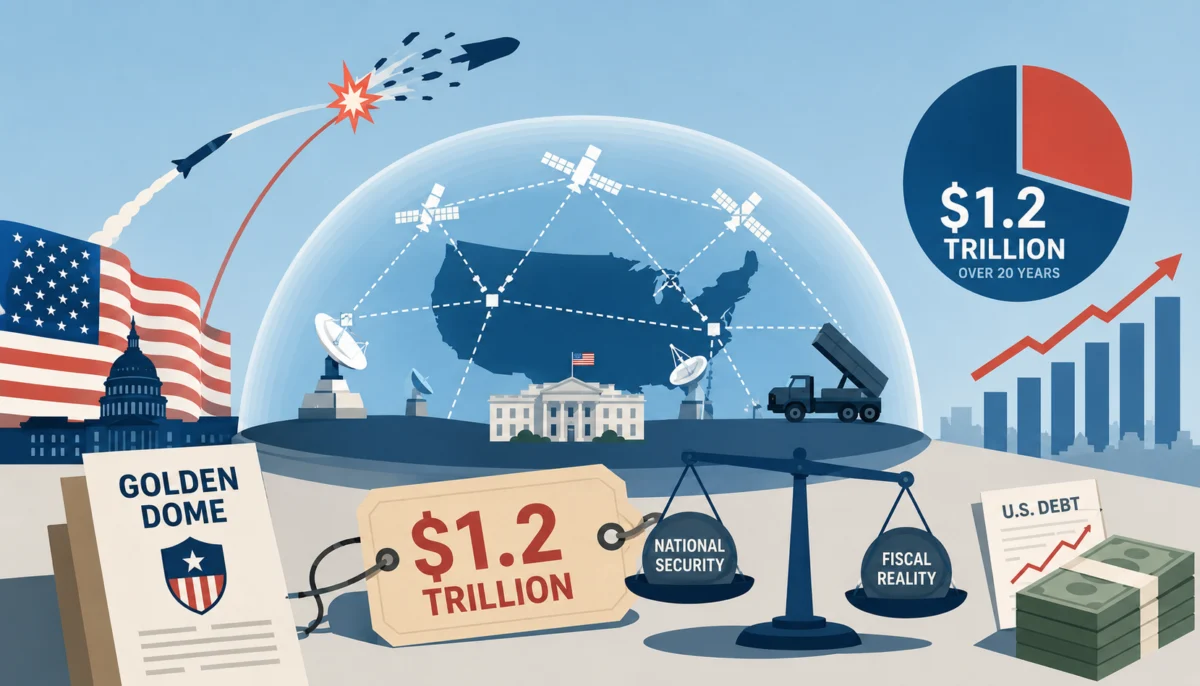
A missile shield is traditionally viewed through the lens of military doctrine—a defensive asset designed to ensure national sovereignty and deterrence. However, a $1.2 trillion missile defense program is far more than a tactical project; it is a profound economic event that threatens to reshape federal budget priorities, influence bond market volatility, and redefine the relationship between the U.S. government and the private defense industrial base.
This week, the Congressional Budget Office (CBO) released a sobering 12-page analysis of President Trump’s "Golden Dome" program. The report estimates that the total cost to develop, deploy, and operate this multi-layered shield over the next two decades will reach roughly $1.2 trillion. This figure has sent shockwaves through Washington, as it sits more than six times higher than the $185 billion projection cited earlier this year by Gen. Michael Guetlein, the Pentagon official overseeing the program, and nearly seven times the $175 billion estimate initially floated by President Trump when the executive order was signed in January 2025.
The Chronology of Ambition and Discrepancy
To understand the scale of this fiscal disconnect, one must track the rapid evolution of the project’s public messaging. When the Golden Dome initiative was unveiled in early 2025, it was marketed as a foundational security architecture designed to shield the continental United States, Alaska, and Hawaii from an evolving array of ballistic, hypersonic, and cruise missile threats.
- January 2025: President Trump signs the founding executive order, with an initial price tag projection of approximately $175 billion.
- Spring 2025: Gen. Michael Guetlein, testifying before the House Armed Services Strategic Forces subcommittee, provides a revised estimate of $185 billion, suggesting that the scope was manageable within existing defense modernization frameworks.
- Mid-2025: The CBO conducts an independent audit, noting a lack of specific, public blueprints from the Department of Defense. By inferring a "notional architecture" from the executive order, the CBO arrives at a 20-year total cost of $1.2 trillion.
The discrepancy between the Pentagon’s initial estimates and the CBO’s projection is not merely a matter of accounting error; it highlights a dangerous level of "architectural ambiguity." The CBO report notes that the Defense Department has released few public details regarding the system’s actual design. Consequently, the gap suggests that the Pentagon may be significantly underestimating the logistical reality of maintaining a space-based shield, or that they are banking on shifting funds from other critical defense accounts to cover the inevitable overruns.
Supporting Data: Why Space is the Fiscal Anchor
The primary driver behind the $1.2 trillion price tag is the project’s reliance on a massive constellation of space-based interceptors. According to the CBO’s analysis, approximately 70 percent of the acquisition costs are tied to these satellite arrays, which are intended to strike enemy missiles during the "boost phase"—the most critical, albeit fleeting, moment just after a missile is launched.
The math required to execute this strategy is, by the CBO’s admission, "brutal." To reliably intercept a barrage of 10 intercontinental ballistic missiles (ICBMs) launched nearly simultaneously, the Pentagon would need to maintain a fleet of approximately 7,800 satellites in low-Earth orbit. The cost of this single layer is estimated at $720 billion over 20 years, with an additional $1 billion in annual operating expenses.
This creates an immediate dilemma for the Pentagon. Gen. Guetlein has already acknowledged the fragility of this plan, telling Congress in April that if a space-based boost-phase intercept is not affordable and scalable, "we will not produce it." This candid admission signals that the final version of the Golden Dome may look drastically different from the one currently being debated, raising concerns that the government is committing to a project without a finalized technological roadmap.
Implications for the Fiscal Outlook and Bond Markets
The economic implications of a $1.2 trillion project are widespread. Spread over 20 years, the cost averages $60 billion annually. While this figure may seem modest against a backdrop of a $1.5 trillion defense budget request for fiscal 2027, it arrives at a time when the U.S. fiscal trajectory is already under extreme pressure.
Interest costs on the national debt have reached multi-decade highs, and entitlement spending continues to grow on autopilot. By layering the Golden Dome on top of these existing obligations, the government is narrowing its "fiscal space." For bond investors, this is a signal of concern. While the Golden Dome alone will not trigger a collapse in 10-year yields, it contributes to a broader fiscal narrative that has been forcing the Treasury to issue more long-dated paper into a market with fewer captive buyers.
Senator Jeff Merkley, the ranking member of the Senate Budget Committee, captured the political friction surrounding this issue, labeling the program "a massive giveaway to defense contractors paid for entirely by working Americans." This sentiment is likely to serve as the rallying cry for a heated debate over whether to fund the project through dedicated appropriations, deficit-funded borrowing, or complex reconciliation packages.
The Industrial Ecosystem: Winners and Losers
For equity investors, the situation is far more transparent than it is for the bond market. The Golden Dome represents a massive influx of capital into the defense industrial base. The U.S. Space Force has already awarded $3.2 billion in contracts to 12 companies to develop prototypes, with a long-term production pipeline valued at up to $3.4 billion annually.
Major prime contractors are already positioning themselves:
- Lockheed Martin: Heavily involved in space-based interceptor contracts, positioning the firm at the heart of the satellite-defense infrastructure.
- Northrop Grumman: Utilizing its expertise in integrated battle command systems to lead the command-and-control (C2) layer of the shield.
- RTX (Raytheon): Leveraging its dominance in radar technology and interceptor missiles to provide the kinetic "teeth" of the program.
- New Entrants: Companies such as Anduril, True Anomaly, and SpaceX are being tapped for agile, AI-enabled tracking and launch capabilities, broadening the contractor base well beyond the traditional Cold War-era firms.
While these stocks may benefit from the sustained spending cycle, the broader macro environment remains complicated. Investors must distinguish between companies with "durable Golden Dome content"—those critical to the satellite and AI-tracking infrastructure—and those that will only benefit at the margins of the broader defense budget.
Effectiveness and the Strategic "Arms Race" Paradox
Beyond the economics, the CBO’s report raises profound questions regarding the efficacy of the system. The agency’s modeling suggests that while the system could potentially handle a limited attack from a regional adversary, it would likely be overwhelmed by a full-scale strike from a peer or near-peer nation like China or Russia.
This creates a strategic paradox. If the system is limited in its defensive capabilities, is it worth $1.2 trillion? Furthermore, if the existence of the Golden Dome incentivizes adversaries to expand their own offensive arsenals—investing in more missiles or anti-satellite weapons—the project could inadvertently intensify the very threat it seeks to mitigate.
The CBO’s blunt assessment that "fully engage" is not the same as "fully defeat" serves as a warning to policymakers: missile defense is not a panacea, and no system can work perfectly every time.
Conclusion: A Gamble with Decades-Long Consequences
The Golden Dome is, simultaneously, a homeland security shield, a massive industrial-policy subsidy, and a long-term fiscal gamble. The CBO has provided Congress and the public with a much-needed reality check by forcing the project’s hidden costs into the light.
The most important takeaway from the CBO’s report is not the $1.2 trillion figure itself, but the widening gap between the initial political promises of affordability and the emerging economic reality of the system’s complexity. As the project moves from the drawing board to potential deployment, the primary challenge for the U.S. will be reconciling these massive budgetary demands with the harsh, often unpredictable realities of 21st-century warfare. The debate over how to fund—and how to justify—the Golden Dome has only just begun.