





The global aerospace landscape is currently undergoing its most significant structural shift since the dawn of the Jet Age. As demand for next-generation commercial aircraft and defense platforms surges, original equipment manufacturers (OEMs) and their sprawling supply chains are facing an unprecedented challenge: the mandate to achieve production rates that were previously considered impossible.
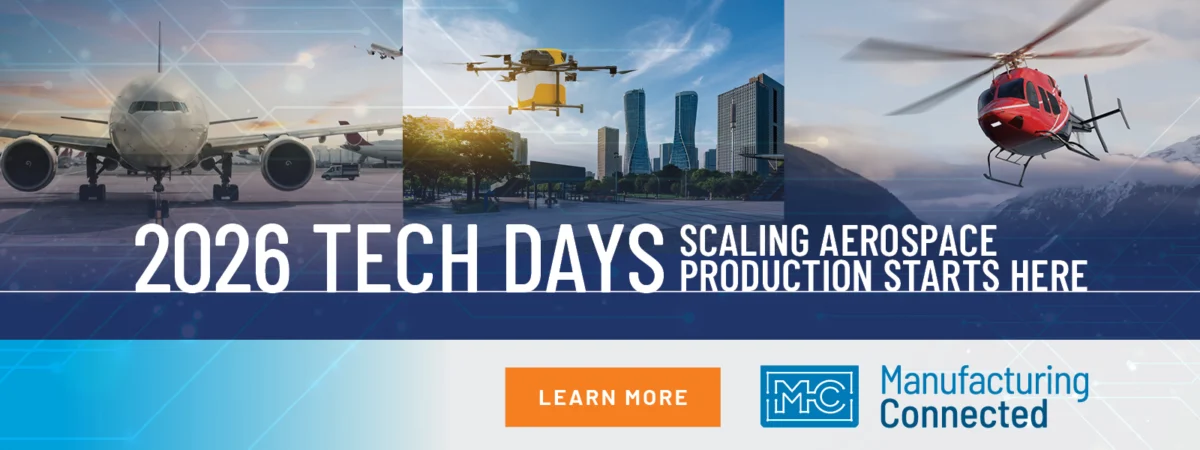
To address these bottleneck-breaking requirements, Manufacturing Connected, in collaboration with Modern Machine Shop, Additive Manufacturing Media, Products Finishing, and CompositesWorld, is hosting a pivotal virtual workshop: "MC Tech Days: Materials & Processes for High-Rate Aerospace Manufacturing." Scheduled for Wednesday, April 22, this half-day event serves as a critical nexus for industry professionals seeking to adapt their processes and secure their competitive edge in a high-velocity market.
Main Facts: The New Production Paradigm
The transition toward "High-Rate Aerospace Manufacturing" is not merely about accelerating existing workflows; it is about a fundamental redesign of how aircraft are conceived, built, and delivered. Historically, aerospace manufacturing has been characterized by craft-based, low-volume, high-complexity assembly. Today, however, the industry is pivoting toward high-volume, automated, and digitized environments.
The upcoming MC Tech Days workshop focuses on three core pillars:
- Advanced Materials: Utilizing high-performance composites and lightweight alloys that cure or set faster without compromising structural integrity.
- Process Innovation: Moving away from manual layup and assembly toward automated fiber placement (AFP), robotic assembly, and digital twinning.
- Supply Chain Resiliency: Integrating real-time data flow to ensure that as production rates climb, the logistics of raw materials and sub-components remain fluid and error-free.
This event is designed for engineers, plant managers, and procurement officers who are navigating the transition from legacy manufacturing to modern, high-rate throughput.
Chronology: The Evolution Toward High-Rate Demand
The urgency behind this workshop is not an isolated development but the result of a decade-long trajectory in aerospace requirements.
- 2015–2018: The Backlog Boom: Major OEMs experienced unprecedented order backlogs. The industry began to realize that traditional, manual-heavy assembly processes could not meet delivery schedules, leading to the first major investments in "moving line" assembly technologies.
- 2019–2021: The Pandemic Disruption: While production paused, the necessity for automation became even more apparent. Manufacturers realized that a future-proof shop floor needed to be less reliant on high-density human labor and more focused on resilient, automated systems.
- 2022–2024: The Ramp-Up Phase: With commercial air travel reaching and exceeding pre-pandemic levels, the pressure to meet "high-rate" production targets has intensified. Aircraft programs are now targeting output rates that are 30% to 50% higher than the 2019 baseline.
- April 22, 2025: MC Tech Days: This workshop arrives at the inflection point where theoretical solutions meet practical implementation. It acts as the bridge between R&D labs and the reality of the factory floor.
Supporting Data: Why Speed is the New Currency
To understand the stakes of this shift, one must look at the quantitative pressures on the modern aerospace facility.
The Cost of Inefficiency
Current industry estimates suggest that labor costs account for nearly 40% of the total manufacturing cost of a single-aisle commercial jet. By implementing high-rate, automated manufacturing processes, companies are looking to reduce this overhead by 15–20%.
Throughput Metrics
In traditional composite manufacturing, the autoclave cycle has long been the primary "bottleneck." Modern high-rate facilities are now transitioning to Out-of-Autoclave (OoA) processes and high-speed resin transfer molding (RTM). These technologies have the potential to reduce cure times from hours to minutes.
Global Market Projections
Market analysis indicates that the global aerospace manufacturing market is expected to grow at a CAGR of roughly 6% over the next five years. However, firms that fail to adopt high-rate technologies are projected to lose as much as 25% of their potential market share to more agile competitors who can guarantee shorter lead times and higher production consistency.
Official Responses and Expert Perspectives
The organizers of MC Tech Days have curated a lineup of industry experts who represent the vanguard of this shift. While the specific agenda continues to evolve as the event date approaches, the core message from sponsors—Toray Group and Composites One—is clear: materials science is the catalyst for production speed.

"High-rate manufacturing is a systems-level challenge," notes a spokesperson for the event organizers. "You cannot simply buy a faster robot. You must ensure your materials, your software, and your workforce are all optimized for a synchronized, high-speed flow. Our goal with MC Tech Days is to break down the silos between these disciplines."
Industry experts scheduled to appear will discuss:
- The Digitization of Quality: How to maintain aerospace-grade tolerances when production speeds are doubled.
- Sustainability in Speed: How to optimize for high rates while minimizing waste—a critical factor for companies with strict ESG mandates.
- Workforce Upskilling: The human component of high-rate manufacturing. As machines take over the repetitive labor, the role of the technician is evolving into that of a process analyst and systems operator.
Implications: The Long-Term Impact on Aerospace
The move to high-rate aerospace manufacturing has profound implications for the future of flight.
A Democratization of Flight
As production costs drop and lead times shrink, the cost of aircraft ownership and operation is expected to stabilize. This could lead to a more accessible commercial aviation market, with lower ticket prices and more frequent routes, effectively democratizing air travel even further.
The Rise of "Connected" Manufacturing
The name of the event—Manufacturing Connected—alludes to the "Industry 4.0" revolution. The implications here are twofold: the connection of machines through the Internet of Things (IoT) and the connection of the supply chain through shared data. Companies that successfully adopt these practices will find themselves in a "digital ecosystem" where parts are tracked from raw resin and billet through to the final test flight, creating an unprecedented level of transparency and safety.
Competitive Consolidation
The most significant long-term implication is a potential wave of consolidation. Smaller shops that cannot afford the capital expenditure required for high-rate automation may struggle to remain in the supply chain. Conversely, those that embrace these technologies will become indispensable partners to Tier 1 suppliers and major OEMs.
Environmental Stewardship
Contrary to the belief that "faster means dirtier," high-rate manufacturing is often more sustainable. Automated systems reduce material scrap, optimize energy usage in heat-treating processes, and allow for the use of more precise, eco-friendly resin systems.
Conclusion: Securing Your Place in the Future
The aerospace industry stands at a crossroads. The transition to high-rate production is not an option; it is an existential requirement. As aircraft orders continue to pile up and the global appetite for air travel grows, the firms that master the balance of speed, quality, and material efficiency will lead the industry into the next decade.
MC Tech Days: Materials & Processes for High-Rate Aerospace Manufacturing provides a unique opportunity to gain the knowledge required to navigate this transition. Whether you are a small machine shop looking to integrate composite parts into your portfolio, or a large-scale integrator seeking to optimize your assembly lines, the insights shared on April 22 will be invaluable.
Interested parties are encouraged to visit the official event page to view the full agenda, register for the workshop, and begin preparing for the high-speed future of aerospace. Don’t just watch the industry change—be the one to drive the acceleration.