For decades, the name Ben & Jerry’s has been synonymous with more than just indulgent pints of Chunky Monkey or Phish Food. It has served as the gold standard for "activist capitalism"—a brand that proved, against the skepticism of traditional corporate boards, that a company could marry deep-rooted social advocacy with high-volume profitability.
However, co-founder Ben Cohen now believes that this legacy is teetering on the edge of extinction. At Advertising Week New York on October 6, 2026, Cohen issued an impassioned plea to the world’s marketing and communications professionals. He framed his address not merely as a business update, but as a "creative brief" for a movement: How does one preserve the activist heart of a brand when the corporate structures surrounding it seek to silence its voice?
The Conflict: A Clash of Corporate Philosophies
The current existential threat to Ben & Jerry’s, according to Cohen, stems from the recent corporate decoupling of the brand from its former parent, Unilever. Following Unilever’s decision to spin off its ice cream division into a standalone public entity known as the Magnum Ice Cream Company, the governance of the iconic Vermont-based brand has become a flashpoint for legal and ideological disputes.
When Unilever first acquired Ben & Jerry’s in 2000, the deal was historic. It included a unique provision granting an independent board of directors the authority to oversee the company’s "social mission"—a safeguard designed to prevent the brand from being stripped of its values in favor of pure profit. Cohen argues that the new Magnum Ice Cream Company has failed to honor the spirit of this foundational agreement. Specifically, he contends that the new management has exerted pressure to muzzle the brand on volatile, high-profile issues, including the humanitarian crisis in Palestine and the policy agenda of the Trump administration.
A Chronology of Activist Capitalism
To understand why Cohen is fighting so hard, one must look at the roots of the brand’s identity. The transition from a local scoop shop to a global icon was never intended to be a silent one.
The Birth of the "Peace Pop" (Late 1980s)
In the late 1980s, amidst the tail end of the Cold War, Ben & Jerry’s made a radical decision: they would treat their packaging not as a marketing vehicle for flavor descriptions, but as a medium for social commentary. The launch of the "Peace Pop," a chocolate-covered ice cream bar, was accompanied by the "1% for Peace" campaign. The goal was ambitious and undeniably political: to lobby the U.S. government to redirect one percent of the national defense budget toward peace-building projects.
At the time, this was corporate heresy. "This was before the term ‘socially responsible business’ was coined," Cohen told the Advertising Week audience. "Upper-level management was divided. Some supported it, but others thought it was stupid. They believed business should stay in its lane and avoid world affairs, especially when it meant challenging the Pentagon budget."
The Three-Part Mission
Following the success of their early advocacy, the company formalized its identity through a "three-part mission," balancing product, economic, and social goals equally. Cohen famously likens this to the process of becoming "real" in The Velveteen Rabbit—it wasn’t about the marketing spend or the aesthetic; it was about the tangible work of integrating justice into the business model.
The Modern Crisis
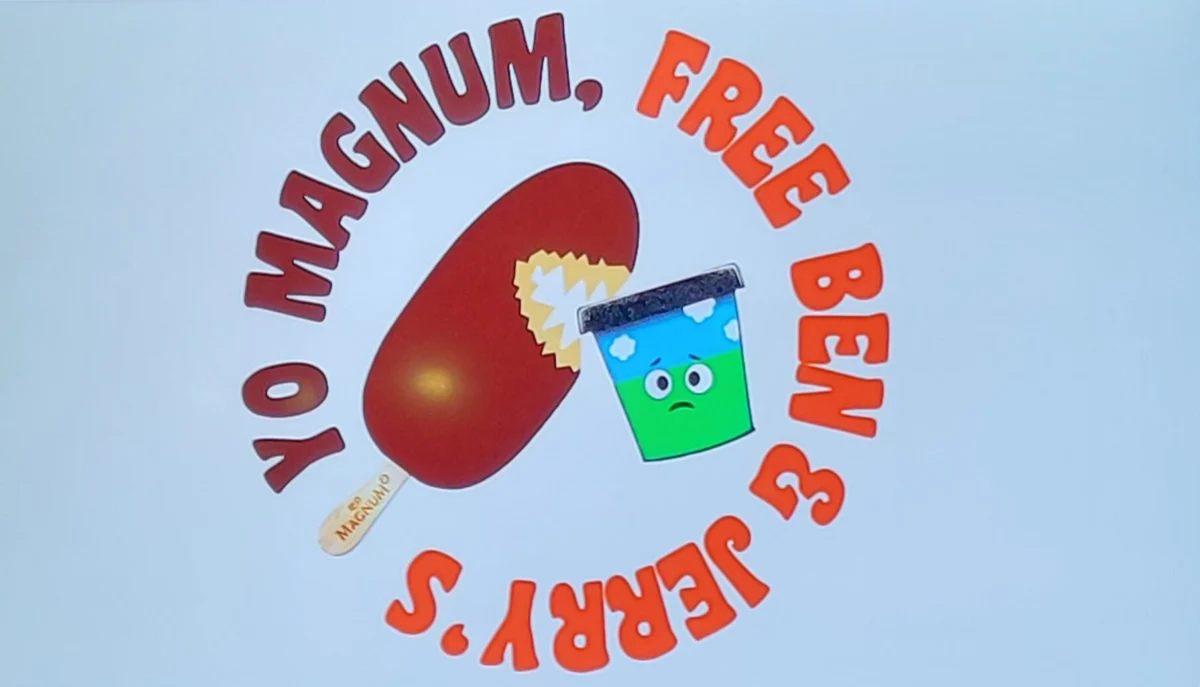
The current friction point began following the 2025 spin-off. While the brand has remained a financial powerhouse—reporting $1.1 billion in global sales in 2025—the perceived interference in its social agenda has led to the formation of the "Free Ben & Jerry’s" campaign, a grassroots effort aimed at restoring the independence of the company’s social mission board.
Supporting Data: Why Authenticity Drives Revenue
The debate over Ben & Jerry’s is not merely ideological; it is a case study in brand equity. In an era where consumers are increasingly cynical about "greenwashing" and performative corporate social responsibility (CSR), Ben & Jerry’s has remained a titan of authenticity.
According to the 2023 Authenticity 500 brand index, Ben & Jerry’s ranked No. 2, trailing only outdoor apparel giant Patagonia. This ranking is not a coincidence. It is the result of decades of "doing the work"—a process Cohen describes as the willingness to be attacked for a position and to continue that advocacy regardless of the fallout.
The data suggests that this strategy works. By refusing to shy away from controversial stands, the brand has cultivated a level of consumer loyalty that traditional advertising simply cannot manufacture. As Cohen noted, "Having a social mission, and then being attacked, yet doing it over and over—that’s what created this amazingly strong brand. That, and some really great ice cream."
Official Responses and Corporate Stance
The management at the Magnum Ice Cream Company has largely maintained a position of corporate continuity. In response to the growing public pressure and the "Free Ben & Jerry’s" campaign, a spokesperson for the new entity has repeatedly stated that the brand is "not for sale."
Regarding the allegations of censorship, the company has emphasized that it has "always respected" the brand’s commitment to its social mission. However, these statements have done little to appease Cohen, who argues that the "respect" being offered is passive at best and restrictive at worst. For Cohen, the freedom to speak out on the most pressing issues of the day is not an optional feature of the brand—it is the very essence of the product.
The Implications for the Marketing Industry
The standoff has significant implications for how brands approach social advocacy in a polarized climate. If a brand as established and successful as Ben & Jerry’s can be silenced by a new corporate owner, what does that mean for smaller, mission-driven companies?
The "Guerrilla" Response
Cohen’s strategy to save the brand has shifted toward the public sphere. After initial polite, behind-the-scenes requests were ignored, the campaign went global. Utilizing a massive network of media outlets—with over 200 articles in the U.S. and 80 in Europe—the campaign has targeted the Netherlands, where Magnum is incorporated.
Cohen even invoked a Dutch idiom, "De aap komt uit de mouw" (The monkey comes out of the sleeve), to describe the situation. In Dutch, the phrase refers to a moment when one’s true, hidden intentions are finally revealed. Cohen is essentially betting that the public will hold the parent company accountable once their "true intentions" regarding the brand’s independence are made clear.
A Call to Arms for Communicators
The most striking part of Cohen’s presentation was his appeal to the attendees at Advertising Week. By launching a contest for the best guerrilla marketing campaign to "save" Ben & Jerry’s, Cohen is crowdsourcing the future of the brand’s advocacy. The prize—a trophy, bragging rights, and a lifetime supply of ice cream—is secondary to the goal: mobilizing a professional class of communicators to protect the integrity of a brand that they view as a cornerstone of the socially conscious business movement.
"Ben & Jerry’s is a leader for socially conscious business," Cohen concluded. "If you cut down the leader, it harms the movement."
Conclusion: The Future of the Pint
The battle between Ben Cohen and the Magnum Ice Cream Company is far more than a disagreement over board-level oversight. It is a fundamental test of the limits of corporate activism. Does a brand belong to its shareholders, who prioritize risk mitigation and market stability, or does it belong to the culture it has helped shape, which prioritizes consistency and moral conviction?
As the "Free Ben & Jerry’s" campaign gains momentum, the marketing world is watching closely. The outcome will likely influence how future mergers and acquisitions are structured, specifically regarding the protection of intangible assets like a "social mission." For now, the fight continues—not just for a brand, but for the principle that a corporation can, and perhaps should, take a stand. Whether that stand will remain part of the Ben & Jerry’s DNA in the coming years remains to be seen, but one thing is certain: Ben Cohen is not going quietly.