By Todd Maiden
Published: October 15, 2026
Main Facts
J.B. Hunt Transport Services (NASDAQ: JBHT) reported its third-quarter financial results on Thursday, slightly outperforming Wall Street’s lowered expectations following a sobering earnings warning issued in September.
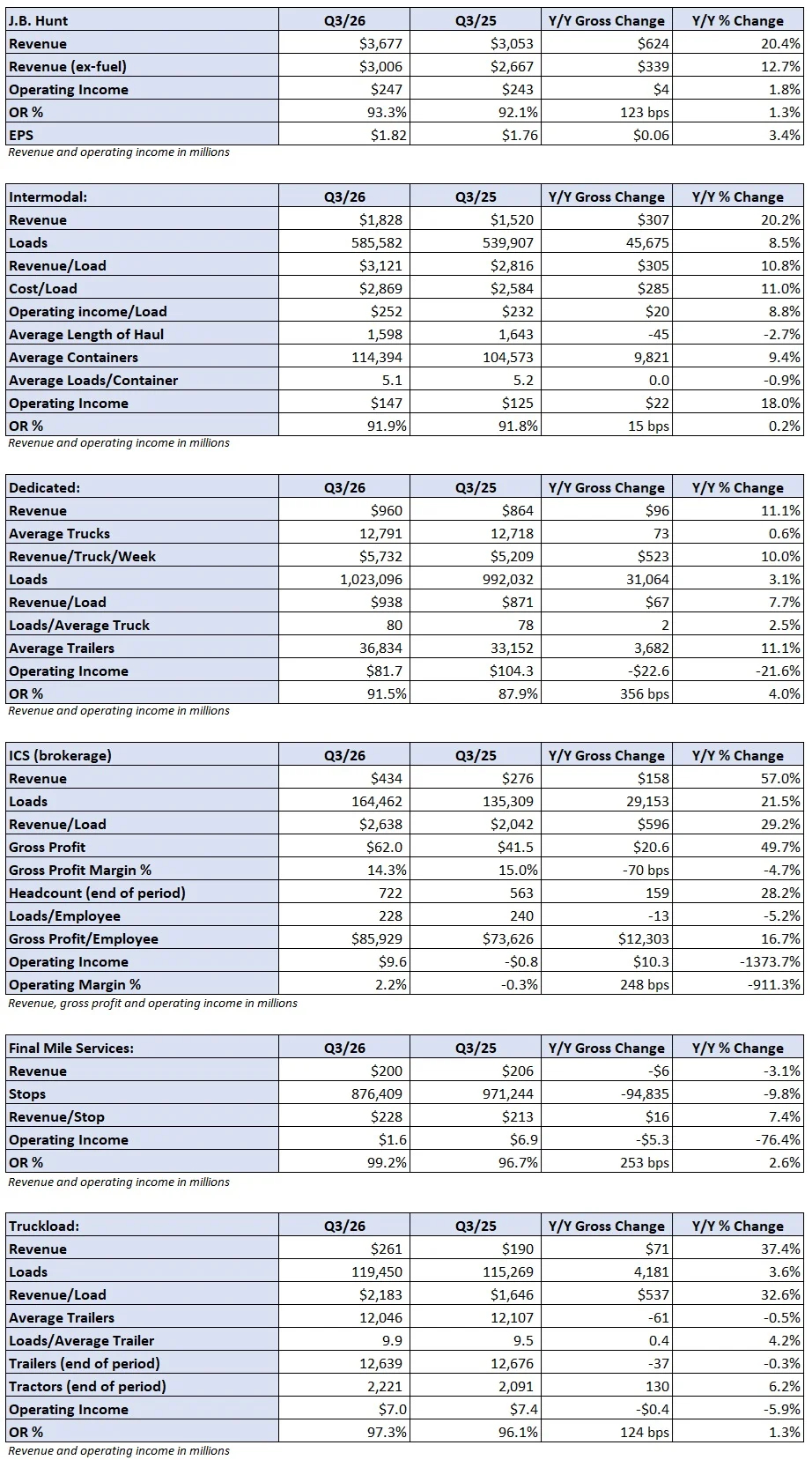
For the quarter, J.B. Hunt posted total revenue of $3.68 billion, easily besting the consensus analyst estimate of $3.59 billion. Earnings per share (EPS) came in at $1.82, beating revised analyst expectations by a penny. This marginal beat occurred despite a higher effective tax rate acting as a 4-cent EPS headwind during the quarter, which was only partially offset by a 2-cent decline in net interest expense.
The quarterly performance demonstrated resilience in the face of steep operational headwinds. J.B. Hunt absorbed more than $50 million in unexpected near-term cost pressures during the period—driven by sharp spikes in diesel prices, driver-related expenses, and elevated cargo claims.
Despite these friction points, the latest report marks the fifth consecutive quarter of year-over-year improvements in both operating income and EPS for the transportation giant. J.B. Hunt’s aggressive earnings turnaround began in the third quarter of 2025, keeping the company well ahead of many of its industry peers in navigating broader freight market cycles.
Chronology of the Quarter
The path to J.B. Hunt’s third-quarter earnings report was characterized by sudden turbulence, reactive guidance adjustments, and a noticeable retreat in investor sentiment.
- Early September: Operational costs began scaling rapidly across J.B. Hunt’s network. Diesel prices experienced a sharp runup, adding roughly $10 million in unanticipated expenses. Simultaneously, driver-related costs swelled by $25 million, and cargo claims rose significantly, adding another $10 million in liabilities.
- Mid-September: Recognizing the mounting financial drag, J.B. Hunt issued an unscheduled earnings warning. The company cautioned investors to expect a 5% to 10% sequential decline in EPS for the third quarter, which implied an outcome around $1.77 at the midpoint of the projected range. Following this update, the company’s stock suffered a sharp sell-off, plunging roughly 14% from mid-September through the close of trading on Thursday.
- Thursday After Market Close: J.B. Hunt officially released its Q3 financial results. Revenue of $3.68 billion and EPS of $1.82 managed to clear the lowered bar set weeks prior, performing slightly better than the mid-September guidance update had implied.
- Thursday After-Hours Trading: Despite beating the consensus estimates, investor caution lingered. Shares of JBHT ticked down 2.4% in after-hours trading, extending the broader downward pressure on the stock following the autumn warning.
- Thursday at 5:00 PM EDT: Company executives hosted a live earnings call to unpack the third-quarter metrics, detail the nature of the cost pressures, and offer strategic insights for the upcoming peak shipping season.
Supporting Data and Segment Performance
A granular look at J.B. Hunt’s key performance indicators (KPIs) reveals a mixed operational environment where revenue growth was frequently countered by margin compression and climbing overhead.
Intermodal
J.B. Hunt’s core Intermodal division put up robust top-line numbers, with revenue jumping 20% year-over-year to $1.83 billion. Total loads grew by 8%, while revenue per load increased by 11%. Much of this revenue expansion was fueled by higher fuel prices; excluding fuel, revenue per load rose a more modest 2% year-over-year.
Geographically, volume trends diverged significantly. Volumes surged 18% year-over-year in the East, while transcontinental lanes crawled ahead with just a 1% volume increase. Furthermore, a 3% decline in the average length of haul—driven primarily by the mix shift toward Eastern lanes—acted as a slight headwind to overall revenue per load.
Profitability in the segment faced minor headwinds. The Intermodal unit booked an operating ratio (OR) of 91.9%. Because operating ratio is the inverse of operating margin, this represented a 15-basis-point deterioration year-over-year, dragged down by inflated driver personnel costs, equipment expenses, and employee benefits.
Dedicated Contract Services (DCS)
The Dedicated unit experienced a more pronounced compression in margins. The segment’s operating ratio deteriorated by 360 basis points year-over-year, settling at 91.5%.
Total DCS revenue climbed 11% year-over-year, though this growth was almost entirely a byproduct of higher revenue per truck per week, which includes fuel surcharges. Excluding fuel, revenue per truck ticked up by a meager 3%. Interestingly, the average number of trailers in service expanded by 11%, even though overall load counts grew by just 3%. The widening gap between asset expansion and load volume, coupled with escalating driver costs, group medical claims, insurance premiums, and new account startup expenses, squeezed profitability.
Brokerage and Asset-Light Truckload
There were notable bright spots in J.B. Hunt’s non-asset and asset-light divisions. The brokerage unit managed to book an operating profit for the second consecutive quarter, breaking a grueling 13-quarter streak in the red. Similarly, the company’s asset-light truckload unit successfully swung back into positive territory, posting a $7 million operating profit after registering a modest loss in the second quarter.
Official Responses and Executive Commentary
While executive leadership addressed the specific drivers of the quarter during the 5:00 PM EDT earnings call, the prior guidance updates and financial disclosures painted a clear picture of management’s perspective.
The primary narrative from the executive suite has centered on acknowledging the external cost shocks while defending the structural health of the company’s network. Management explicitly quantified the unexpected friction points that materialized during the quarter:
- Diesel Volatility: A sudden $10 million hit from fuel price surges.
- Labor Pressures: A $25 million increase driven by driver-related expenses.
- Risk Management: $10 million tied to elevated cargo claims.
In total, these discrete elements accounted for over $50 million in headwinds. Despite these challenges, leadership has emphasized that the core operational turnaround—which began in earnest during the third quarter of 2025—remains structurally intact. The ability of non-traditional segments like Brokerage and Truckload to turn a profit indicates that internal belt-tightening and efficiency measures are successfully taking root, even if macro-level cost pressures temporarily clouded the quarterly financial picture.
Industry Implications and Outlook
The Bellwether Effect
In the freight and logistics ecosystem, J.B. Hunt is widely regarded as a premier bellwether. Because its operations span intermodal rail, dedicated contract carriage, brokerage, and asset-light truckload, the company’s financial health serves as a comprehensive barometer for the broader macroeconomic and supply chain landscape.
The third-quarter results indicate a distinct, albeit modest, slowdown following four consecutive quarters of robust recovery. The sharp spike in diesel costs, insurance premiums, and cargo claims points to lingering inflationary pressures that continue to challenge motor carriers across the United States. Furthermore, the rising cost of driver retention and recruitment underscores ongoing structural labor tightness within the trucking sector.
Transitory vs. Structural Costs
A critical question for analysts and industry observers moving forward is whether the $50-plus million in cost pressures experienced by J.B. Hunt are systemic or fleeting.
Industry analysts generally view several of these headwinds—particularly the sharp runup in diesel prices and certain spikes in cargo claims—as transitory market phenomena rather than permanent structural impairments. If fuel volatility stabilizes and insurance markets normalize, J.B. Hunt’s operating ratios in Intermodal and Dedicated are positioned to rebound toward historical norms.
At the same time, structural cost realities, such as rising driver wages and group medical benefits, appear here to stay. Shippers relying on intermodal and dedicated capacity should anticipate that carriers will continue pushing for rate adjustments to offset these enduring labor expenses. Ultimately, J.B. Hunt’s ability to outpace lowered expectations suggests that the freight market, while navigating pockets of turbulence, is maintaining its forward momentum heading into the peak shipping season.