In a geopolitical twist dripping with irony, Canada is formally launching a massive push into offshore wind power along its North Atlantic coast, with sights set on powering not just domestic provinces, but energy-hungry markets in the United States as well. The initiative, spearheaded by the federal government and anchored in the robust wind resources of Nova Scotia, directly challenges the ongoing anti-turbine crusades south of the border.
While the administration of U.S. President Donald Trump attempts to halt offshore wind development within American waters, Canada is seizing a multi-trillion-dollar global market opportunity. By leveraging its skilled offshore workforce, world-class meteorological conditions, and strategic international partnerships, Canada’s new clean energy playbook threatens to surround the U.S. with renewable power infrastructure—proving that clean energy momentum cannot easily be blocked by political fiat.
Main Facts
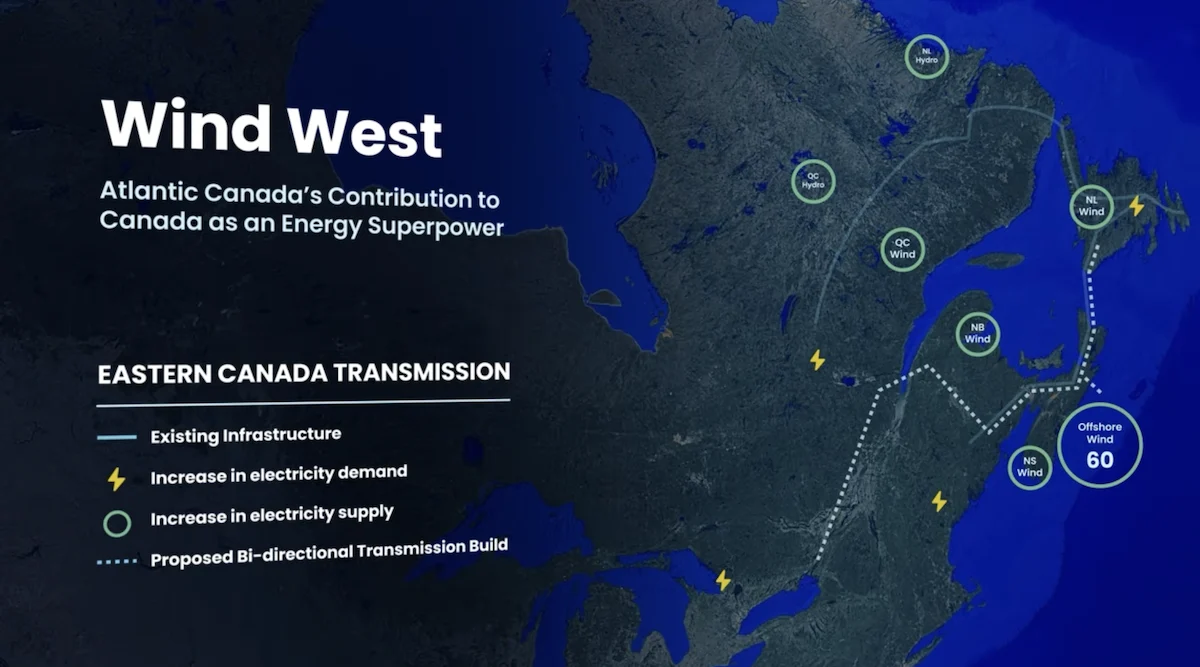
The core of Canada’s recent announcement centers on the "Wind West" initiative, an ambitious component of the broader Atlantic Energy Strategy.
- The Financial Commitment: The Canadian federal government has committed an initial $100 million CAD to jumpstart Nova Scotia’s offshore wind sector, designed to de-risk the market and attract private capital.
- Scope and Scale: The initiative aims to generate enough zero-emissions electricity to fully power Nova Scotia while exporting surplus energy via newly planned transmission infrastructure.
- Cross-Border Reach: Building on existing energy trade frameworks—such as Canadian hydropower deliveries to New York City and a recent energy-sharing agreement with Massachusetts—the offshore wind generated off Nova Scotia is strategically positioned to feed regional U.S. grids.
- Target Audience and Timeline: The initial phase rolls out mapping and sensing infrastructure in 2027, followed by a formal call for investors.
- The U.S. Counter-Landscape: Despite repeated federal roadblocks, legal battles, and executive orders by the Trump administration to halt domestic offshore projects like Connecticut’s Revolution Wind, multiple wind farms continue to operate or advance along the U.S. Atlantic seaboard.
Chronology of Events
The collision course between Canadian renewable expansion and American energy politics has developed through a series of key milestones over the past two decades:
- The Early 2000s: A foundational grudge is born when Donald Trump engages in a high-profile, ultimately unsuccessful legal battle with the Scottish government to block an offshore wind farm near one of his premier golf courses, establishing a lifelong political animus against wind turbines.
- February 4, 2026: Nova Scotia and the Commonwealth of Massachusetts sign a formal bilateral agreement establishing a framework for Canadian offshore wind assets to supply clean electricity to the American state.
- Late September 2026: Natural Resources Canada (NRC) officially begins teasing the massive offshore wind potential of the Atlantic coast, setting the stage for national policy shifts.
- October 15, 2026: Natural Resources Canada formally unveils the $100 million investment package, officially launching the "Wind West" initiative and allocating funds for meteorological buoys and transmission research.
- Mid-October 2026: The Trump administration files a last-minute legal brief attempting to rescind federal approval for the nearly completed 65-turbine Revolution Wind project off Connecticut, continuing a pattern of aggressive judicial opposition to offshore wind.
- 2027 and Beyond: Canada’s scheduled rollout of data collection buoys, paving the way for the first wave of private sector developer bids and the construction of subsea transmission lines.
Supporting Data and Economic Context
Canada’s east coast possesses some of the most potent and consistent wind resources on the planet. According to assessments by Natural Resources Canada and regional energy bodies, this natural advantage provides a launchpad to capture a share of the expanding $1-trillion global offshore wind market.
- $100 Million CAD: The baseline federal injection intended to catalyze private investment and draft foundational regulatory frameworks.
- $5 Million CAD: Specific allocation for advanced marine buoys equipped with meteorological and oceanographic sensors to provide de-risked data to potential developers ahead of the 2027 investor call-out.
- $3 Million CAD: Dedicated funding awarded to Net Zero Atlantic to map out subsea cabling and electrical pathways connecting Nova Scotia to Quebec and export markets beyond.
- Thousands of Turbines: The anticipated long-term yield of the North Atlantic leasing framework, which will capitalize on a regional workforce transitioned from traditional offshore oil and gas extraction.
Official Responses
Reactions to the aggressive scaling of North Atlantic wind power highlight a stark contrast between Canadian economic ambition and U.S. protectionist resistance.
- Tim Hodgson, Canada’s Minister of Energy and Natural Resources: Emphasized the unique strategic advantages held by the region, stating, "Nova Scotia’s world-class wind and highly skilled offshore workforce, developed through the legacy of offshore oil and gas, give Canada a competitive advantage in the potentially $1-trillion global offshore wind market — an advantage we are determined to seize."
- Natural Resources Canada (NRC): Highlighted the transformative economic potential of the geography, noting in an official statement: "Canada’s east coast has some of the strongest winds in the world, and developing that natural advantage presents a transformative economic opportunity for Nova Scotia, Atlantic Canada, and our entire nation."
- U.S. Federal Administration: Maintaining a hardline stance against renewable expansion, the current White House administration continues to pursue legal blockades, filing briefs to rescind approvals for active operations like the Revolution Wind project, arguing against federal favoritism while actively picking fossil fuel winners and losers.
Implications
The divergence in energy policy between Canada and the United States carries profound economic, environmental, and geopolitical consequences.
Economic Opportunity vs. Protectionist Stagnation
While the U.S. federal government attempts to stifle domestic manufacturing and suppress clean-tech employment—sacrificing tens of thousands of good-paying jobs in both red and blue states—Canada is actively welcoming the future. By repurposing the heavy-industry expertise and maritime workforce of its declining oil and gas sectors, Atlantic Canada is insulating its economy against global fossil fuel volatility.

Cross-Border Energy Interdependence
Energy markets notoriously defy political borders. Just as Canadian hydropower illuminates major U.S. metropolitan areas like New York City, future electrons harvested from Nova Scotia’s offshore arrays are bound to find their way into American homes and businesses via interconnected regional grids. State-level agreements, such as the pact between Massachusetts and Nova Scotia, demonstrate that regional climate mandates in the U.S. will bypass federal obstruction by sourcing clean power from international neighbors.
The Inevitability of the Energy Transition
Ultimately, the current wave of anti-wind litigation and regulatory hurdles in the U.S. is viewed by energy analysts as a temporary speedbump. With multiple wind farms reaching operational status despite executive interference, and foundational legal challenges repeatedly failing in court, the momentum behind offshore wind is deeply entrenched. When the current U.S. political cycle concludes, the pent-up demand for zero-emissions generation is expected to unleash a massive wave of domestic and imported offshore infrastructure—ensuring that the winds of the North Atlantic will drive North America’s energy grid for generations to come.