By Editorial Staff, Plant Engineering
In the high-stakes world of dry food, dairy, and pharmaceutical manufacturing, plant managers often find themselves trapped in a zero-sum game. The mission is binary: keep workers safe from slip-and-fall injuries while simultaneously maintaining a pristine, pathogen-free environment that satisfies the stringent requirements of the Food Safety Modernization Act (FSMA) and the U.S. Department of Agriculture (USDA). For decades, these two goals have been at odds, with traditional flooring solutions forcing operators to choose between effective traction and the ability to sanitize a surface.
However, recent advancements in materials science are beginning to dissolve this dichotomy. By moving away from legacy patterns and embracing engineered surface technologies, plant leaders can now secure both worker safety and regulatory compliance without compromise.
The Core Conflict: Traction vs. Sanitation
Slips, trips, and falls remain the second-leading cause of fatal workplace injuries, according to the U.S. Bureau of Labor Statistics. In industrial settings, the immediate reaction to these risks is often the installation of high-traction flooring. Traditionally, this meant creating a textured landscape—grooves, ridges, or abrasive grit—designed to bite into the sole of a worker’s boot.
In wet-processing environments, this approach is often manageable, as daily water washdowns flush out debris. However, in dry-processing facilities—such as those handling flour, milk powder, or pharmaceutical ingredients—water is the enemy. Introducing moisture into these areas creates the perfect breeding ground for Listeria, Salmonella, and other hazardous pathogens.
"When you use aggressive, deep-grooved flooring in a dry-processing plant, you are essentially building a microscopic harbor for organic dust," says Quinn Poor, Manager of Engineering and Product Development at SLIPNOT. "The very texture meant to prevent a fall becomes a storage facility for contaminants that are nearly impossible to reach without intensive, water-based cleaning—which the facility is explicitly trying to avoid."
A Chronology of Industrial Flooring Evolution
The history of plant flooring has been a decades-long search for a "silver bullet" that never quite materialized. Understanding the evolution of these materials helps explain why the current shift toward engineered, sweepable surfaces is so significant.
- The Era of Coatings (Pre-1990s): Early attempts focused on grit-based paints and epoxy coatings. While these offered high initial friction, they proved to be temporary solutions. Under the pressure of heavy foot traffic and, more importantly, the abrasive nature of metal-wheeled carts, these coatings quickly delaminated or wore down, creating "bald spots" that were both slippery and unhygienic.
- The Rise of Mechanical Textures (1990s–2010s): Industry moved toward mechanical alternatives like diamond plate and dotted metal patterns. These were durable, but flawed. Diamond plate relies on a raised metal geometry that loses its efficacy the moment a thin film of oil or dust settles into the valleys. Dotted plates, while popular, create hundreds of "pockets" around the welded beads where fine powder packs in, resisting standard dry-cleaning methods like push brooms or vacuuming.
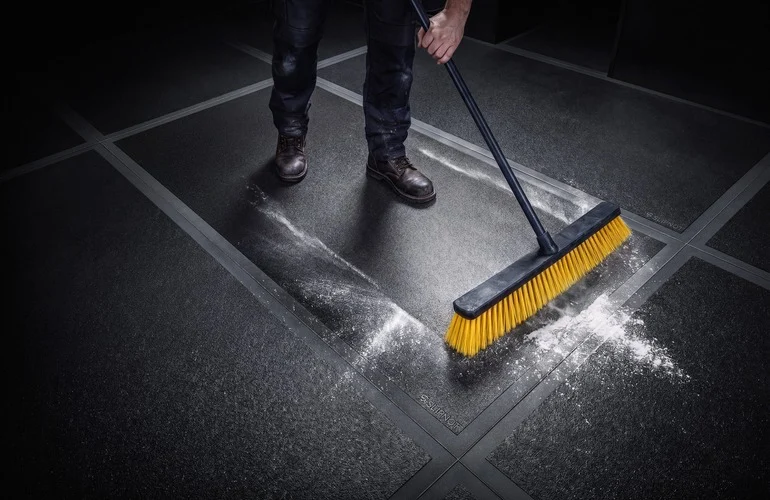
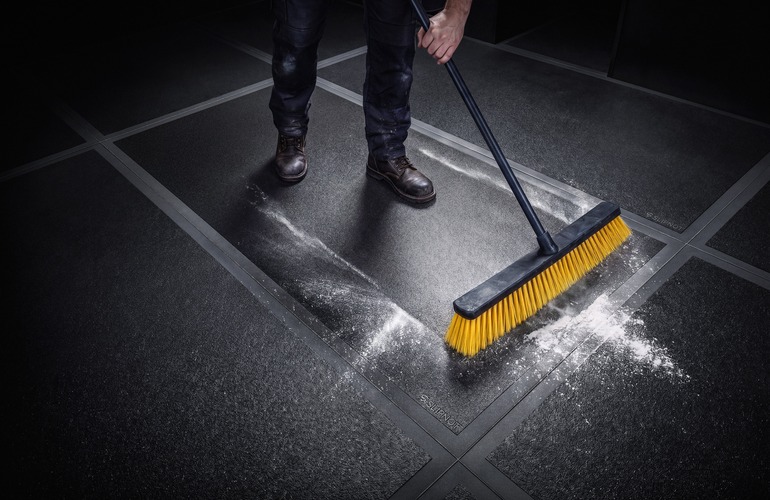
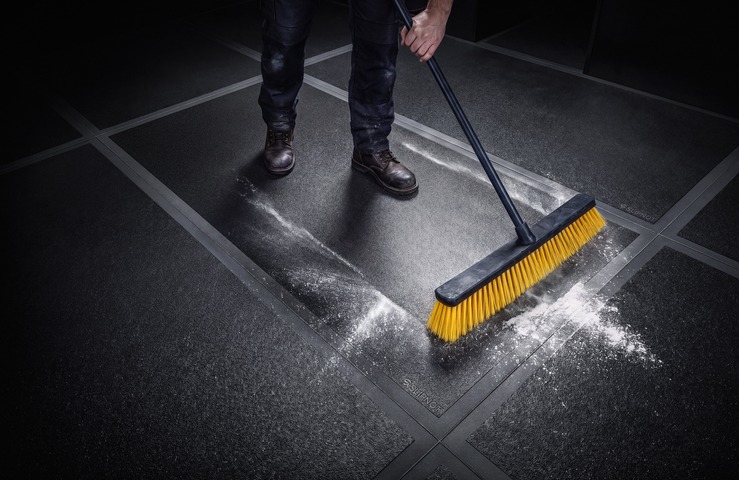
- The Shift to Engineered Surfaces (2020–Present): The modern era has introduced high-traction stainless steel surfaces that utilize a "valley-filling" design. Instead of deep, sharp grooves, these surfaces use a tool-steel-hard texture that sits flush with the surface, leaving millions of traction peaks exposed while effectively eliminating the "valleys" that trap dust. This innovation marks the first time that a surface can be classified as both "high-traction" and "easy to sweep."
Supporting Data: Why DCOF Matters
The failure of many legacy flooring choices stems from an reliance on outdated testing metrics. For years, static testing—measuring friction on a non-moving object—was the standard. However, the industry is increasingly moving toward Dynamic Coefficient of Friction (DCOF), which measures the grip of a surface while a person is in the act of walking.
"Plant managers need to stop looking at clean-room data," says Poor. "A surface that performs well in a lab setting while clean is irrelevant. The data that matters is the DCOF measured with fine powder worked into the surface."
According to the American National Standards Institute (ANSI) A326.3 protocols, a dry DCOF above 0.80 on a clean surface is considered excellent. More critically, a reading above 0.60 with contamination present is the benchmark for real-world safety.
Comparative Performance Table (Representative Data):
| Flooring Type | Clean DCOF | Contaminated DCOF | Sweepability |
|---|---|---|---|
| Standard Diamond Plate | 0.65 | 0.40 | Poor |
| Dotted Metal Plate | 0.70 | 0.45 | Moderate |
| Engineered Sweepable Surface | 0.97 | 0.71 | Excellent |
These figures demonstrate that while legacy surfaces might pass basic safety audits, they offer a false sense of security once the facility is operational and dust accumulates.
Official Responses and Regulatory Implications
Regulatory bodies like the USDA and the FDA’s FSMA division do not "approve" specific flooring brands, but they do mandate that all surfaces in food-processing zones be cleanable and free of harborage points.
One of the most frequent points of failure during an audit is the perimeter. If a floor is installed but the edges are not fully seam-welded, the gap between the wall and the floor becomes a primary site for microbial growth. Furthermore, the heat from welding can often ruin the finish or the slip-resistant properties of specialized coatings.
"We’ve seen facilities spend millions on high-end flooring, only to have it rejected by an inspector because the perimeter welding was poorly executed," says an industry sanitation consultant. "The current best practice involves using pre-masked perimeters that allow for high-integrity, seam-welded joints without compromising the traction surface. If a manufacturer can’t provide a clear protocol for how their product handles edge sealing, you should move on."
Economic and Operational Implications
The business case for investing in superior flooring is often undervalued until an incident occurs. However, the "total cost of ownership" model presents a compelling argument for high-quality, engineered surfaces.
1. The Cost of Injury
The Liberty Mutual Workplace Safety Index reports that overexertion and slip-related injuries cost employers more than $13 billion annually. When a worker slips, the costs are not limited to the immediate workers’ compensation claim; they include lost productivity, administrative overhead, legal fees, and the potential for regulatory fines.
2. The Efficiency Dividend
Sanitation is a massive drain on operational availability. In a three-line facility, the time required to manually clear debris from difficult, textured flooring adds up. Modeling suggests that by switching to a surface that can be cleared with a single pass of a push broom, a facility can recover approximately 20 minutes of production time per line, per cleaning. In a facility running two cleanings a day, this equates to over 730 hours of regained annual production time—a direct, measurable improvement to Overall Equipment Effectiveness (OEE).
The Decision Framework: Four Questions for Plant Leaders
Before committing to a flooring installation, plant leaders must transition from a reactive mindset—fixing floors after a slip or a failed audit—to a proactive one. Any supplier under consideration should be able to provide transparent, verifiable answers to these four questions:
- "What is your DCOF data under contaminated conditions?" Demand documentation that shows how the floor performs with the specific powders or debris present in your facility.
- "What is the actual debris-removal process?" Ask for before-and-after cleanability data, ideally utilizing visual indicators like UV tracer powder to demonstrate particle retention.
- "How does the perimeter sealing process work?" Ensure the installation method supports full seam-welding without damaging the surface integrity.
- "What is the five-year total cost of ownership?" Factor in not just the initial purchase price, but the labor costs of cleaning and the projected lifecycle of the material before replacement is required.
By treating the floor as an engineered component of the production line rather than a peripheral construction material, plant managers can bridge the gap between safety and sanitation. The era of choosing between a clean floor and a safe floor is coming to an end; in its place is a new standard of industrial hygiene that treats both as fundamental requirements for the modern, high-efficiency facility.