OTTAWA, Canada — In a major push to secure Canada’s clean energy future and modernize critical provincial infrastructure, federal officials have announced a nearly $270 million financial commitment aimed at upgrading New Brunswick’s hydropower capabilities and strengthening regional transmission networks.
Tim Hodgson, Canada’s Minister of Energy and Natural Resources, unveiled the funding package, which highlights the federal government’s ongoing strategy to transition toward an electrified economy, curtail carbon emissions, and stabilize regional power grids against rising demands.
At the heart of the announcement is a substantial $219 million site development loan extended by the Canada Infrastructure Bank (CIB) to NB Power. The capital is earmarked directly for the ambitious Mactaquac Life Achievement Project—an extensive, multi-year rehabilitation effort designed to secure the operational longevity of the Mactaquac Generating Station.
Additionally, the funding package incorporates a $50 million direct investment from Natural Resources Canada (NRCan). This secondary tranche will support the deployment of advanced grid technology at the Salisbury Terminal, reinforcing the transmission backbone across southern New Brunswick.
Together, these initiatives align with the broader federal roadmap outlined in Powering Canada Strong: A National Strategy for an Electrified Canadian Economy, a federal initiative launched earlier this year to double Canada’s electricity grid capacity by 2050.
Main Facts: What the Investment Entails
The nearly $270 million infusion is bifurcated into two distinct, high-impact projects managed by NB Power, designed to tackle both generation longevity and grid reliability:
- The Mactaquac Life Achievement Project ($219 million CIB Loan): This capital will fund crucial pre-construction and preparatory activities. Specifically, it will underwrite technical engineering studies, comprehensive regulatory reviews, ongoing First Nations engagement, and advanced operational planning.
- The Salisbury Terminal STATCOM Project ($50 million NRCan Grant): This funding targets transmission infrastructure, specifically supporting the installation of a Static Synchronous Compensator (STATCOM) at the high-voltage Salisbury Terminal. The technology is engineered to optimize power flows, enhance voltage stability, and facilitate the integration of intermittent renewable energy sources, such as wind and solar.
The Cornerstone Asset: Mactaquac Generation Station
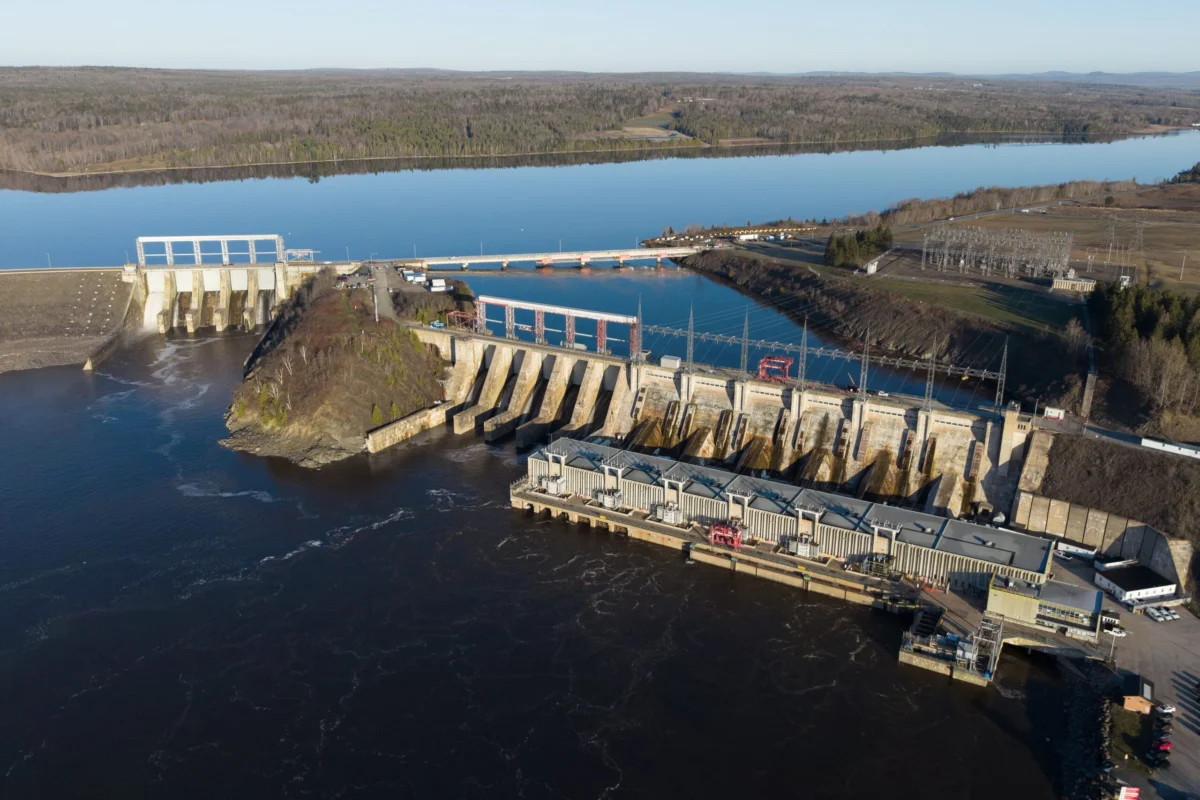
The Mactaquac Generating Station is not merely an operational asset; it is the cornerstone of New Brunswick’s renewable energy portfolio. Commissioned in 1968 and situated on the St. John River just upstream from Fredericton, the 672-megawatt (MW) run-of-river facility is the largest hydroelectric station operated by NB Power.
The station punches well above its weight class in terms of provincial energy security, supplying roughly 30% of New Brunswick’s total renewable energy requirements and satisfying an impressive 20% of the province’s peak electricity demand. Furthermore, because of its run-of-river design and rapid-response capabilities, Mactaquac plays a pivotal role in balancing the grid, seamlessly absorbing and stabilizing the variable power output from growing wind and solar installations across the region.
However, the facility has faced severe engineering hurdles for the past two decades. The station has been battling structural degradation driven by an alkali-aggregate reaction (AAR)—a phenomenon commonly referred to as "expanding concrete." This premature concrete deterioration has placed mounting physical stress on critical electro-mechanical components, including the facility’s massive turbines and spillway gates, necessitating comprehensive, long-term intervention.
Chronology: From Crisis Identification to the 2026 Lifespan Extension
To understand the weight of the current $219 million loan, it is necessary to examine the decades-long operational history and the rigorous planning cycle that brought the Mactaquac project to this juncture:
1968: Commissioning and Initial Operation
The Mactaquac Dam and Generating Station are completed on the St. John River, designed with an anticipated 100-year operational lifespan slated to stretch well into the 21st century.
The Late 1990s – Early 2000s: Emergence of Structural Issues
Engineers identify early signs of an alkali-aggregate reaction within the concrete structures. The chemical reaction between the aggregate and alkaline pore solution in the concrete causes the material to expand and crack, exerting immense pressure on embedded steel structures, turbine housings, and water control gates.
2016: The Comprehensive Public Review and Aquatic Studies
Faced with the prospect of premature decommissioning due to expanding concrete, NB Power launches a comprehensive public review process in 2016 to evaluate the facility’s future. The review explores various scenarios, ranging from complete removal of the dam to full-scale rehabilitation.
To ensure scientific and social rigor, the evaluation incorporates extensive socioeconomic impact studies, engineering assessments, business case analyses, and independent scientific research conducted by the Canadian Rivers Institute through its Mactaquac Aquatic Ecosystem Study (MAES). Following this multi-year consultation, stakeholders and leadership agree that rehabilitating the dam is the most viable path forward, leading to the formulation of the Mactaquac Life Achievement Project.

May 2026: Federal Policy Alignment
The Government of Canada introduces Powering Canada Strong: A National Strategy for an Electrified Canadian Economy, establishing a federal framework to double the nation’s grid capacity by 2050. This policy framework creates the financial and regulatory environment necessary to support massive long-term green infrastructure investments like Mactaquac.
Late 2026: The $270 Million Federal Investment Announcement
Minister of Energy and Natural Resources Tim Hodgson announces the federal funding package, officially unlocking the $219 million CIB site development loan and the $50 million Salisbury Terminal grant. This milestone moves the Mactaquac Life Achievement Project from conceptual planning into active pre-construction development.
Supporting Data & Technical Infrastructure
The viability of New Brunswick’s energy transition rests heavily on hard data, asset performance metrics, and sophisticated power-management engineering.
Mactaquac Operational Metrics
- Generation Capacity: 672 Megawatts (MW)
- Energy Contribution: Generates 30% of New Brunswick’s renewable energy supply.
- Peak Demand Support: Delivers 20% of the province’s total peak electricity demand.
- Target Lifespan: Phased rehabilitation aims to secure the facility’s structural integrity to reach its original 100-year operational design target.
Salisbury Terminal and STATCOM Technology
The $50 million investment in the Salisbury Terminal addresses a different, yet equally critical, bottleneck in New Brunswick’s power grid: transmission and voltage stability. As the province incorporates more distributed, variable renewable resources (such as regional wind farms and utility-scale solar arrays), grid operators face increasing volatility in voltage levels and power quality.
The installation of a Static Synchronous Compensator (STATCOM) at the high-voltage Salisbury substation provides dynamic reactive power compensation. Unlike traditional mechanical switching devices, a STATCOM can inject or absorb reactive power within milliseconds. This rapid response stabilizes system voltage during sudden shifts in load or generation, prevents cascading outages, and ensures that the transmission corridor linking southern New Brunswick remains robust.
Official Responses and Strategic Perspectives
Federal and provincial stakeholders have underscored the transformative nature of this capital injection, framing it as both an economic and environmental imperative.
"Investing in reliable, clean energy infrastructure is foundational to growing our economy, keeping life affordable for Canadians, and meeting our climate targets," said Tim Hodgson, Minister of Energy and Natural Resources. "By supporting NB Power in modernizing Mactaquac and reinforcing the Salisbury Terminal, we are securing generational energy reliability for New Brunswickers while laying the groundwork for a fully electrified, resilient Canadian economy."
The Canada Infrastructure Bank (CIB) emphasized the unique financial structuring required to manage multi-decade infrastructure assets. Through its site development loan, the CIB provides predictable, long-term capital that absorbs early-stage development risks—such as intricate environmental reviews and engineering deep-dives—before primary construction begins.
NB Power executives have similarly praised the partnership, noting that rehabilitating Mactaquac is far more cost-effective and environmentally sound than building an entirely new generation facility of equivalent scale. Furthermore, the utility has highlighted the importance of collaborative engagement with First Nations communities throughout the St. John River watershed, ensuring that environmental stewardship and indigenous rights remain central to the rehabilitation process.
Broader Implications for Canada’s Energy Landscape
The funding for Mactaquac and the Salisbury Terminal does not exist in a vacuum; it is a critical chess piece in Canada’s overarching climate and economic strategy.
1. Advancing the 2050 National Electrification Strategy
Under the Powering Canada Strong framework, Ottawa has set an aggressive target to double the nation’s electrical generation and transmission capacity over the next quarter-century. Achieving this requires not just building new assets, but aggressively preserving, retrofitting, and optimizing existing clean energy infrastructure. Hydroelectric facilities—which currently provide a massive share of Canada’s zero-emission baseload power—must be preserved to prevent a regression to fossil-fuel generation during high-demand periods.
2. Consumer Savings and Economic Relief
Federal modeling associated with the national electrification strategy projects that aggressive grid expansion and modernization will deliver up to $15 billion in total energy savings by 2050. More tangibly for everyday citizens, the federal government estimates that these grid-efficiency measures will lower total energy costs for roughly 7 in 10 Canadian households. By avoiding the premature retirement of a 672-MW asset like Mactaquac, NB Power shields ratepayers from the exorbitant capital costs of constructing replacement generation from scratch.
3. Fostering Regional Grid Resilience in the Face of Climate Change
As extreme weather events become more frequent—ranging from severe winter ice storms to intense summer heatwaves—grid reliability is a matter of public safety. The combination of Mactaquac’s baseload flexibility and the Salisbury Terminal’s advanced voltage stabilization equips New Brunswick to withstand acute grid shocks while safely integrating high volumes of intermittent green energy.
Looking Ahead
With the financial framework now secured, NB Power will advance the comprehensive technical studies, regulatory applications, and First Nations consultations mandated by the CIB loan. As these preparatory phases unfold over the coming years, the Mactaquac Life Achievement Project will serve as a vital case study in how mature, aging hydroelectric infrastructure can be successfully revitalized to serve the decarbonized economies of the 21st century.