FRAMINGHAM, Mass. — In the high-stakes world of commercial property management, building infrastructure upgrades are often synonymous with tenant disruption, noise complaints, and logistical nightmares. However, Building Automation Systems (BAS) recently redefined industry standards for efficiency in Framingham, Massachusetts. Over the course of a single, highly coordinated weekend, the BAS team successfully executed the replacement, installation, and commissioning of a massive 172-ton Seasons 4 rooftop unit (RTU) atop a sprawling 162,000-square-foot commercial office building.
The operation, which required military-grade precision and meticulous engineering foresight, was initiated on Friday night, September 11th, and brought to full, operational status by Sunday, September 13th. By compressing a notoriously complex mechanical overhaul into a strict 48-hour window, BAS ensured that building tenants returned to work on Monday morning with zero awareness of the monumental engineering feat that had occurred overhead.
This project serves as a masterclass in modern commercial HVAC design-build execution, highlighting how advanced pre-planning, manufacturer collaboration, and skilled in-house labor can mitigate downtime in high-density office environments.
Main Facts
The core of the Framingham project centered on the replacement of an aging, end-of-life commercial heating, ventilation, and air conditioning unit with a state-of-the-art system manufactured by Seasons 4 and supplied through their regional representative, Noble Associates, Inc.
The logistical footprint and technical specifications of the new installation underscore the scale of the undertaking:
- Project Location: Framingham, Massachusetts.
- Building Scope: 162,000-square-foot multi-tenant commercial office facility.
- Execution Timeline: Exactly one weekend (Friday evening, September 11, through Sunday evening, September 13). Tenant impact was kept at an absolute zero.
- Equipment Specifications: A custom-engineered Seasons 4 rooftop unit boasting 172 tons of direct expansion (DX) cooling capacity, powered by 8 high-efficiency scroll compressors.
- Physical Weight: The total weight of the new RTU reached an imposing 32,300 pounds (approximately 16.15 tons), requiring heavy crane rigging and structural engineering evaluations.
- Key Partners: Building Automation Systems (BAS) as the primary engineering and installation contractor; Seasons 4 as the equipment manufacturer; and Noble Associates, Inc. as the manufacturer’s representative.
The success of the project hinged not merely on the physical lifting and bolting of heavy machinery, but on an intensive preliminary engineering phase that guaranteed seamless integration with the building’s legacy infrastructure.
Chronology of a Weekend Transformation
Executing a heavy mechanical replacement of this magnitude within a 48-hour window leaves zero room for error. Every hour of the operation was mapped out well in advance. Below is the chronological breakdown of how the BAS team transformed the roof of the Framingham office building over a single weekend.
Phase 1: Pre-Construction and Engineering Design (Weeks Prior)
Long before the first crane arrived on-site, the BAS engineering team conducted comprehensive structural and thermal load surveys of the 162,000-square-foot office building. Engineers analyzed cooling loads, airflow requirements, and historical climate data to ensure the new 172-ton Seasons 4 unit would meet peak tenant demand without over-cycling.
Concurrently, BAS collaborated directly with Seasons 4 engineers to address a critical logistical challenge: fitting the brand-new, high-capacity unit onto the building’s existing structural roof curb. By tailoring the physical dimensions of the RTU housing to match the legacy footprint, the team avoided costly and time-consuming structural modifications to the roof.
Furthermore, the electrical and control interfaces were meticulously mapped. Engineers designed the new alignment to utilize all existing electrical power feeds and control wiring runs, completely eliminating the need for new field wiring or conduit routing. Finally, BAS and Seasons 4 programmers developed custom RTU operational sequences ahead of time to guarantee flawless communication with the building’s existing Building Management System (BMS).
Phase 2: Friday, September 11 – Mobilization and Extraction
The physical operation commenced immediately after business hours on Friday, September 11, ensuring that office tenants had vacated the premises.
- Evening (5:00 PM – 9:00 PM): Cranes and heavy rigging equipment were mobilized and secured on-site. Safety perimeters were established around the perimeter of the Framingham property.
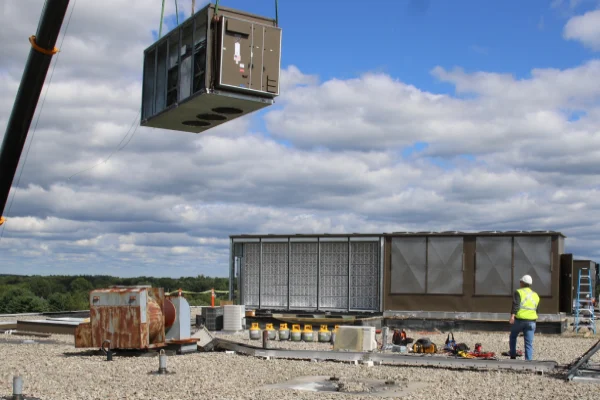
- Night (9:00 PM Onward): The legacy HVAC unit was safely powered down, disconnected from electrical and ductwork feeds, and unbolted from the roof curb. Using a high-capacity crane, the old machinery was hoisted off the roof and lowered onto flatbed transport trucks for off-site recycling. Rigging teams worked through the night under specialized lighting to prepare the curb for the incoming equipment.
Phase 3: Saturday, September 12 – Rigging and Placement
Saturday was dedicated to the high-stakes lift and placement of the new equipment.
- Morning: The massive 32,300-pound Seasons 4 RTU arrived on-site, transported in coordinated loads from Noble Associates, Inc.
- Mid-Day: Under the direction of BAS safety coordinators and master riggers, the crane hoisted the 172-ton unit into the air. With millimeter precision, the massive assembly was guided down onto the existing roof curb.
- Afternoon and Evening: Mechanical contractors secured the unit to the curb, weather-proofed the transitions, and coupled the unit to the existing ductwork, plumbing, and pre-mapped electrical feeds. Because of the pre-engineering work completed weeks prior, the unit dropped into place without requiring field modifications to the electrical infrastructure.
Phase 4: Sunday, September 13 – Commissioning and Integration
With the physical hardware secured, Sunday was dedicated to the critical phases of system integration, testing, and commissioning.
- Morning: BAS technicians verified all mechanical connections, refrigerant pressures, and electrical circuits. The 8 scroll compressors underwent preliminary resistance and voltage checks.
- Afternoon: Software integration took center stage. Technicians uploaded the custom RTU control sequences developed in collaboration with Seasons 4. The unit was successfully integrated into the facility’s existing Building Management System (BMS).
- Late Afternoon / Evening: Full system commissioning commenced. The unit was brought online and put through rigorous performance tests, cycling through various cooling loads to ensure proper airflow, temperature regulation, and energy efficiency.
- Sunday Night: The system passed all diagnostic tests with flying colors. The job site was cleared, and the building was handed back over to property management, fully conditioned and ready for Monday morning business.
Supporting Data and Technical Specifications
The engineering complexity of the Framingham project is best understood through a technical lens. Commercial office buildings of 162,000 square feet present unique thermal challenges, particularly during transitional weather seasons when internal solar loads clash with perimeter heating or cooling demands.
Cooling Capacity and Compressor Architecture
The selected Seasons 4 unit delivers a robust 172 tons of DX (Direct Expansion) cooling capacity. To achieve optimal energy efficiency and precise temperature control across multi-zone office layouts, the unit utilizes 8 distinct scroll compressors.
Unlike older single-stage or dual-stage compressors that operate on a "binary" on/off basis—leading to massive energy spikes and temperature fluctuations—an 8-scroll configuration allows for staged modulation. The system can incrementally scale its cooling output up or down depending on real-time building demand. This not only extends the operational lifespan of the mechanical components by reducing wear and tear but also significantly lowers daily energy consumption for the building owner.
Weight and Structural Load Dynamics
Weighing in at 32,300 lbs (over 16 tons), placing a unit of this mass onto an existing commercial structure requires rigorous analysis. Dynamic wind loads, seismic considerations, and dead-weight distribution must be calculated to prevent structural fatigue. By working closely with Seasons 4 to match the footprint of the old unit, BAS avoided the need to reinforce the building’s steel skeleton, saving the property owner tens of thousands of dollars in structural engineering and construction costs.
Electrical and Controls Integration
One of the most innovative aspects of the project was the elimination of additional field wiring. Major HVAC retrofits frequently stall out in the field when technicians discover that new equipment requires heavier gauge wiring, relocated power feeds, or entirely new control protocols.
By conducting exhaustive pre-installation site surveys, BAS engineers ensured that the new Seasons 4 unit was manufactured with terminal layouts matching the legacy unit’s power drops. Furthermore, the custom software integration ensured that the BMS could seamlessly "talk" to the new RTU’s microprocessors, preserving historical data tracking, automated scheduling, and remote monitoring capabilities without downtime.
Official Responses and Industry Insights
While no public crisis occurred during the smooth weekend operation, industry stakeholders and BAS representatives emphasized the significance of design-build collaboration in modern commercial real estate.
In a post-project statement, leadership at Building Automation Systems highlighted the value of their vertically integrated business model:
"Property managers throughout the New England region can count on the top-quality engineering and HVAC services available from Building Automation Systems (BAS). With in-house licensed engineers, certified programmers, and technicians, our team can help you complete your most critical HVAC projects."
Industry analysts observing the Framingham project noted that the ability to execute a complex rooftop replacement over a 48-hour weekend window is becoming the gold standard for commercial property management. In today’s competitive leasing market, office tenants have zero tolerance for scheduled daytime outages, elevated ambient noise, or climate control inconsistencies.
Representatives from Noble Associates, Inc., the manufacturer’s rep that supplied the Seasons 4 equipment, praised the synchronization between equipment manufacturing and field installation:
"When supplying heavy commercial machinery of this scale, the margin for error is razor-thin. The precision with which BAS engineered the curb match and pre-planned the electrical feeds allowed our equipment to be integrated and commissioned without a hitch. It is a testament to what happens when manufacturers and engineering contractors work in true partnership."
Implications for New England Commercial Real Estate
The successful deployment of the 172-ton Seasons 4 RTU in Framingham carries broad implications for property managers, building owners, and mechanical contractors across the greater New England region.
1. Zero-Downtime Expectations as the New Norm
As commercial office spaces vie to retain tenants in a post-pandemic market characterized by hybrid work models and high tenant expectations, building amenities and environmental comfort are paramount. Tenants paying premium rent for Class-A and Class-B office space expect climate control to be invisible and flawless. The BAS Framingham project proves that major mechanical overhauls no longer require multi-week disruptions, weekday shutdowns, or temporary cooling trailers.
2. The Value of In-House Design-Build Expertise
The complexity of modern HVAC systems—integrating advanced metallurgy, complex refrigerant circuits, microprocessors, and building automation software—means that traditional, fragmented contracting models are increasingly obsolete. When general contractors, electrical subs, mechanical installers, and software programmers operate in silos, miscommunications inevitably lead to delays and cost overruns.
By utilizing an integrated design-build approach featuring in-house licensed engineers, certified programmers, and field technicians, BAS demonstrated how single-source accountability safeguards project timelines and budgets.
3. Energy Efficiency and Sustainability Goals
Older commercial HVAC units are notoriously energy-inefficient, often contributing significantly to a building’s carbon footprint and operational overhead. By upgrading to a modern 172-ton Seasons 4 unit featuring advanced multi-stage scroll compressors, the Framingham office building immediately lowered its energy consumption profile. For New England property managers facing stringent municipal energy reporting laws and corporate ESG (Environmental, Social, and Governance) mandates, strategic HVAC modernization is no longer optional—it is a financial and regulatory necessity.
Looking Ahead
As aging commercial infrastructure across New England reaches the end of its useful lifecycle, property owners will increasingly face the daunting task of heavy equipment replacement. The BAS Framingham project stands as a blueprint for success: a triumph of engineering foresight, manufacturer collaboration, and disciplined execution that kept a 162,000-square-foot building humming without missing a single beat.
Property managers and building owners seeking expert guidance on upcoming design-build projects, HVAC retrofits, or automation upgrades are encouraged to contact Building Automation Systems (BAS) to request a comprehensive project estimate.