OLYMPIA, Wash. — A routine residential and commercial plumbing service call turned catastrophic in January 2026, culminating in a violent, high-speed rollover crash that claimed the life of an experienced 44-year-old truck driver and severely injured his co-worker. According to a recently released incident investigation from the Washington State Fatality Assessment and Control Evaluation (FACE) Program, the fatal crash was the direct result of a cascading series of mechanical failures, improper route selection, and a complete absence of routine preventative maintenance by the employer.
The accident, documented under Case Report #71-273-2026, sheds urgent light on the lethal risks associated with operating heavy commercial vehicles without mandated inspection protocols. Investigators discovered that the heavily loaded tanker truck—weighing more than 50,000 pounds at the time of the crash—suffered from severely compromised rear-axle drum brakes that had not been serviced or inspected for nearly two years.
As regulatory agencies and labor safety advocates review the findings, the incident serves as a grim reminder of the absolute necessity of rigorous vehicle maintenance standards, comprehensive pre-trip inspections, and strict adherence to approved corporate transit routes, particularly when navigating treacherous mountainous terrain in the Pacific Northwest.
Main Facts of the Incident
The tragedy unfolded on a steep, unfamiliar roadway in Washington State, leaving a devastating impact on the local community, the victim’s family, and the workforce of the plumbing contracting company involved.
- Date of Incident: January 2026 (Report issued January 23, 2026)
- Location: Unidentified steep grade terminating in a T-shaped intersection in Washington State
- Victim: A 44-year-old male commercial truck driver with three years of experience at the company
- Passenger/Co-worker: One male passenger who sustained severe injuries, requiring a one-week hospitalization
- Vehicle Involved: A commercial tanker truck loaded with residential and commercial septic waste
- Total Gross Weight: In excess of 50,000 pounds
- Investigating Agency: Washington State Fatality Assessment and Control Evaluation (FACE) Program, in collaboration with state patrol motor carrier inspectors
The primary narrative established by investigators indicates that the truck was operating far beyond safe mechanical parameters. While the vehicle was hauling a massive load, state patrol inspections revealed that two of the truck’s rear-axle drum brakes were entirely non-functional prior to the descent. Compounding these latent mechanical defects, the vehicle was traveling down an unfamiliar, unapproved route characterized by a severe downward grade.
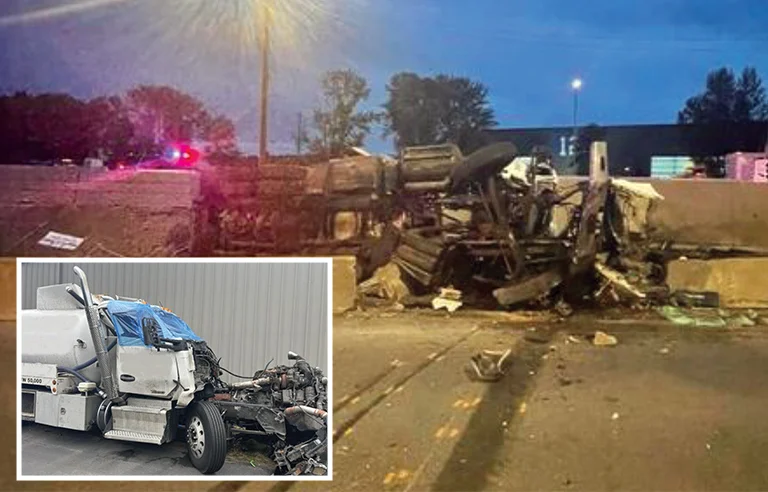
When the driver attempted to check the vehicle’s momentum, the combination of excessive weight, non-responsive primary braking systems, and a catastrophic mechanical snap in the driveline rendered the truck completely uncontrollable. The ensuing crash demolished a concrete safety barrier, resulting in instantaneous fatal injuries to the driver and critical trauma to his co-worker.
Detailed Chronology of the Crash
Understanding how a routine septic pumping job escalated into a fatal runaway truck scenario requires a meticulous examination of the timeline leading up to the final moments of the descent.
Phase 1: The Pumping Operation and Route Deviation
Earlier in the day, the 44-year-old driver and his co-worker successfully completed a septic system extraction at a customer’s property. The tanker tank was filled to capacity with liquid waste, pushing the gross vehicle weight past the 25-ton threshold (50,000+ pounds).
Per company policy, drivers were expected to follow specific, pre-approved logistical routes designed to avoid hazardous geographical features, such as steep mountainous grades and complex intersections. However, for reasons still under scrutiny, the driver and his co-worker deviated from the standard route and ventured onto unfamiliar secondary roads. This diversion led them directly to the top of a steep, quarter-mile-long hill that terminated abruptly at a T-shaped intersection.
Phase 2: The Runaway Descent and Brake Failure
As the heavily laden tanker crested the hill and began its descent, gravity quickly accelerated the massive vehicle far beyond safe operating speeds. Recognizing the immediate danger, the driver initiated emergency procedures by applying both the service brakes and the parking brakes.
To the driver’s horror, the braking system failed to respond adequately. Unknown to the crew at that moment, two of the truck’s rear-axle drum brakes were completely inoperable due to extreme neglect, wear, and a lack of routine adjustment. With the primary hydraulic and pneumatic braking capacities severely diminished, the truck continued to gather dangerous momentum down the steep incline.
Phase 3: Driveline Failure and Loss of Auxiliary Systems
Desperate to regain control, the driver attempted an emergency mechanical maneuver: downshifting the transmission from fifth gear down to second gear to leverage engine compression braking.
The sudden, violent torque shift proved too much for the stressed mechanical components. The driveshaft connecting the transmission to the rear axles snapped under the extreme load. The snapping of the driveshaft triggered a catastrophic secondary failure: it severed the operational link required to utilize the supplementary engine brake, commonly known as a "Jake brake" or compression engine release brake. The driver was now entirely stripped of his auxiliary retardation systems.
Phase 4: Final Moments and Rollover
In a final, frantic effort to cut power to the wheels, the driver released the clutch, successfully shutting down the engine. Still, the immense forward momentum of the 50,000-pound vehicle defied the engine shutdown.
As the truck hurtled toward the T-shaped intersection at the base of the hill at highway speeds, the driver attempted a sharp right-hand steering maneuver to negotiate the turn. The high center of gravity inherent to a loaded liquid tanker truck—combined with the excessive speed—caused the vehicle to violently tip over onto its left side. The sliding, rolling mass smashed directly through a heavy concrete barrier, absorbing the full brunt of the kinetic energy against the driver’s side of the cab.
First responders arrived swiftly at the scene, but the driver had sustained unsurvivable blunt-force trauma and was pronounced dead at the site. His co-worker was extricated from the wreckage with severe, life-threatening injuries and transported to a regional trauma center, where he remained hospitalized for seven days before beginning a long road to physical and psychological recovery.
Supporting Data and Technical Findings
The technical post-incident investigation conducted by the Washington State FACE program and state patrol motor carrier inspectors uncovered systemic failures in both machinery upkeep and corporate oversight.
Maintenance Negligence
The most damning finding of the official report centered on the vehicle’s maintenance history. Investigators examined the maintenance logs and physical components of the tanker truck and discovered that:
- Zero Routine Maintenance Policy: The employing residential and commercial plumbing contractor possessed no formal safety program requiring routine vehicle maintenance schedules, periodic safety checks, or preventative servicing.
- Profoundly Neglected Brakes: The brakes on the truck had not been serviced, inspected, or adjusted for at least 21 months prior to the fatal incident.
- Mechanical Deficiencies: Inspection of the rear axles confirmed that two drum brakes were fundamentally non-functional before the truck ever left the yard that morning, meaning the vehicle was operating in direct violation of state and federal motor carrier safety regulations.
The Physics of a Runaway Tanker
Commercial liquid haulers present unique engineering and driving challenges. When a tanker is partially or fully loaded, liquid surge can shift the vehicle’s center of gravity unpredictably. When combined with a gross weight exceeding 50,000 pounds on a steep downward grade, the kinetic energy generated multiplies exponentially.
According to commercial driving safety metrics, descending a steep grade requires a delicate balance of steady snub braking and engine retardation. When primary drum brakes are poorly maintained—resulting in out-of-adjustment slack adjusters, worn friction material, or glazed shoes—they quickly overheat and experience "brake fade." In this case, the total failure of two drum brakes meant the remaining operational brakes had to absorb double their rated thermal and mechanical load, leading to immediate failure. Furthermore, the snapping of the driveshaft eliminated the Jake brake, converting a manageable mechanical emergency into an uncorrectable physics problem.
Official Responses and Regulatory Implications
The release of Case Report #71-273-2026 has sent shockwaves through the commercial transport and plumbing contracting sectors across the Pacific Northwest, drawing sharp commentary from safety advocates, labor representatives, and state regulators.
The Washington State FACE Program
The FACE program, an occupational safety surveillance system funded by the National Institute for Occupational Safety and Health (NIOSH) and administered locally, emphasized that this fatality was entirely preventable. In its closing summary, the agency underscored that commercial vehicle safety cannot be treated as an afterthought. Operating heavy machinery without baseline preventative maintenance creates rolling hazards on public roadways that endanger not only the vehicle occupants but every motorist sharing the highway.
Industry and Legal Ramifications
Legal experts specializing in commercial transportation liability note that the absence of a documented safety program and the 21-month lapse in brake maintenance expose the employer to severe civil litigation and potential regulatory penalties from the Washington State Department of Labor & Industries (L&I). Under Occupational Safety and Health Administration (OSHA) and state equivalent standards, employers have a general duty clause—and specific motor vehicle safety mandates—to ensure that tools and equipment provided to workers are in safe, working order.
Labor advocates are calling for increased random roadside inspections of vocational trucks—such as septic pumpers, vacuum trucks, and construction vehicles—which historically face less rigorous daily oversight compared to long-haul interstate semi-trucks.
Prevention and Future Safety Implications
To ensure that similar tragedies are averted, safety engineers and workplace investigators have outlined a series of mandatory protocols that all commercial vehicle operators and fleet owners must implement immediately.
The Washington State FACE Program report stresses that employers must take proactive steps to institutionalize safety from the top down. Specifically, fleet operators and plumbing contractors utilizing heavy commercial vehicles must adhere to the following safety mandates:
- Establish Comprehensive Preventative Maintenance Programs: Employers must develop, implement, and strictly enforce scheduled preventative maintenance programs for all company vehicles. Maintenance intervals must comply with manufacturer specifications and regulatory standards, particularly regarding critical safety components like brakes, steering, and suspension.
- Mandate Regular Professional Inspections: Brakes, slack adjusters, air or hydraulic lines, and drums must be professionally inspected and serviced at frequent, documented intervals—well within the threshold of multi-month or multi-year gaps that characterized this fatal incident.
- Conduct Rigorous Pre-Trip and Post-Trip Inspections: Drivers must be thoroughly trained and legally required to conduct comprehensive pre-trip inspections every day before operating a commercial vehicle. Any defects identified—especially concerning braking systems—must result in the vehicle being immediately grounded and placed out of service until repaired by a certified mechanic.
- Enforce Approved Routing Policies: Employers must establish clear, mandatory operational routes for heavy transport vehicles, ensuring drivers are explicitly prohibited from navigating unapproved, steep, or hazardous secondary grades where vehicle weight and braking limitations pose extreme rollover risks.
- Provide Specialized Training for Heavy Load Dynamics: Drivers operating specialized commercial vehicles, such as liquid tankers, must receive advanced training on weight distribution, liquid surge dynamics, emergency braking techniques, and the proper utilization of auxiliary engine retarding systems (Jake brakes).
By transforming these recommendations into mandatory corporate policy, transport and service industries can honor the memory of the driver lost in January 2026 and protect the lives of countless workers navigating the roadways every day.
For more information or to access the complete investigative findings, you can download the full Washington State FACE Program report.