WASHINGTON — In its latest comprehensive review of maritime accidents, the National Transportation Safety Board (NTSB) has delivered a sobering assessment of the state of commercial and private shipping: the vast majority of maritime casualties investigated in 2025 were entirely preventable.
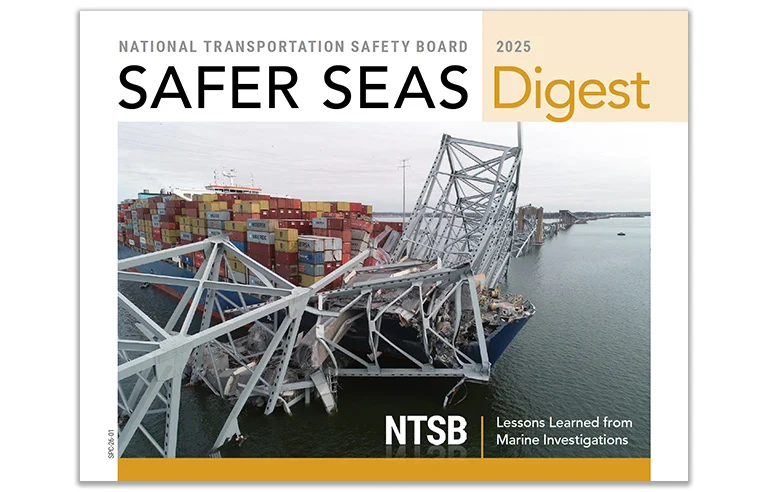
The findings, published in the agency’s flagship annual review, the Safer Seas Digest 2025, distill critical takeaways from 49 intensive investigations conducted by the NTSB Office of Maritime Safety. The report covers a broad spectrum of catastrophic events—including vessel capsizings, violent collisions, costly allisions with fixed objects, devastating shipboard fires, progressive floodings, accidental groundings, and catastrophic machinery failures.
Rather than viewing these marine casualties as unavoidable acts of nature or unpredictable mechanical failures, the NTSB’s exhaustive analyses point to human error, systemic procedural breakdowns, and deferred maintenance as the true culprits behind the headlines. To combat this trend, the agency has outlined 12 foundational lessons aimed at vessel operators, marine employers, and crew members designed to fundamentally alter safety cultures across the global maritime industry.
Main Facts: The Core Findings of the NTSB Report
At the heart of the Safer Seas Digest 2025 is a recurring narrative: while the physical settings, vessel types, and geographical locations of marine accidents vary wildly, the underlying human and operational factors remain remarkably consistent.
NTSB Chair Jennifer Homendy underscored this reality in her opening remarks for the publication.
“While each marine casualty is unique,” Homendy writes, “our investigators uncovered some notable commonalities that all mariners should consider.”
The digest highlights several core areas where operational lapses routinely lead to disaster. Among the most prominent findings are systemic failures in routine equipment upkeep, inadequate pre-voyage planning, deficiencies in active fire detection and suppression systems, a lack of structured emergency preparedness, and poor risk assessment when navigating through severe weather or treacherous currents.
By analyzing 49 specific case studies, the NTSB attempts to move the maritime industry away from reactive firefighting toward proactive risk mitigation. The report emphasizes that regulatory compliance alone is insufficient; true maritime safety requires an active, questioning attitude from every member of a vessel’s crew, from the bridge team to the engine room.
Chronology: How the Safer Seas Digest Unfolds and Shapes Policy
To understand the weight of the Safer Seas Digest 2025, it is helpful to look at the timeline of how maritime safety investigations transition from chaotic disaster scenes into actionable regulatory and industry-wide lessons.
Phase 1: The Initial Response and Casualty Discovery
When a marine disaster occurs—whether it is an engine room fire miles offshore or a catastrophic allision with a bridge pillar—the NTSB deploys Go-Teams consisting of naval architects, marine engineers, human performance experts, and operational specialists. These investigators arrive on the scene to secure perishable evidence, interview surviving crew members, review Voyage Data Recorder (VDR) logs, and inspect damaged hulls and machinery.
Phase 2: Root Cause Analysis (Throughout the Investigation Cycle)
Months of laboratory testing, metallurgical analysis, simulator reconstructions, and procedural audits follow. Investigators look beyond the immediate "what happened" to ask the vital "why." Was the equipment maintained according to manufacturer specifications? Was the watchstander fatigued? Did the company incentivize speed over safety?
Phase 3: The Synthesis of Annual Findings
At the conclusion of each calendar year, the NTSB’s Office of Maritime Safety compiles these individual accident reports into a single, cohesive volume. The Safer Seas Digest aggregates data to identify macro-trends across the maritime sector. The 2025 edition represents the culmination of investigations launched in response to accidents occurring over the preceding months and years.
Phase 4: Industry Distribution and Implementation (Current Stage)
Released publicly via the NTSB portal, the 2025 digest is distributed directly to maritime academies, commercial shipping companies, labor unions, and regulatory bodies like the U.S. Coast Guard. The ultimate goal of this timeline is behavioral and structural modification: driving vessel operators to integrate the digest’s lessons into their Safety Management Systems (SMS) before the next voyage begins.
Supporting Data: Breaking Down the 2025 Safety Pillars
The Safer Seas Digest 2025 organizes its guidance around preventative pillars. A closer examination of the NTSB’s key findings reveals the specific operational vulnerabilities that continue to plague the waterways.
1. Performing Maintenance Effectively
Equipment reliability is the bedrock of maritime safety. According to the NTSB, a alarming number of 2025 incidents traced back to deferred, skipped, or improperly executed maintenance routines.
- The Vulnerability: Relying on machinery until it breaks rather than adhering to preventative maintenance schedules.
- The Lesson: Without rigorous maintenance, critical systems—such as steering gear, main propulsion engines, bilge pumps, and navigation electronics—cannot be relied upon to perform as designed during high-stress situations.
2. Effective Voyage Planning and Management
Many groundings and allisions investigated by the agency could have been avoided with better preliminary groundwork.
- The Vulnerability: Rushing into maneuvering evolutions or transiting unfamiliar waters without a comprehensive, verified navigation plan.
- The Lesson: Before getting underway, bridge teams must consult appropriate, up-to-date resources. This includes leveraging the U.S. Coast Pilot, electronic and paper navigational charts, Local Notices to Mariners (LNMs), and tide/current tables to assess and plan for risks along the intended route, as well as at intended mooring or anchoring locations.
3. Detecting and Containing Vessel Fires
A fire at sea remains one of the most terrifying and destructive scenarios a mariner can face, largely due to the confined environment and the challenge of external rescue.
- The Vulnerability: Delayed fire detection, poorly maintained fire boundaries, or the lack of automatic detection systems in high-risk zones (such as auxiliary machinery spaces and galleys).
- The Lesson: Early detection buys precious minutes. The NTSB stresses the critical necessity of installing and regularly testing smoke and fire detectors in all areas susceptible to combustion, alongside ensuring that fixed suppression systems are fully charged and operable.
4. Planning and Training for Emergencies
When disaster strikes, panic and confusion can multiply the severity of an accident if roles are not clearly defined.
- The Vulnerability: Ad-hoc responses to crises due to a lack of realistic, routine emergency drills.
- The Lesson: Establishing formalized emergency response procedures provides a structured framework to account for the specific responsibilities of every crew member, passenger, and third-party contractor aboard a vessel. Regular, unscripted drills ensure these responses become second nature.
5. Operating in Strong Currents or Heavy-Weather Conditions
Mother Nature remains a formidable adversary, but human miscalculation often transforms bad weather into a catastrophe.
- The Vulnerability: Pushing ahead into severe meteorological conditions without a contingency plan or failing to respect the hydrodynamic forces of strong river and tidal currents.
- The Lesson: Developing a proactive heavy-weather and strong-current plan allows a crew to anticipate environmental challenges and make the smart decision to seek shelter, delay departure, or ballast down before conditions become unmanageable.
Official Responses: Industry Stakeholders and Regulatory Reaction
The release of the Safer Seas Digest 2025 has prompted widespread discussion across the maritime sector, drawing responses from regulatory authorities, maritime trade associations, and labor unions.
The U.S. Coast Guard Perspective
While an independent investigative agency, the NTSB works closely alongside the United States Coast Guard, which holds regulatory and enforcement authority over domestic and flagged commercial vessels. Coast Guard spokespersons have praised the 2025 digest for shining a spotlight on human factors.
Maritime safety officials note that while vessel engineering has advanced significantly over the past century, human error remains the variable responsible for upwards of 75% to 80% of all marine casualties. The Coast Guard continues to urge commercial operators to treat the NTSB’s 12 lessons not merely as reading material, but as a checklist for internal safety audits.
Commercial Operators and Safety Management Systems (SMS)
Response from commercial shipping fleets has been mixed in terms of speed, though progressive operators have already begun updating their safety protocols. Major towing, dredging, and cargo shipping firms utilize the digest as a case-study resource in crew resource management (CRM) training seminars.
However, maritime labor advocates point out that smaller, family-owned operations and independent commercial fishing fleets often lack the administrative resources to fully integrate complex safety management programs. Representatives from these sectors have called for increased government outreach and subsidized training initiatives to help smaller operators bridge the gap between regulatory expectation and operational reality.
Implications: What the 2025 Digest Means for the Future of Maritime Work
The implications of the Safer Seas Digest 2025 extend far beyond the pages of a government report; they directly impact the lives of tens of thousands of mariners who make their living on rivers, lakes, coastal waterways, and the open ocean.
Shifting from Compliance to Culture
For decades, maritime safety has often been viewed through a legalistic lens: checking boxes to satisfy Port State Control, class societies, and insurance underwriters. The NTSB’s repeated emphasis on "preventable" incidents sends a clear signal that compliance is not the same as safety. A vessel can possess all required certificates yet still suffer a catastrophic fire or grounding if the crew lacks situational awareness, effective communication, or the empowerment to halt unsafe operations.
The Economic Cost of Preventable Errors
Beyond the tragic loss of human life and environmental degradation, maritime accidents carry staggering economic consequences. Billions of dollars are lost annually due to damaged infrastructure, destroyed cargo, delayed supply chains, hull repairs, and skyrocketing liability insurance premiums. By demonstrating that most of these incidents stem from fundamental oversights—such as poor voyage planning or neglected maintenance—the NTSB report highlights massive potential cost-savings for vessel owners willing to invest heavily in proactive training and maintenance regimes.
Empowering the "Right to Stop Work"
One of the most profound underlying themes of modern maritime safety advocacy, heavily supported by NTSB findings over the years, is the empowerment of junior crew members. If a deckhand or oiler notices a skipped maintenance log, a faulty fire detector, or an overly risky navigation plan, a truly safe corporate culture must grant that worker the unquestioned right to halt operations without fear of professional retaliation.
As the Safer Seas Digest 2025 concludes, the responsibility for change rests squarely in the hands of the industry.
“By considering our lessons learned or finding your own lessons learned from the accidents we investigated,” the report pleads, “it is our hope that mariners can make changes to avoid similar accidents.”
In an industry where the margin for error is razor-thin and the environment is unforgiving, ignoring these lessons is a luxury the maritime community can ill afford.