INDUSTRIAL & WORKPLACE OPERATIONS — In an era defined by rapid technological advancement, supply chain pressures, and an uncompromising focus on employee well-being, organizations across the globe are constantly searching for ways to optimize their day-to-day operations. Whether managing a sprawling manufacturing facility, a high-volume distribution warehouse, a bustling healthcare clinic, a corporate office, or an educational institution, leaders face a universal challenge: waste.
Waste manifests in many forms—wasted time spent searching for tools, wasted space cluttered with unnecessary inventory, wasted physical energy resulting from poor ergonomic layout, and, most importantly, wasted human potential. To combat these inefficiencies, forward-thinking organizations are increasingly turning to a foundational operational framework: the 5S methodology.
A comprehensive new resource and free implementation guide has been released to help organizations successfully launch and sustain 5S programs. Designed for leaders seeking to reduce waste, elevate productivity, and foster a culture of safety, this guide provides a roadmap for integrating the five core principles of 5S into any operational environment.
Main Facts: Decoding the 5S Methodology
At its core, 5S is a systematic, visual management tool rooted in Lean manufacturing principles. Originating in Japan, the acronym stands for five Japanese terms that, when translated and adapted for Western workplaces, provide a step-by-step approach to organizing and managing the physical workspace.
The five pillars of 5S include:
- Sort (Seiri): Removing all unnecessary items from the workplace. If an item is not needed for current operations, it is either relocated or discarded. This eliminates clutter and frees up valuable floor and storage space.
- Set in Order (Seiton): Organizing the remaining items logically so they can be easily found, used, and returned. "A place for everything, and everything in its place." This step heavily relies on visual cues, shadow boards, and clearly labeled storage zones.
- Shine (Seiso): Cleaning the workspace thoroughly. This goes beyond basic janitorial duties; it involves inspecting machinery, workstations, and floors while cleaning to identify early signs of wear, leaks, or potential hazards.
- Standardize (Seiketsu): Establishing consistent procedures, rules, and schedules for the first three "S" steps. Standardization ensures that workplace organization is not a one-time event, but a repeatable, daily routine.
- Sustain (Shitsuke): Building the discipline necessary to maintain 5S standards over the long term. This involves leadership commitment, employee training, regular audits, and fostering a workplace culture where continuous improvement is second nature.
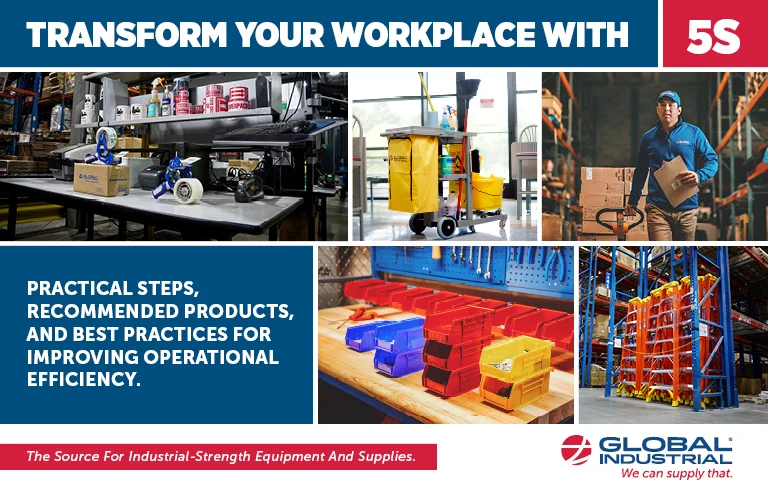
The newly introduced guide serves as a practical blueprint, offering organizations proven best practices, recommended technological solutions, and actionable steps to move from concept to execution.
Chronology: The Evolution of Workplace Organization
To understand the enduring relevance of 5S, it is helpful to look at how workplace organization has evolved over the past century.
Early Beginnings (Early to Mid-20th Century)
The roots of structured workplace organization can be traced back to the early days of industrial engineering. Pioneers like Frederick Winslow Taylor (Scientific Management) and Henry Ford recognized that physical layout directly impacted manufacturing efficiency. Ford’s assembly lines famously incorporated early concepts of flow and material placement, though they lacked the holistic cultural framework found in modern Lean systems.
The Post-War Japanese Industrial Renaissance (1950s–1980s)
The true foundation of 5S was forged in Japan following World War II, most notably within the Toyota Production System (TPS). Japanese industrial engineers and executives sought innovative ways to rebuild their economy and compete globally with limited resources. Through trial, observation, and refinement, manufacturing leaders synthesized various housekeeping and efficiency practices into what eventually became formalized as the 5S methodology. During this period, companies realized that cleanliness and organization were not merely cosmetic features, but vital prerequisites for high-quality production and error reduction.
Global Adoption and Integration with Lean (1990s–2000s)
As Western manufacturers faced intense global competition in the late 20th century, management philosophies like Six Sigma, Total Productive Maintenance (TPM), and Lean Manufacturing swept across North America and Europe. Organizations quickly discovered that advanced manufacturing techniques could not succeed in a chaotic, disorganized environment. Consequently, 5S was adopted as the foundational "gateway" practice—the essential first step before attempting complex continuous improvement initiatives.
Cross-Sector Expansion (2010s–Present)
While 5S was born on the factory floor, its principles proved universally applicable. Over the past decade, service industries, hospitals, administrative offices, and educational institutions have successfully adapted the methodology. Healthcare facilities use 5S to organize medication carts and surgical supply rooms, drastically reducing medical errors. Offices use digital and physical 5S to streamline document management and reduce administrative friction. Today, 5S is recognized not just as a manufacturing tool, but as a universal framework for organizational excellence.

Supporting Data: The Measurable Impact of 5S
Organizations often struggle to justify the time and resources required to launch cultural and operational initiatives. However, decades of operational data demonstrate that a well-executed 5S program yields substantial, quantifiable returns on investment.
- Reduction in Search Time: Studies on workplace ergonomics and time-motion analyses reveal that employees in unorganized environments spend an average of 1.5 to 2 hours per day searching for tools, documents, or materials. Implementing the "Set in Order" phase typically reduces search time by up to 80%, directly reclaiming lost productive hours.
- Safety Improvements: Slips, trips, falls, and struck-by accidents are among the leading causes of workplace injuries. By systematically removing clutter, cleaning up spills, and clearly marking walkways and hazard zones, facilities implementing 5S routinely report a 30% to 50% decrease in safety incidents within the first year.
- Floor Space Recovery: Through aggressive sorting and elimination of obsolete inventory and equipment, facilities often recover 20% to 40% of their floor space. This recovered space can be repurposed for revenue-generating operations or additional workstations without the need for costly facility expansions.
- Equipment Reliability: The "Shine" phase incorporates proactive inspection into daily cleaning routines. Research indicates that organizations practicing regular 5S audits experience a 15% to 25% reduction in unexpected machinery downtime, as operators catch minor mechanical issues before they escalate into catastrophic failures.
- Employee Turnover and Morale: Workplace frustration caused by disorganization is a subtle yet powerful driver of employee dissatisfaction. Companies that actively engage workers in 5S implementation report higher employee morale, greater ownership of workspaces, and measurable decreases in staff turnover.
Official Responses and Industry Insights
Operational experts, safety directors, and organizational psychologists have long championed the transformative power of visual management systems. Industry leaders emphasize that the success of a 5S program hinges on leadership commitment and cultural integration rather than rigid compliance.
"Too many organizations view 5S as nothing more than a glorified spring cleaning event," notes a leading operational excellence consultant. "In reality, it is a psychological and structural framework. When you give employees the tools and the autonomy to organize their workspace, you are signaling that their time, safety, and ideas matter. That is where true engagement begins."
Safety professionals also highlight the direct correlation between cleanliness and risk mitigation. According to occupational health advocates, a disorganized workspace creates cognitive overload. When workers are forced to navigate physical clutter, their attention is divided, increasing the likelihood of human error and workplace injuries.
Furthermore, administrative and healthcare leaders have praised the adaptability of the methodology. In clinical settings, where split-second decisions can impact patient outcomes, standardized workspace organization is literally a matter of life and death. By applying 5S to emergency crash carts, nursing stations, and electronic file structures, hospitals have eliminated critical delays in patient care.
Implications: Building a Sustainable Future of Continuous Improvement
The release of the new 5S implementation guide comes at a critical juncture for modern enterprises. As businesses navigate labor shortages, economic uncertainties, and rising operational costs, the margin for error has narrowed significantly. Organizations can no longer afford the hidden taxes imposed by inefficiency and disorganization.
1. Cultural Transformation Over Temporary Fixes
A primary takeaway for organizational leaders is that 5S cannot be successfully mandated from the top down without grassroots participation. Achieving the "Sustain" phase requires shifting the organizational culture so that continuous improvement becomes an everyday habit for every employee, from the C-suite to the frontline worker. When workers participate in defining how their workspace is organized, they take pride in maintaining it.
2. Integration with Advanced Technologies
As workplaces digitize, the principles of 5S are expanding beyond physical spaces into the digital realm. Organizations are applying "Digital 5S" to shared network drives, email systems, and software interfaces. Sorting obsolete digital files, setting standardized folder structures, shining digital workspaces by removing malware and outdated shortcuts, and sustaining these digital housekeeping habits are becoming just as critical as physical plant organization.
3. Strengthening Environmental, Social, and Governance (ESG) Profiles
Investors and stakeholders increasingly evaluate companies based on their ESG metrics. 5S naturally aligns with these goals:
- Environmental: By reducing waste, optimizing resource consumption, and preventing material obsolescence, 5S supports corporate sustainability initiatives.
- Social: By prioritizing worker safety, ergonomics, and mental well-being through reduced workplace stress, 5S directly contributes to a healthier, safer workforce.
- Governance: Standardized operational audits and transparent procedural documentation reinforce corporate governance and accountability.
4. The Path Forward
For leaders looking to transform their operations, the journey begins with education and a structured plan. The newly available free guide offers a comprehensive starting point, breaking down complex Lean principles into accessible, actionable steps. By focusing on practical best practices, visual management strategies, and methods for securing cross-functional buy-in, organizations can build a resilient foundation for long-term success.
In an increasingly competitive global marketplace, operational excellence is no longer an optional luxury—it is an existential necessity. By embracing the proven principles of the 5S methodology, organizations across all sectors can unlock hidden efficiencies, protect their most valuable asset—their people—and pave the way for sustainable, continuous growth.