Date: Wednesday, October 14, 2026
Location: San Francisco, CA
In an era where the traditional television commercial is increasingly challenged by ad-free streaming tiers and the "second-screen" phenomenon, advertisers are being forced to innovate or risk irrelevance. This week, a significant technological leap arrived in the world of connected TV (CTV) advertising. Magnite, the world’s largest independent sell-side advertising platform, and LG Ad Solutions announced a strategic partnership to bring LG smart TV home screen inventory to agencies through "agentic AI" media buying.
The Northern California Toyota Dealers Association, supported by the independent agency H/L, is the first to pilot this cutting-edge infrastructure. Featuring San Francisco 49ers quarterback Brock Purdy, the campaign signals a fundamental shift in how brands secure "prime real estate" on the living room’s most important screen.
The Mechanics of the "Hero" Placement
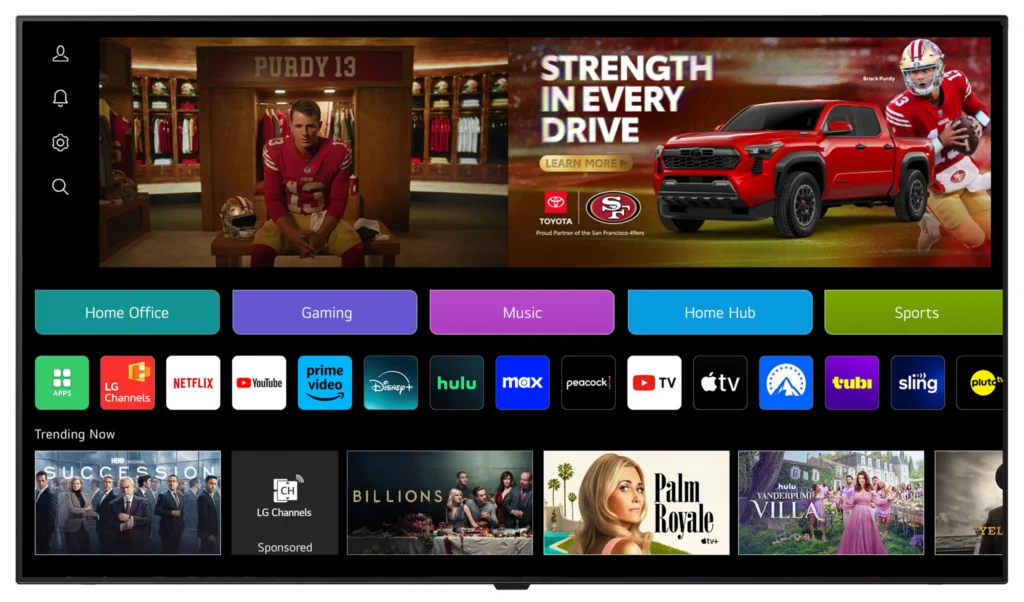
The campaign, which launched this week, centers on the high-impact "hero" placement found on the home screens of millions of LG smart TVs. The creative execution is designed to be immersive without being intrusive.
When a user navigates to their LG home screen, they are greeted by a split-screen format. On the left, a video component captures the viewer’s attention, while the right side features a high-quality static image of Brock Purdy standing alongside a rugged, red Toyota Tacoma. To create a seamless user experience, the video’s audio only triggers if the viewer lingers on the ad via their remote, preventing the "blaring commercial" frustration common in legacy TV experiences.
For Jeremy Cobb, VP at H/L, these home screen placements have become "table stakes" in a modern media buying strategy. "Many viewers are dual-tasking—scrolling through social media on their phones while the TV plays—or they are opting for ad-free streaming tiers," Cobb noted. "Home screen ads allow us to capture the viewer’s attention at the moment of entry, before they become fully immersed in a show or distracted by a second screen."
Chronology of a Tech-First Campaign
The integration of agentic AI into the media buying workflow represents an evolution that has been years in the making. The following timeline outlines the progression of this specific campaign and the broader technological shift:
- Q3 2026: H/L and Magnite begin exploring the integration of Model Context Protocol (MCP) to streamline the transaction workflow for LG home screen inventory.
- Early October 2026: The campaign brief is established, targeting NFL fans who are simultaneously "in-market" for a new vehicle purchase.
- October 12, 2026: The "agentic pipe" is activated. An AI buyer agent from H/L communicates directly with Magnite’s seller agent via MCP.
- October 14, 2026: The official announcement confirms that the campaign is live, with human oversight ensuring that the AI-negotiated plan meets all brand safety and creative standards.
Agentic Infrastructure: The New "Plumbing" of AdTech
For decades, programmatic advertising has relied on manual bidding, complex spreadsheets, and intermittent communication between demand-side platforms (DSPs) and sell-side platforms (SSPs). The introduction of "agentic" buying—where AI agents execute tasks autonomously—is fundamentally altering this landscape.
According to Mike Laband, Group SVP of revenue at Magnite, agentic infrastructure sits atop existing programmatic frameworks like SpringServe (video ad serving) and ClearLine (direct-to-buyer platform). The secret sauce here is the Model Context Protocol (MCP). MCP acts as a "universal adapter," allowing different AI models and systems to speak the same language.
"Agentic media buying is the next evolutionary step in the buying process," Cobb explained. "It makes the workflow cleaner and significantly faster. Instead of our teams spending days on manual setup, these agents collaborate to activate the campaign brief based on hyper-specific audience data."
Crucially, the "human in the loop" remains a non-negotiable part of the process. Before the campaign went live on millions of LG screens, the agent-led media plan was rigorously vetted and approved by both LG and H/L stakeholders.
Supporting Data and Strategic Rationale
Why pivot to home screen advertising? The data suggests a growing "attention deficit" in the streaming world. As streaming platforms fragment and consumers become more adept at bypassing traditional mid-roll ads, the "pre-roll" or "home screen" moment has become the most valuable commodity in the digital marketing ecosystem.
The Attention Economy Shift
- High-Intent Mindset: Home screen mastheads capture viewers at the "decision point"—those vital few seconds after turning on the TV but before settling into a specific content stream.
- Reduced Friction: By avoiding the interruption of a show, the ad feels less like an intrusion and more like a discovery, which often leads to higher brand recall.
- Metrics of Success: For this Toyota campaign, H/L is prioritizing "cost per reach" and "upper-funnel awareness." While the industry has been obsessed with lower-funnel conversion for years, the agency argues that branding is the prerequisite for all sales.
"The standard marketing funnel is dead," Cobb argued. "Upper-funnel branding efforts are essential to ensure that consumers actually come down the funnel in the way we want them to. We are normalizing the industry’s focus back toward attention and awareness as the building blocks for future sales."
Official Responses and Industry Implications
The partnership between Magnite and LG Ad Solutions is being viewed as a bellwether for the future of CTV.
Mike Laband (Magnite): "We’ve always aimed to make streaming ad formats as easy to buy as 15- or 30-second spots. By adding agentic infrastructure, we are not just making it easier; we are making it more efficient and effective. The AI handles the heavy lifting of the transaction, leaving the strategy and creative oversight to the humans."
Jeremy Cobb (H/L): "Agentic media buying is not going to fundamentally change what we do from a marketing perspective—we are still telling stories and building brands. But it is going to change how we do it. It makes the work better, faster, and stronger."
Implications: A New Era for Media Buying
The implications of this development are twofold: technical and cultural.
Technically, the use of MCP as a "plumbing layer" for ad-buying means that we are moving toward a future where "negotiation" is a background task performed by machines. If an agency wants to pivot a campaign based on real-time viewership data—for example, if the 49ers were playing a high-stakes playoff game—an agent could theoretically adjust the bid, creative asset, or targeting parameters in milliseconds.
Culturally, this marks the end of the "TV industry’s infatuation with pure performance." For years, the move to digital-first TV led to an over-reliance on click-through rates and immediate conversion metrics. This campaign represents a maturation of the medium. Advertisers are acknowledging that even in a digital world, the "big screen" is still a branding tool, and the most effective way to use it is to respect the user experience.
As we look toward 2027 and beyond, the success of the Toyota campaign will likely encourage other major advertisers to adopt agentic workflows. For the consumer, this may mean more personalized, relevant, and less interruptive advertising. For the agencies, it means a shift from manual execution to high-level strategic orchestration.
Ultimately, as the lines between "the show" and "the ad" continue to blur, the brands that can capture the user’s attention on the home screen—before the show even begins—will be the ones that win the game. And, much like the 49ers on the field, it appears that the combination of data-driven precision and human-led strategy is the winning playbook.