In the rapidly evolving landscape of Industry 4.0, the ability to accurately simulate, validate, and optimize manufacturing workflows has become a cornerstone of competitive manufacturing. Visual Components, a global leader in 3D manufacturing simulation and robot offline programming (OLP), has taken a massive leap forward in this domain with the announcement of FactoryLens.
By integrating NVIDIA Omniverse libraries directly into its simulation ecosystem, Visual Components is effectively blurring the line between conceptual design and photorealistic reality. This new viewport is not merely a cosmetic upgrade; it represents a fundamental shift in how engineers, stakeholders, and AI developers interact with their digital factory twins.
Main Facts: What is FactoryLens?
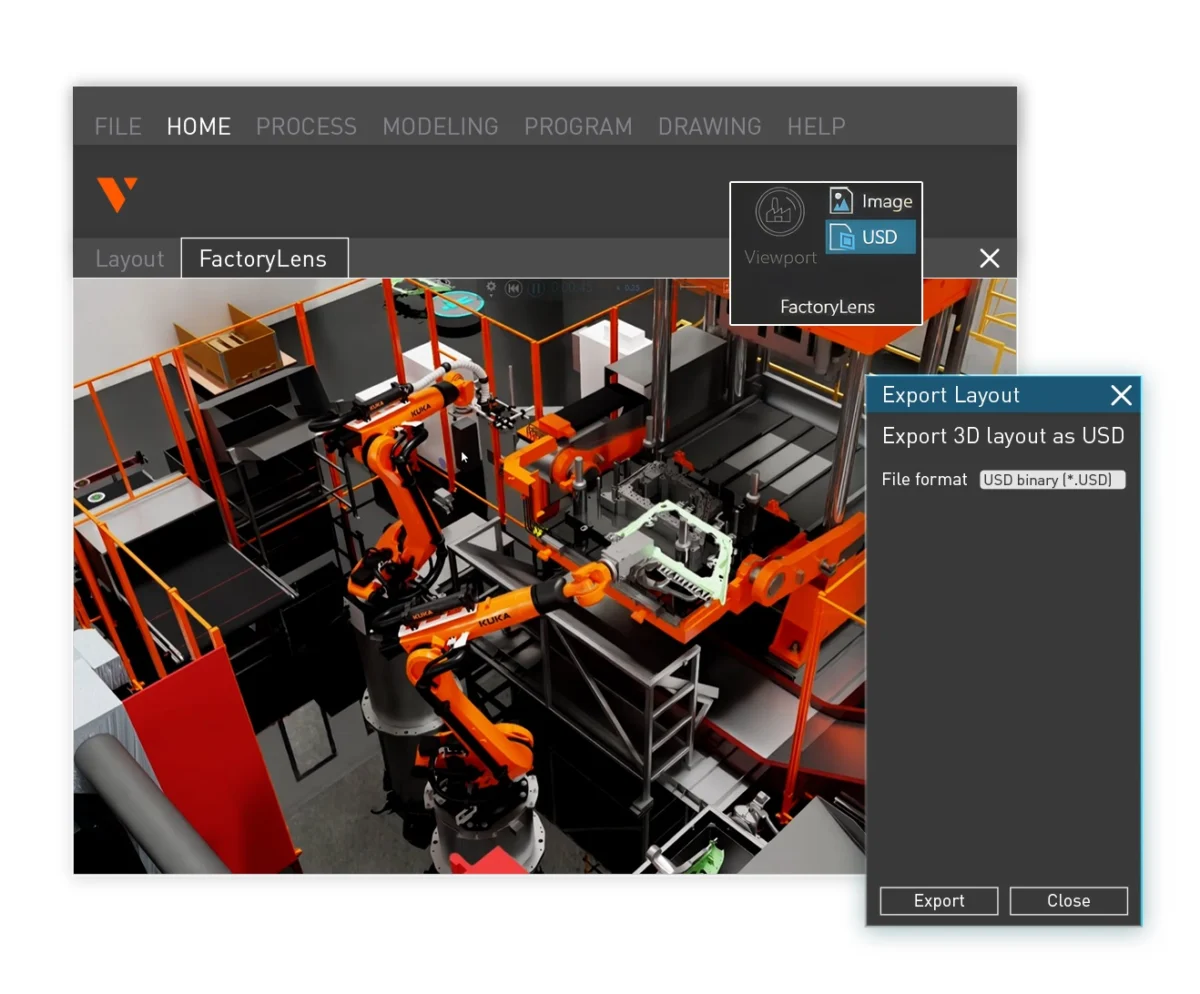
At its core, FactoryLens is a sophisticated, real-time viewport embedded directly within the existing Visual Components simulation platform. It serves as a high-fidelity visualization layer that allows users to elevate their standard, functional simulations into immersive, photorealistic digital twins.
Unlike traditional methods that often require exporting complex CAD data to separate rendering software—a process prone to data loss and time-consuming conversions—FactoryLens operates natively within the user’s familiar workspace. Powered by NVIDIA’s Omniverse, the tool utilizes Universal Scene Description (OpenUSD) to allow for seamless data exchange and high-quality visualization.
Key Features of FactoryLens:
- Native Real-Time Visualization: Users can switch from standard simulation to a high-fidelity, RTX-powered environment instantly.
- OpenUSD Integration: Leverages the industry-standard Universal Scene Description, enabling interoperability with other 3D software and platforms.
- Advanced Material and Lighting Controls: Provides users with the ability to adjust the look and feel of their factory floors, from metallic surfaces on machinery to lighting conditions in warehouse settings.
- High-Quality Output: Enables the recording of cinematic-grade video and high-resolution snapshots directly from the simulation, simplifying communication with non-technical stakeholders.
- Seamless Workflow: Eliminates the need to recreate or port models between disparate software packages, ensuring that the digital twin remains synchronized with the functional simulation.
Chronology: The Evolution of Digital Twin Technology
The journey toward FactoryLens did not happen overnight. It is the culmination of years of iterative development in simulation technology and a strategic partnership between Visual Components and NVIDIA.

Phase 1: The Foundations of Simulation (Pre-2020)
For over two decades, Visual Components has built its reputation on robust 3D simulation software. The primary focus during this era was functionality: calculating cycle times, optimizing robot paths, and validating logic for factory floor layouts. While these simulations were effective, they were often visually utilitarian, prioritized for speed and logic verification rather than aesthetic realism.
Phase 2: The Emergence of the Digital Twin (2020–2023)
As the term "Digital Twin" gained traction, the manufacturing sector demanded higher fidelity. Stakeholders wanted to see exactly how a factory would look before construction, leading to a rise in separate rendering workflows. During this time, Visual Components expanded its library to over 4,000 components, including sophisticated autonomous mobile robots (AMRs) and complex conveyor systems.
Phase 3: The Collaboration with NVIDIA (2024–Present)
The partnership with NVIDIA marked a pivot point. Recognizing that artificial intelligence and physical AI would require more than just logic-based simulations, the two companies began working to integrate NVIDIA’s RTX and PhysX technologies. FactoryLens is the latest, most significant milestone in this collaboration, bringing the power of the Omniverse directly to the factory floor planner.
Supporting Data: Why Fidelity Matters
The shift toward high-fidelity simulation is not merely for aesthetics; it is driven by the necessity of precision in an era of Physical AI.
The Component Library Advantage
Visual Components provides a vast, pre-validated library of over 4,000 industrial assets. By applying the "FactoryLens layer" over these assets, users can see how lighting, reflections, and environmental variables impact machine sensors. For instance, in automated vision-based inspection systems, the lighting model in a digital twin must accurately replicate the real-world factory floor to ensure the AI vision algorithms are trained correctly.

The Power of RTX and PhysX
- NVIDIA RTX: Provides hardware-accelerated ray tracing, allowing for real-time lighting and shadow effects that make digital twins indistinguishable from reality.
- NVIDIA PhysX: Ensures that the physical interactions—collisions, gravity, and material dynamics—remain mathematically accurate, which is essential for virtual commissioning and stress testing.
Efficiency Gains
By eliminating the "export-convert-import" cycle, companies can reduce the time spent on visualization tasks by an estimated 30–40%. This efficiency allows teams to run more "what-if" scenarios, ultimately leading to better decision-making and reduced risk during the physical commissioning phase.
Official Responses: Insights from Industry Leadership
Mustafa Kamal, the Business Development Director at Visual Components, has been a driving force behind the integration of NVIDIA’s technology.
"Integrating NVIDIA technologies into Visual Components helps bring greater physical accuracy and realism to simulated environments, making simulation an even more valuable tool as physical AI continues to evolve," Kamal stated during the product launch.
He further elaborated on the philosophy behind the product: "By combining NVIDIA’s open libraries and frameworks with Visual Components’ fast, easy-to-use simulation software, we’re making it easier for more people to build realistic digital twins and explore how physical AI can perform in the real world."
The sentiment from the industry is clear: the goal is to lower the barrier to entry for high-fidelity simulation. By making these tools accessible within a platform that engineers already use, Visual Components is democratizing the ability to create and test sophisticated digital twins.

Implications: The Future of Manufacturing and Physical AI
The introduction of FactoryLens is a bellwether for the future of industrial design. Its implications extend far beyond simple visualization.
1. The Rise of Synthetic Data
One of the most critical challenges in training Physical AI (robots and autonomous systems) is the lack of diverse, high-quality data. With FactoryLens, companies can generate synthetic datasets in a simulated, photorealistic environment. This data can be used to train vision systems to recognize obstacles, identify parts, or detect defects before a single physical robot is ever purchased.
2. Virtual Commissioning and De-risking
Virtual commissioning—testing the software and controls of a manufacturing line before physical hardware arrives—is already standard practice. However, FactoryLens takes this a step further. By providing a high-fidelity visual representation, engineers can identify issues related to human-robot interaction, ergonomic safety, and sightline obstructions that might not be visible in a basic, blocky simulation.
3. Collaborative Stakeholder Engagement
Factory design often involves multiple stakeholders: floor managers, financial officers, safety engineers, and executive leadership. Traditionally, translating technical simulation data for these disparate groups is difficult. FactoryLens provides a photorealistic, "walkthrough-ready" view that can be used for presentations and executive reviews, ensuring that everyone is on the same page regarding the vision and operational efficiency of the proposed factory.
4. A Foundation for the Future
As the platform evolves, FactoryLens is expected to become the bedrock for even more advanced use cases. We are likely to see increased support for real-time sensor data streaming, cloud-based collaboration, and deeper integration with generative AI, allowing users to prompt changes to their layout (e.g., "Add three more robots to this cell") and see the result in high-fidelity immediately.

Conclusion
Visual Components has successfully bridged the gap between functional engineering simulation and immersive digital visualization. With FactoryLens, they have not only provided a tool for better aesthetics but have also laid a critical foundation for the next generation of industrial innovation.
As manufacturers face increasing pressure to shorten product lifecycles and increase automation, the ability to "see" the future of their production lines with near-perfect accuracy will be a critical competitive advantage. Through its strategic partnership with NVIDIA, Visual Components is ensuring that its users remain at the forefront of this digital transformation, prepared to navigate the complexities of a world where the physical and the virtual are increasingly inseparable.
For more information on how to implement this technology in your facility, visit the Visual Components website.