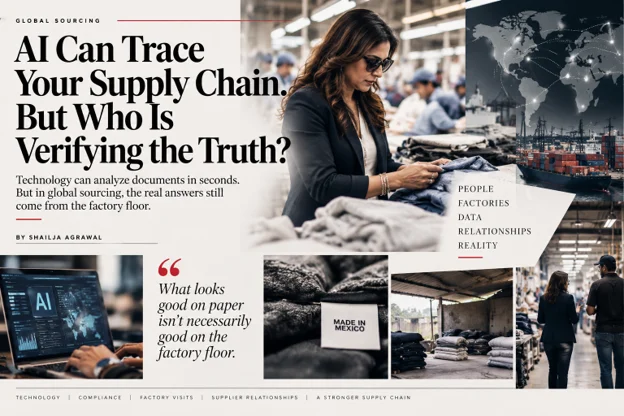
In the high-stakes world of global apparel sourcing, a digital revolution is underway. Artificial Intelligence (AI) has emerged as the panacea for supply chain opacity, promising to turn mountains of fragmented data into actionable intelligence. By automating the reconciliation of audit reports, flagging expired compliance certifications, and identifying discrepancies in shipment volumes, AI tools are saving sourcing teams thousands of hours. However, as supply chains grow increasingly complex, industry veterans are raising a critical alarm: relying solely on digital dashboards can create a dangerous "mirage of transparency."
While AI excels at processing what is reported, it remains fundamentally blind to what is hidden. In an era where supply chain resilience is synonymous with brand survival, the industry must grapple with a sobering reality—compliance is not merely a data-entry exercise; it is a physical, human, and geographical challenge that software alone cannot solve.
The Disconnect: When Paperwork Masks Reality
The disconnect between digital documentation and factory-floor reality is a persistent thorn in the side of global retailers. Shailja Agrawal, Vice President of Production and Sourcing for a major international apparel company, recalls a pivotal experience in Mexico that underscored this fragility.
“The primary factory presented a polished front,” Agrawal notes. “Their compliance documentation was meticulous. On paper, every box was checked, and the arrangement appeared perfectly aligned with our corporate standards.”
However, the physical reality told a different story. Upon conducting an on-site visit, Agrawal discovered that the primary facility was merely the tip of the iceberg. The production process had been fractured across a web of unauthorized subcontractors and makeshift storage sites. Garments were being transported between washing facilities and printing houses that had never been disclosed, stored in conditions ranging from damp, inadequate shelters to cramped, unventilated rooms.
The result was a catastrophic failure of quality control and logistics. Merchandise went missing, communication channels collapsed, and the brand was left exposed to significant risks. This experience serves as a cautionary tale: a compliance certificate is a snapshot of a moment in time, not a guarantee of operational integrity.
The AI Paradox: Symptoms Versus Root Causes
To understand why sophisticated software can fail, one must distinguish between symptoms and causes. In theory, an AI-powered supply chain management system should have caught the issues in Mexico. By reconciling cut-to-shipment ratios and comparing production volumes against quality control reports, the software would likely have flagged the missing units.
Yet, as Agrawal points out, AI would only have alerted the team to the symptoms.
The Limits of Machine Logic
- Input Bias: AI operates on the principle of "garbage in, garbage out." If a supplier deliberately hides a facility, that location never enters the digital ecosystem. The system cannot analyze data that does not exist.
- The "Agreeing Document" Trap: When two disparate documents (such as a purchase order and an invoice) align, an algorithm interprets this as "correct." It lacks the contextual intuition to recognize that both documents might be fabricated or based on incomplete information.
- Lack of Physical Verification: AI cannot walk a factory floor. It cannot smell the chemical fumes, hear the lack of safety equipment, or observe the tension between management and workers. It cannot verify that a "certified" factory is the one actually performing the work.
This gap is not just a nuisance; it is a legal and ethical liability. Under tightening regulations, such as the Uyghur Forced Labor Prevention Act (UFLPA), the burden of proof rests on the importer. If an undisclosed subcontractor is involved in a supply chain, the brand is effectively blind to the labor conditions within that facility. A "clean" digital dashboard is no defense in a court of law or the court of public opinion.
Chronology of a Compliance Failure
The failure of compliance often follows a predictable, albeit slow, trajectory:
- Phase 1: Procurement and Onboarding: The vendor presents a primary, high-standard facility for audit. Contracts are signed based on the promise of that facility’s capabilities.
- Phase 2: The "Shadow" Expansion: As production demands scale, the primary factory hits capacity. Without informing the buyer, the vendor outsources overflow production to smaller, unvetted workshops to maintain delivery timelines.
- Phase 3: Administrative Siloing: To maintain the illusion of compliance, the primary facility maintains the paperwork, while the physical work happens elsewhere.
- Phase 4: The Trigger Event: A quality issue, a late shipment, or a third-party investigation brings the discrepancy to light.
- Phase 5: The Fallout: The buyer discovers the breach. The consequences include reputational damage, financial loss due to rejected goods, and potential legal penalties for non-compliance with trade regulations.
Supporting Data and Industry Trends
The shift toward "Traceability as a Management System" is gaining momentum. During the American Apparel & Footwear Association (AAFA) webinar on October 14, 2026, industry experts emphasized that traceability is not a software plugin—it is an organizational culture.
Current industry data suggests that while investment in Supply Chain Visibility (SCV) platforms has increased by 40% over the last three years, the incidence of "Tier 2 and Tier 3" compliance breaches remains high. The reason is a failure in engagement. Technology is the tool, but the foundation must be built on:
- Supplier Risk Mapping: Identifying not just the primary partners, but the entire network of subcontractors.
- Due Diligence Cycles: Moving beyond annual audits to continuous, risk-based monitoring.
- Human-Centric Verification: Integrating worker interviews and community engagement into the standard audit protocol.
Official Responses and Strategic Implications
Major retail organizations are beginning to respond to these risks by shifting their sourcing strategies. There is a marked move toward "Nearshoring," which reduces the physical distance between the buyer and the factory, making the "boots-on-the-ground" approach more feasible.
Furthermore, trade compliance departments are now increasingly collaborating with procurement teams earlier in the vendor selection process. The consensus is clear: compliance is no longer a "back-office" function. It is a core strategic pillar that informs which suppliers a company chooses to grow with and which it must prune from its network.
The Call to Action: Why Executives Must Leave Their Laptops
The most potent tool in a sourcing executive’s arsenal is not an algorithm—it is an airline ticket.
The digital age has fostered a culture of "remote oversight" that is fundamentally at odds with the tactile nature of manufacturing. If there is one mandate for the modern sourcing executive, it is to bridge the gap between the screen and the shop floor.
Recommendations for Leadership:
- Unannounced Site Visits: Scheduled audits are performances; unannounced visits are windows into reality. They provide the most accurate look at daily operations.
- Worker Engagement: Build rapport with those on the production line. Employees are often the first to know when a factory is struggling with safety or when production is being diverted to unauthorized sites.
- Cultivate Relationships: A deep, long-term relationship with a supplier owner creates the trust necessary to solve problems before they become systemic failures. When a supplier feels like a partner rather than a data point, they are far more likely to disclose capacity issues before they lead to a compliance breach.
- Local Market Fluency: Understand the local holidays, labor laws, and economic pressures of the regions where you manufacture. A supplier’s "inability to deliver" is often a symptom of local challenges that you can help solve if you understand the context.
Conclusion: The Complementary Future
AI is an extraordinary gift to global trade. It provides a level of visibility that was unthinkable even a decade ago, allowing us to manage complex, global networks with unprecedented speed. However, it must be viewed as a compass, not the destination.
Visibility is not the same as understanding. Data can tell you what is happening, but only human intuition and physical presence can tell you why it is happening and whether it is sustainable. As the global supply chain continues to evolve, the most successful companies will be those that marry the cold, hard efficiency of AI with the warmth, skepticism, and insight of the human eye.
In the end, manufacturing is a human endeavor. Until we can digitize trust, there is no substitute for walking the floor, speaking the language, and witnessing the reality behind the reports.