




SYDNEY — Australia’s flagship green energy transition initiative, the monumental Snowy 2.0 pumped-storage hydro project, has once again been rocked by severe financial blowouts and schedule adjustments. According to a comprehensive review released by state-owned project owner Snowy Hydro, the total cost of the ambitious undertaking could now reach a staggering A$25 billion.
When initially unveiled to the public in 2017, the country’s largest renewable energy infrastructure project carried an estimated price tag of just A$2 billion. The latest revision underscores the extraordinary financial and engineering hurdles associated with mega-scale energy storage, casting a long shadow over Australia’s broader transition toward a decarbonized electrical grid.
In addition to the soaring budget, Snowy Hydro confirmed that the target commissioning timeline has slipped further. While previous estimates pointed toward a completion window by December 2028, the latest reassessment pushes the expected operational rollout to late 2029.
Despite the ballooning costs and prolonged delays, project leaders maintain that the engineering marvel remains vital to stabilizing Australia’s future power supply, acting as a massive subterranean battery designed to support an electricity grid increasingly reliant on intermittent wind and solar generation.
Main Facts: The Scope and Scale of Snowy 2.0
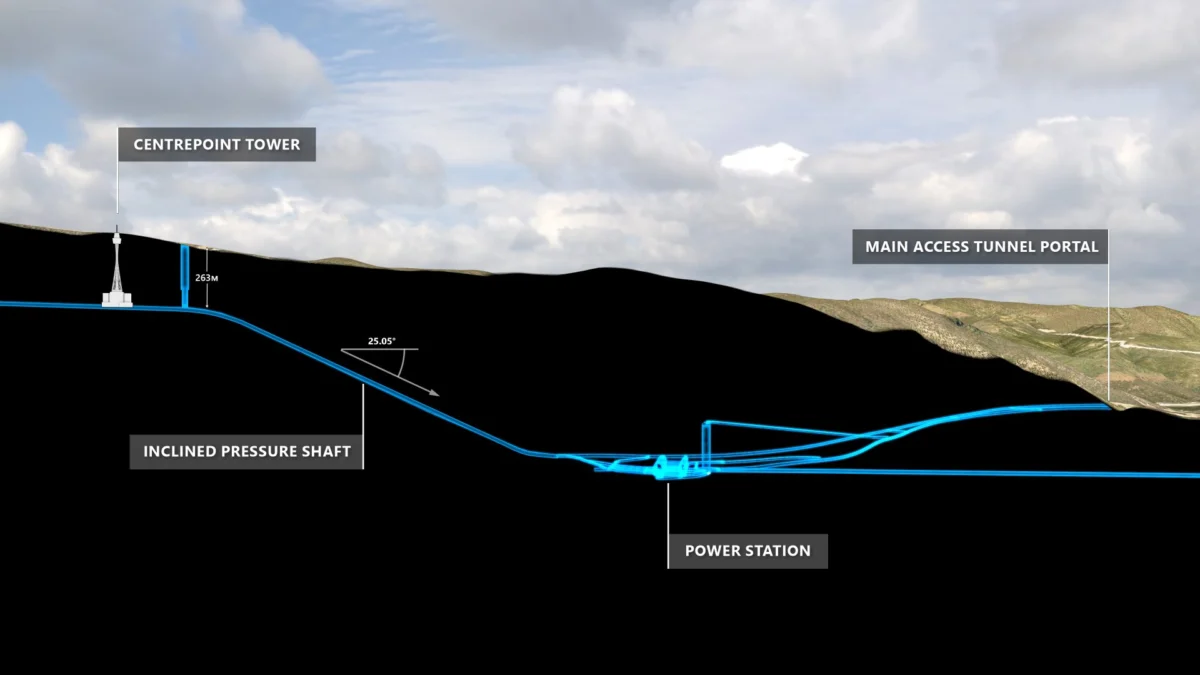
At its core, Snowy 2.0 is an engineering endeavor of epic proportions. Located in the Snowy Mountains region of New South Wales, the project links two existing reservoirs—Talbingo and Tantangara—via a network of deep underground tunnels and a massive subterranean power station.
Key Project Metrics:
- Generation Capacity: 2.2 Gigawatts (GW) of dispatchable renewable energy.
- Energy Storage Volume: 350,000 megawatt-hours (MWh) of deep storage capacity, enough to power millions of homes for days during periods of peak demand or low renewable generation.
- Current Cost Projections: A baseline target cost of A$22.2 billion set by the principal contractor, with total potential costs scaling up to A$25 billion.
- Original 2017 Estimate: A$2 billion.
- Revised Delivery Timeline: Late 2029 (shifted from late 2028).
The project is an expansion of the historic Snowy Mountains Hydro-Electric Scheme, constructed between 1949 and 1974. Snowy 2.0 will act as a giant water battery. During periods of low electricity demand and cheap renewable power generation, surplus energy will pump water uphill from Talbingo to Tantangara. When electricity demand spikes, that water will be released back down through massive turbines to generate rapid-response hydroelectricity.
Chronology: From A$2 Billion Vision to a A$25 Billion Reality
To understand how a green energy infrastructure project multiplies in cost by more than tenfold, it is necessary to examine the tumultuous timeline of Snowy 2.0 from its inception to the present day.
- March 2017: Then-Prime Minister Malcolm Turnbull officially announces the Snowy 2.0 concept, projecting an estimated cost of A$2 billion and a swift construction schedule.
- Late 2018 – 2019: Feasibility studies are completed, and the Final Investment Decision (FID) is reached. Critics and independent engineers begin warning that the initial A$2 billion estimate fails to account for the deep underground geological complexities of the Snowy Mountains.
- 2019–2021: The Future Generation Joint Venture (FGJV)—comprising Salini Impregilo (now Webuild), Clough, and Lane Construction—is awarded the primary engineering, procurement, and construction (EPC) contract. Work begins, but the project immediately encounters severe headwinds, including the COVID-19 pandemic, global supply chain disruptions, and unexpected geological anomalies.
- 2022–Early 2023: The project faces intense friction under its original fixed-price contract structure. Contractor disputes, multi-billion-dollar claims, and safety incidents culminate in work slowdowns. The project is effectively brought to a near-halt amid mounting financial pressures between Snowy Hydro and FGJV.
- Mid-2023 (The Project Reset): Snowy Hydro executes a major project reset, transitioning away from the unmanageable fixed-price contract to a cost-reimbursable model. This move is designed to keep the project alive and prevent the contractor from abandoning the site under the weight of mounting financial liabilities.
- Late 2023 – 2024: Tunneling and excavation push forward, though technical difficulties persist. Tunnelling boring machines (TBMs) encounter exceptionally hard rock, fault zones, and subterranean water inflows.
- Current Status (Latest Review): FGJV completes its latest cost reassessment, setting a target cost of A$22.2 billion, with Snowy Hydro acknowledging that ultimate outlays could reach A$25 billion and pushing completion back to late 2029.
Supporting Data & Engineering Progress
While the financial headlines are grim, project stakeholders emphasize that physical construction has advanced significantly, particularly deep beneath the earth’s surface.
According to progress reports released alongside the cost review:
- Machine Tunneling: Reached 65% completion across the project’s network of access and power waterways.
- Cavern Excavation: Reached 90% completion for the massive underground machine halls that will house the hydroelectric generator units.
- Underground Power Station: Civil and structural construction works are actively underway to prepare for the installation of heavy electromechanical equipment.
Why Did the Costs Spiral?
The cost reassessment conducted by FGJV and reviewed by Snowy Hydro points to a confluence of systemic failures, planning oversights, and macroeconomic shocks:
- Design Immaturity at Final Investment Decision: Detailed technical analysis has revealed that the project lacked sufficient geological and engineering maturity when the final investment decision was made in 2019. The true nature of the subterranean strata was heavily underestimated.
- Construction Complexities and Productivity Shortfalls: The physical reality of excavating through the complex terrain of the Snowy Mountains proved far more difficult than anticipated. FGJV routinely missed internal productivity targets, dragging out timelines and driving up labor costs.
- Cost Planning Underperformance: Initial budgeting models failed to accurately capture the true delivery scope required for a project of this unprecedented scale, leading to foundational underestimations.
- Global Inflation and Supply Chain Pressures: Post-pandemic inflationary spikes caused global costs for specialized heavy equipment, industrial services, and skilled engineering labor to outpace initial allowances made even during the 2023 contract reset.
Official Responses: Defending the Reset and Managing Public Scrutiny
The revelation of a potential A$25 billion price tag has drawn fierce political debate and public skepticism. However, executive leadership at Snowy Hydro has defended the decisions made to keep the project alive, arguing that the alternatives would have been far worse for Australian taxpayers and energy consumers.
Snowy Hydro CEO Dennis Barnes did not shy away from the gravity of the situation, calling the cost increase “disappointing.” Nevertheless, Barnes argued that the decisive 2023 project reset fundamentally shielded the enterprise from catastrophic failure.
"I have no doubt that moving from a fixed price contract, which was never suitable for such scale, uniqueness and complexity, has protected the project from an even greater cost increase," Barnes stated during the release of the review.
"It’s also likely that under a fixed price contract, the project would again be stopped under the weight of billions of dollars of claims from the contractor, as it was prior to the reset."
Under the previous fixed-price framework, the contractor bore the financial risks of inflation, delays, and design changes. However, when those risks overwhelmed the contractor’s financial capacity, work ground to a halt. Transitioning to a cost-reimbursable model transferred a greater degree of financial exposure back to Snowy Hydro—and by extension, its sole shareholder, the Australian Federal Government—but ensured that work could continue without legal paralysis.
Industry regulators and energy market analysts have echoed cautious sentiments. While the financial blow is severe, energy experts point out that the cost of abandoning Snowy 2.0 entirely would result in a massive capacity shortfall as Australia’s aging fleet of coal-fired power stations continues to retire over the coming decade.
Implications for Australia’s Energy Transition
The budgetary explosion of Snowy 2.0 carries profound implications for the Australian National Electricity Market (NEM) and the federal government’s target of achieving net-zero emissions.
1. The Looming Closure of Coal-Fired Power
Australia is experiencing a rapid transition away from fossil fuels. Major coal-fired power stations—such as Eraring in New South Wales and Liddell (which closed in 2023)—are scheduled to retire or have already exited the market. Snowy 2.0 was designed specifically to firm up the grid during these closures, providing instantaneous dispatchable power when wind and solar output drops. Any delay in Snowy 2.0’s operational date means the grid must rely more heavily on gas-peaking plants or face heightened risks of supply shortfalls during extreme weather events.
2. Public Trust and Governance of Mega-Projects
The transformation of a A$2 billion project into a A$25 billion financial commitment inevitably raises serious questions regarding government oversight, infrastructure planning, and risk management. Critics and opposition lawmakers have pointed to Snowy 2.0 as a prime example of "megaproject syndrome"—where initial cost estimates are artificially depressed to secure political approval, only to escalate wildly once construction passes the point of no return.
3. Impact on Consumer Electricity Bills
As a government-owned enterprise, the capital costs incurred by Snowy Hydro ultimately trace back to the public balance sheet. While the direct costs will not immediately manifest as line items on household power bills, the financial burden placed on the federal budget limits fiscal space for other public infrastructure investments. Furthermore, the economic viability of the project will depend heavily on future wholesale electricity price volatility; Snowy Hydro will need to capture high peak-period prices to recoup its massive capital expenditures over its operating lifespan.
4. A Cautionary Tale for Global Storage Infrastructure
On an international scale, Snowy 2.0 serves as a case study for the hidden complexities of pumped-storage hydroelectricity—historically the backbone of grid-scale energy storage. As nations worldwide rush to build massive long-duration energy storage (LDES) systems to balance variable renewable grids, the Snowy 2.0 experience demonstrates that subterranean engineering and geological uncertainties can quickly shatter financial projections.
Conclusion
As tunneling operations cross the two-thirds threshold and underground cavern excavation nears completion, Snowy 2.0 remains a project of contradictions. It is simultaneously an engineering triumph—pushing the boundaries of what is possible in subterranean energy infrastructure—and a cautionary fiscal tale of extreme budget blowouts.
With completion now pushed out to late 2029 and a price ceiling of A$25 billion, all eyes will remain locked on Snowy Hydro and the Future Generation Joint Venture. For Australia’s energy transition, failure is not an option, but the price of success has proven to be exponentially higher than anyone in 2017 ever dared to imagine.