






INDUSTRIAL SAFETY TECHNOLOGY — In high-risk operational environments such as construction sites, heavy manufacturing plants, oil and gas facilities, and public utility yards, the perimeter gate has long represented a critical blind spot in safety management. For decades, organizations have invested heavily in rigorous contractor prequalification programs, comprehensive insurance verifications, and mandatory control-of-work training modules. Yet, the moment a contractor’s vehicle pulls up to the facility entrance, that extensive compliance paper trail frequently evaporates, replaced by analog clipboards, paper sign-in sheets, or generic badge-scanning systems that capture little more than a name and a timestamp.
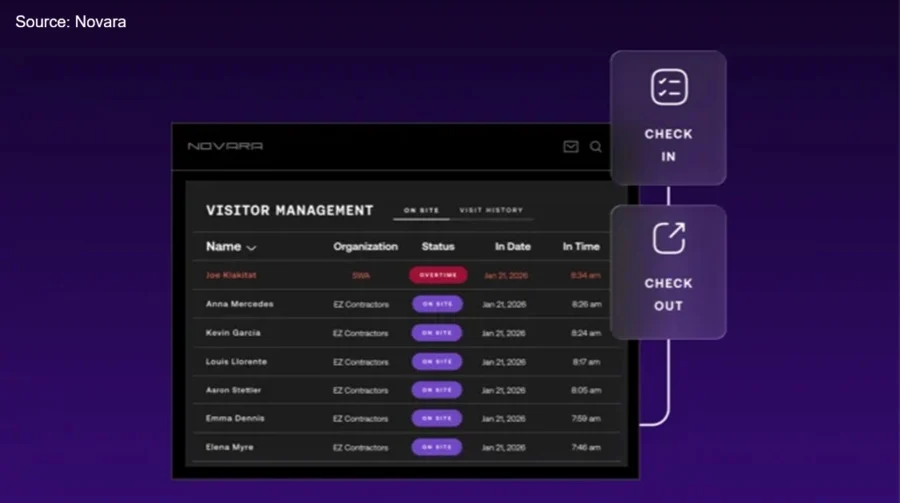
Recognizing this persistent vulnerability, Novara has officially announced the launch of Visitor Management, a powerful new module built directly into its flagship Flex Contractor Risk Management platform. Designed to eliminate the disconnect between digital compliance records and physical site access, the new module verifies a contractor’s training credentials, corporate approval status, and compliance requirements the exact moment they arrive at a work site. By replacing outdated manual logging methods with real-time digital verification, Novara aims to provide high-hazard industries with an uncompromised, live accounting of every individual currently operating on their premises.
Main Facts: Transforming Site Access into an Active Compliance Checkpoint
The newly introduced Visitor Management module is engineered to address a fundamental flaw in industrial safety protocols: the separation of pre-work qualification from day-of-site execution. Key structural elements and operational capabilities of the release include:
- Seamless Platform Integration: Visitor Management is available immediately to existing users of Flex Contractor Risk Management at zero additional cost. It requires no secondary vendor contracts, no separate software logins, and no complex data reconciliation between disparate systems.
- Point-of-Access Enforcement: Gate staff, site supervisors, and foremen can check in contractors and visitors instantly using either a standard web dashboard or a mobile device, utilizing name searches or corporate affiliations.
- Real-Time Data Verification: Each check-in sequence automatically surfaces vital safety data, including the individual’s name, employing contractor organization, corporate approval status, and any outstanding training or compliance requirements before entry can be formally confirmed.
- Live Headcount Tracking: Safety teams gain immediate visibility into total onsite headcounts, current occupants, and average onsite durations, all of which can be filtered dynamically by physical location, contractor company, or custom tags.
- Automated Oversight and Error Mitigation: To prevent inaccurate safety logs caused by neglected departures, the system automatically flags any individual who remains checked in for more than 12 hours without a corresponding check-out, prompting them via push notification to clear their status.
- Flexible Check-Out Mechanics: The check-out process mirrors the ease of entry, supporting individual or bulk departures via web or mobile interfaces, complete with confirmation steps and instantaneous headcount adjustments.
- Robust Reporting and Auditing: Comprehensive historical data and activity logs can be exported seamlessly to CSV formats. These reports are fully filterable by date, compliance status, contractor organization, location, and visitor type, streamlining safety audits, incident investigations, and post-drill debriefs.
- Centralized Multi-Site Roll-Up: While each individual site maintains its own dedicated check-in point, activity across all operational locations rolls up into a single, centralized administrative dashboard for enterprise-wide visibility.
Chronology: The Evolution of Industrial Contractor Risk Management
To fully understand the significance of Novara’s latest release, it is helpful to examine the historical trajectory of contractor management within heavy industries over the past several decades.
Era of Paper and Manual Oversight (Pre-2000s)
Historically, managing third-party contractors on industrial sites was an entirely manual, administrative burden. Safety managers relied on physical filing cabinets to store paper certificates of insurance (COIs), training completion cards, and signed policy acknowledgments. At the facility gate, security guards relied on physical sign-in sheets. If an auditor or safety director wanted to know who was on site, they had to physically tally handwritten names. This method offered zero real-time verification; a worker whose safety certifications had expired weeks prior could easily sign their name on a clipboard and gain unrestricted access to hazardous areas.
The Rise of Digital Prequalification (2000s–2010s)
As regulatory frameworks tightened and corporate liability concerns mounted, the industry saw the emergence of dedicated software platforms focused on contractor prequalification. Platforms like Flex Contractor Risk Management digitized the vetting process, allowing safety departments to verify that a contracting firm met financial, safety, and insurance standards long before dispatching workers to a job site. E-learning modules and digital training records became the norm.
However, this created a new operational silo. While back-office compliance managers had unprecedented visibility into who was qualified to work, field-level supervisors and gate guards at the physical worksite remained disconnected from those databases. The office knew if a contractor was compliant, but the gate guard did not.
The Convergence of Access Control and Compliance (Present)
With the launch of Novara’s Visitor Management module, the industry is entering a new phase where digital prequalification and physical access control finally converge into a single, unified workflow. By leveraging the cloud and mobile technology, safety data is no longer trapped in desktop databases or back-office software; it is pushed directly to the frontline gate, closing the final loop in industrial site safety.
Supporting Data & Industry Challenges: Closing the Gate-Compliance Gap
The vulnerabilities that Visitor Management seeks to mitigate are not minor administrative oversights; they represent severe legal, financial, and operational risks for industrial operators. In sectors such as oil and gas refineries, chemical manufacturing plants, and heavy construction sites, unauthorized or improperly trained personnel represent a catastrophic liability.
The Perils of the "Clipboard Gap"
In high-risk environments, specialized competencies are legally and operationally mandatory. For instance, tasks involving potential ignition sources require specific "hot work" safety certifications; confined space entry demands specialized rescue training; and electrical work requires adherence to strict arc-flash safety protocols.
Under traditional legacy systems, a security guard or gate clerk checking in a visitor typically evaluates two primary criteria: Is there a name, and does the person have a badge? The guard has no technological mechanism to verify whether the individual holding that badge has completed hot work training, whether their medical clearance is up to date, or whether their employer’s liability insurance lapsed yesterday.
Furthermore, during an emergency evacuation—such as a toxic gas release, structural fire, or industrial explosion—safety coordinators must rapidly account for every soul on the property. Traditional paper sign-in sheets are notoriously unreliable during crises. Illegible handwriting, forgotten check-outs, and missing exit timestamps often result in frantic, inaccurate headcounts, putting emergency responders at grave risk as they search facilities for workers who may have already left the premises hours earlier.
Operational Efficiency Meets Strict Oversight
Implementing rigorous security checks traditionally posed a significant operational hurdle for sites that lack permanent, high-security gatehouses. Many utility and construction projects operate across remote, decentralized, or temporary locations where gate guards are absent, and site foremen manage access alongside their primary supervisory duties. If a check-in process is overly cumbersome, field personnel will inevitably bypass it, rendering the data collection useless.
Novara designed the Visitor Management module specifically to counter this friction. By enabling foremen to process check-ins via mobile devices in a matter of seconds, the system bridges the gap between uncompromising compliance and rapid, frictionless field operations.
Official Responses: Industry Perspectives on the New Module
The release of Visitor Management has drawn strong early endorsement from industrial safety leaders and corporate partners who recognize the immediate practical value of unifying site access with compliance data.
Derek Buchinger, representing Flex customer Hooper Corporation, emphasized the critical importance of operational simplicity in distributed field environments:
"We don’t have gate guards and high security at all of our sites, so a foreman being able to check a visitor in from his phone in a few seconds, rather than a process he views as laborious, is a must-have."
Jade Hendrix, Chief Product Officer at Novara, underscored the strategic philosophy driving the product’s development, noting that corporate compliance must extend all the way to the physical boundary of the workplace:
"Approving a contractor is only part of the job. You also need to know the people arriving at your site have met your requirements. Visitor Management gives guards that information at check-in, including whether someone’s training is current and their employer is approved. It also gives safety teams a clear view of who’s on site throughout the day, without having to count names on sign-in sheets."
Implications: What This Means for Industrial Operators
The integration of visitor tracking and contractor compliance software into a single, cohesive ecosystem carries far-reaching implications for industrial organizations, safety directors, and legal counsels.
1. Elevated Emergency Preparedness
By maintaining a live, dynamically updated digital ledger of every individual currently on site—complete with precise timestamps and automatic duration flags—industrial facilities can drastically improve their emergency response capabilities. In the event of an evacuation, safety managers can instantly provide first responders with verified, accurate headcounts, eliminating the dangerous guesswork associated with missing paper logs.
2. Streamlined Regulatory Audits and Liability Mitigation
Regulatory bodies such as the Occupational Safety and Health Administration (OSHA) and equivalent international agencies place immense scrutiny on contractor management practices. In the unfortunate event of a workplace incident or OSHA inspection, organizations must be able to prove unequivocally that every worker on site was authorized, qualified, and properly trained for the tasks they were performing. The automated, exportable historical audit trails generated by Visitor Management provide indisputable documentation of compliance due diligence.
3. Elimination of Administrative Redundancy
By operating on a shared data model with Flex Contractor Risk Management, safety departments eliminate the need to purchase, maintain, and reconcile separate visitor log software or badge-printing hardware. This unified approach reduces software subscription bloat, minimizes IT overhead, and eliminates human errors caused by manual data entry across multiple disconnected platforms.
Conclusion
Novara’s introduction of the Visitor Management module represents a maturation of industrial safety technology. By extending rigorous back-office prequalification standards directly to the physical front gate, the company has effectively closed one of the most persistent security and safety gaps in high-hazard industries. For construction firms, manufacturers, energy producers, and utility operators, the ability to confirm training, verify credentials, and track live headcounts effortlessly from a mobile device is no longer just a luxury—it is the new baseline for modern industrial safety operations.