BIRMINGHAM, Mich. — For decades, lean manufacturing has stood as the gold standard for industrial optimization. Promising a roadmap to minimized waste, maximized productivity, and streamlined efficiency, methodologies rooted in lean principles have transformed assembly lines across the globe. Yet, despite decades of case studies, certified training programs, and heavy investments in consulting, a troubling paradox persists: many manufacturers continue to struggle with implementation, finding that their hard-won results are frustratingly inconsistent or painfully short-lived.
According to Dr. Shannon Flumerfelt, a renowned professor at Oakland University and a leading authority on organizational systems, the root of this widespread failure is rarely the methodology itself. The tools work. The frameworks are sound. Instead, the persistent breakdown stems from a fundamental misunderstanding—and misapplication—of leadership within the industrial environment.
To unpack these complex dynamics, Dr. Flumerfelt is slated to present a comprehensive webinar on lean leadership on November 11 at 2:00 p.m. ET. Titled to address the cultural engines of manufacturing success, the session will focus heavily on how modern leaders can build resilient, self-sustaining cultures that champion continuous improvement across all tiers of manufacturing operations. Industry professionals interested in attending can register for the webinar here.
Main Facts
The upcoming webinar and Dr. Flumerfelt’s broader body of work highlight several core tenets that challenge conventional manufacturing wisdom:
- The Management vs. Leadership Divide: Organizations frequently conflate operational management with true leadership, treating them as interchangeable when they actually serve fundamentally distinct operational functions.
- Unused Capacity: While physical bottlenecks, poor floor layouts, and excess motion are easily spotted, the most damaging operational inefficiencies are often hidden within communication channels, team dynamics, and psychological safety.
- The Theory-Practice Gap: Knowing lean principles is not the same as practicing them. Executive disconnect—relying on static reports rather than direct, gemba-style observation—cripples sustainable improvement.
- Proactive vs. Reactive Culture: True lean success requires shifting an organization from a reactive stance (putting out daily fires) to a proactive one (systematically optimizing long-term potential).
Chronology: The Evolution and Pitfalls of Modern Lean Implementation
To understand why modern manufacturing organizations still stumble over lean transformations, it is helpful to look at how the discipline evolved and where standard deployment timelines typically derail.
The Historical Context
Originating largely from the Toyota Production System (TPS) in the mid-20th century, lean manufacturing was initially celebrated for its hyper-efficient approach to eliminating waste (muda), unevenness (mura), and overburden (muri). As these practices migrated to Western manufacturing sectors in the 1980s and 1990s, they were often codified into rigid toolkits: 5S, Kanban, Value Stream Mapping (VSM), and Six Sigma black belt programs.
The Standard Deployment Lifecycle
Typically, when a modern manufacturing plant decides to adopt a lean framework, it follows a predictable chronological path:
- The Kickoff Phase: Leadership brings in consultants, buys training software, and launches high-profile pilot programs on specific assembly lines. Initial metrics look promising; waste drops, and floor space is cleared.
- The Stagnation Phase (Months 6–18): As the initiative expands from the pilot zones to the broader plant floor, resistance builds. Department silos harden, and cross-functional cooperation breaks down. Executives notice that while the toolkits are present, the spirit of continuous improvement has flatlined.
- The Regression Phase (Year 2 and Beyond): Without ongoing executive reinforcement, the plant gradually slips back into old, comfortable habits. Metrics regress to pre-lean baselines, and leadership blames the "tool" rather than their own management strategy, eventually abandoning the framework or searching for a new corporate fad.
Dr. Flumerfelt’s work directly targets the dangerous middle of this timeline—intervening before stagnation turns into full-scale regression.
Supporting Data: Understanding the Human and Operational Elements
While hard data in manufacturing typically focuses on cycle times, scrap rates, and Overall Equipment Effectiveness (OEE), Dr. Flumerfelt’s research emphasizes the "tacit" data—the invisible human variables that dictate whether physical metrics move up or down.
Management vs. Leadership Defined
Dr. Flumerfelt draws a sharp, operational line between the two roles:
"Management is about running the operation and meeting key performance indicators," she explains. "Leadership is about improving the system and increasing its potential."
In the high-pressure environment of a modern factory, this distinction is routinely blurred. Plant managers are evaluated on daily output, shift yields, and safety quotas. Consequently, their default mode is firefighting: resolving immediate anomalies, pushing out delayed shipments, and hitting quarterly KPIs.
However, firefighting is inherently reactive. It treats the symptoms of a broken system rather than redesigning the system to prevent the fires in the first place. That systemic redesign is the exclusive domain of leadership.
Uncovering Hidden Capacity
When manufacturers think of "capacity," they picture machine uptime, footprint utilization, and labor hours. Flumerfelt argues that the most severely underutilized capacity in contemporary manufacturing is psychological and communicative.
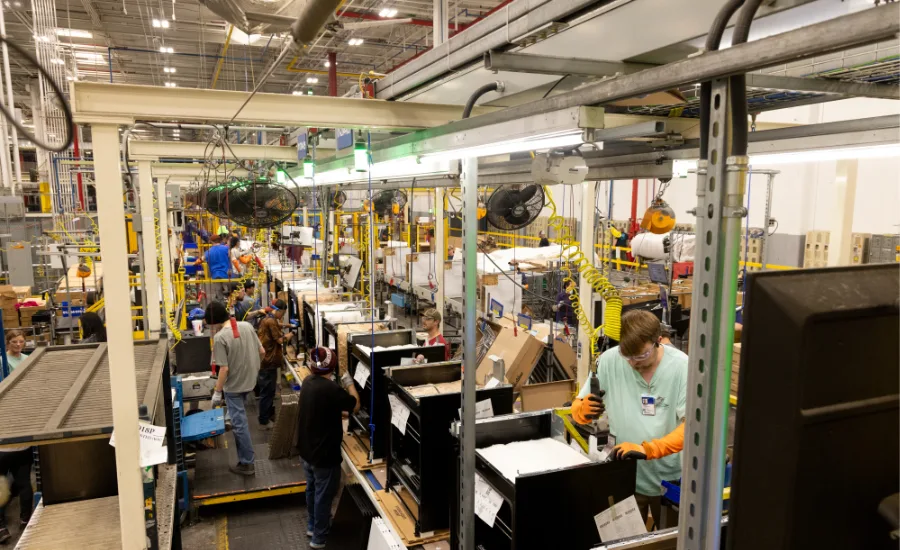
- Explicit Elements: These are the physical realities of the factory floor—excess motion, inventory piles, poor cell design, and machinery bottlenecks. They are easily identified through standard lean audits.
- Tacit Elements: These are invisible cultural dynamics—how operators communicate with supervisors, how fear of reprimand affects error-reporting, and how freely cross-functional teams collaborate.
"There are explicit things you can see on the factory floor," Flumerfelt notes. "But there are also tacit elements, like communication and team dynamics, that have a significant impact on performance."
For example, consider a scenario where an assembly line worker notices a recurring micro-defect in a fastener component. In a toxic or strictly top-down management culture, the worker may hesitate to stop the line out of fear of being blamed for lost productivity. The defect compounds down the line, resulting in massive scrap rates downstream. Conversely, in a true lean leadership culture, stopping the line is celebrated as an opportunity to protect quality, and the worker is rewarded for their vigilance.
Official Perspectives and Expert Insights
Dr. Flumerfelt has spent years examining how leadership manifests across high-stakes industries, including manufacturing, healthcare, and finance. Her extensive findings—synthesized into a widely recognized six-book series on lean leadership—paint a consistent picture: tools alone are dead weights without the cultural winds of leadership behind them.
The Danger of the Executive Disconnect
One of the most insidious barriers to lean maturity is the distance between the boardroom and the assembly line. Many executives believe they are practicing lean leadership because they review daily dashboards, review Pareto charts, and demand root-cause analyses in PowerPoint presentations.
According to Flumerfelt, this arms-length approach is a trap.
"In most cases, that gap comes down to leadership," she states. "Leaders may talk about lean principles, but they don’t model them in practice."
Effective lean leadership requires stepping away from the desk and embracing the manufacturing concept of Gemba—going to the place where value is actually created. When leaders walk the floor, ask genuine questions, and work alongside frontline technicians to observe friction points firsthand, the entire dynamic shifts.
"When leaders go to the floor, ask questions and work alongside their teams, that’s when things start to change," Flumerfelt emphasizes.
This hands-on presence accomplishes two vital objectives:
- It uncovers the genuine root causes of operational friction rather than relying on sanitized management reports.
- It builds mutual trust, cementing a culture of collective accountability where employees feel psychologically safe to experiment, innovate, and flag errors.
Implications for the Future of Manufacturing
As the industrial sector accelerates into an era defined by automation, smart manufacturing, and the Industrial Internet of Things (IIoT), the lessons of lean leadership are more urgent than ever.
Many modern manufacturers make the mistake of assuming that technology will solve cultural friction. They invest millions in automated guided vehicles (AGVs), predictive maintenance sensors, and manufacturing execution systems (MES), only to find that human resistance to change undermines the software’s utility.
Technology is merely an amplifier. If an organization has poor communication, broken trust, and reactive leadership, technology will only accelerate the production of chaos. Conversely, when advanced manufacturing tools are paired with a mature, people-first lean leadership culture, the results are exponential.
Key Takeaways for Plant Managers and Executives
- Audit Your Leadership, Not Just Your Processes: Before commissioning another lean workshop or bringing in external efficiency auditors, leadership teams must evaluate their own behaviors. Are you managing metrics or are you developing people?
- Invest in Psychological Safety: Create environments where frontline operators feel empowered to stop the line, voice concerns, and propose systemic changes without fear of reprisal.
- Embrace Gemba Walk-Throughs: Stop relying exclusively on dashboard reports. Spend structured time on the shop floor observing how processes actually function in real time, side-by-side with the operators who run them.
- Commit to Long-Term System Potential: Shift the organizational mindset away from short-term firefighting and toward long-term capability building.
Conclusion
Dr. Shannon Flumerfelt’s upcoming webinar on November 11 offers a timely and vital reminder for an industry too often obsessed with the latest technical quick fixes. Lean manufacturing is not a software package to be installed or a poster to be hung on a breakroom wall; it is a living, breathing organizational culture that rises or falls on the quality of its leadership.
For manufacturers striving to break the cycle of short-lived improvements and inconsistent results, the directive is unequivocal: tools are necessary, but leadership is the catalyst. Without leaders willing to roll up their sleeves, walk the floor, and bridge the gap between theory and practice, even the most meticulously designed operational systems will ultimately fall short.
To secure your spot for Dr. Flumerfelt’s upcoming webinar on November 11 at 2:00 p.m. ET, register through the official portal today.