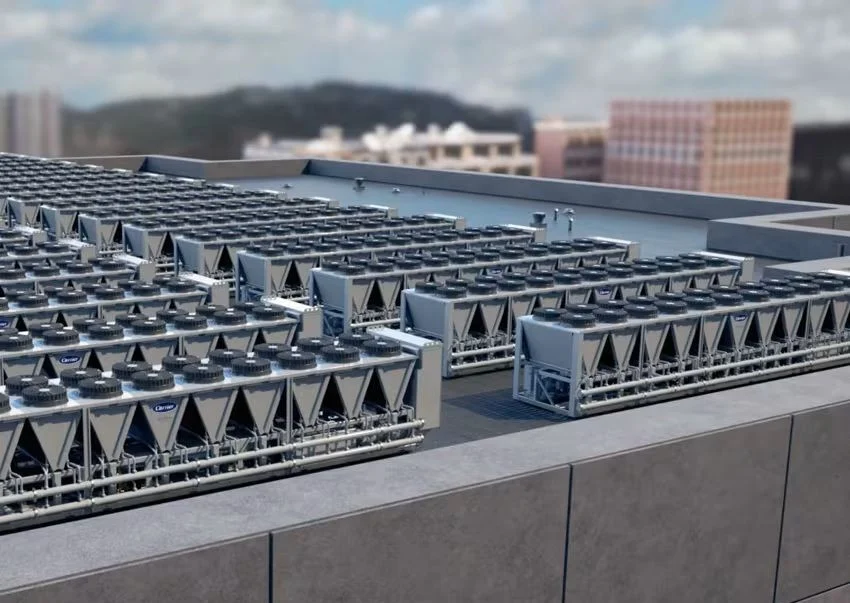
FORT WORTH, TX — In a landmark move signaling robust confidence in the trajectory of domestic industrial output, Carrier Global Corp. has officially announced plans to construct a massive, state-of-the-art manufacturing and engineering center in Fort Worth, Texas. Backed by an investment exceeding $600 million, the sprawling complex will encompass more than 1 million square feet dedicated primarily to the production of high-performance commercial chillers.
The strategic expansion is designed to address an explosive, market-wide surge in demand for sophisticated thermal management systems—particularly those required by modern hyperscale data centers, large-scale commercial real estate, and critical infrastructure. As artificial intelligence, cloud computing, and high-performance computing continue to drive unprecedented data processing requirements, the need for reliable, energy-efficient cooling technology has become an operational imperative for the global technology ecosystem.
Operations at the sprawling new Lone Star State facility are aggressively slated to ramp up by the end of next year, adding a premier manufacturing jewel to Carrier’s already extensive North American operational footprint.
Main Facts
The core parameters of Carrier Global Corp.’s Texas investment outline a transformative project for both the region and the HVAC (heating, ventilation, and air conditioning) sector:
- Capital Investment: In excess of $600 million.
- Facility Scale: More than 1 million square feet of advanced manufacturing and engineering space.
- Primary Output: Advanced thermal management systems, specifically focusing on air- and water-cooled commercial chillers.
- Key Markets Served: Rapidly expanding data center operations, commercial buildings, industrial facilities, and critical infrastructure.
- Target Operational Date: Production and operational ramp-up scheduled by the end of next year.
- Strategic Location: Fort Worth, Texas, selected for its robust manufacturing ecosystem, logistical advantages, and deep pool of skilled industrial labor.
The facility will not only serve as a high-volume assembly plant but will also house dedicated engineering laboratories. These labs will focus on the continuous optimization of energy efficiency, refrigerant transition, and next-generation thermodynamic performance.
Chronology: A Century of Cooling Innovation Leading to the Fort Worth Expansion
To understand the weight of Carrier’s latest investment, it is helpful to contextualize the historical milestones that have shaped the company and the modern cooling landscape:
- 1922: Willis Carrier invents the centrifugal refrigeration machine, universally recognized as the commercial chiller. This breakthrough transforms modern architecture and urban life, allowing for stable climate control in skyscrapers, hospitals, schools, and factories.
- Decades of Evolution: Over the subsequent century, Carrier pioneers numerous iterations of climate control and refrigeration technology, cementing its status as a global leader in HVAC systems.
- Recent Years: The exponential rise of cloud computing, edge computing, and artificial intelligence creates an unprecedented strain on global data processing infrastructure. Data centers require uninterrupted, high-capacity cooling systems to prevent catastrophic hardware overheating.
- Recent Milestones: Carrier’s existing chiller-manufacturing facility in Charlotte, North Carolina—operational for over 25 years—receives regional acclaim, being named the "Coolest Thing Made in North Carolina."
- The Present Announcement: Carrier commits over $600 million to break ground on the massive 1-million-plus-square-foot Fort Worth facility, aimed at locking in long-term supply chain dominance for high-capacity commercial chillers.
Supporting Data and Market Drivers
The decision by Carrier to allocate hundreds of millions of dollars to a greenfield manufacturing facility in Texas is underpinned by powerful macro-economic and technological shifts.
The Data Center Boom
Modern data centers generate staggering amounts of heat. As server racks pack denser computational power into smaller spaces, traditional HVAC solutions are often insufficient. Liquid and high-capacity air- and water-cooled chillers are vital components in maintaining optimal operating temperatures. Industry analysts project that global data center energy consumption—and by extension, cooling infrastructure spending—will compound aggressively over the next decade. By positioning a 1-million-square-foot manufacturing plant directly in the United States, Carrier ensures that domestic tech hubs have immediate, localized access to essential climate control hardware without the vulnerabilities of extended overseas supply chains.
Supply Chain Resilience
In the wake of global logistical disruptions experienced over recent years, industrial leaders have pivoted toward localized and regionalized manufacturing models. Expanding the U.S. manufacturing footprint allows Carrier to shorten delivery lead times, protect against international freight volatility, and maintain stringent quality control standards over critical components.
Workforce Development Integration
Modern advanced manufacturing is no longer defined by simple assembly lines; it relies heavily on automation, robotics, precision engineering, and digital quality assurance. Carrier’s blueprint for the Fort Worth facility explicitly incorporates workforce development organizations. By partnering with local schools, vocational institutions, and colleges, the company is proactively addressing the skilled labor shortage plaguing American manufacturing. These partnerships are designed to train the next generation of technicians, engineers, and assembly specialists, ensuring a sustainable talent pipeline for the region.
Official Responses and Leadership Insights
Carrier Global Corp. leadership has emphasized that the Fort Worth facility is much more than a routine capacity expansion—it is a strategic alignment of manufacturing capability with the future of digital and physical infrastructure.
David Gitlin, CEO of Carrier, highlighted the broader implications of the investment during the announcement:

"This investment reflects the strong demand we are securing for high-performance, energy-efficient solutions and underscores our confidence in the future of American manufacturing. By expanding our U.S. manufacturing and engineering footprint, we are increasing capacity for critical technologies, strengthening supply chain resilience, and creating high-quality jobs."
Gitlin further elaborated on the holistic nature of the new campus, pointing out its blend of cutting-edge research and community-focused education:
"This landmark facility represents the next chapter in our legacy of innovation, combining state-of-the-art engineering labs with dedicated workforce development organizations. We will partner with local schools and colleges to help prepare the next generation of skilled talent."
When asked why Fort Worth was chosen out of numerous potential locations across the United States, Gitlin pointed to the region’s proven industrial assets:
"Fort Worth offers a highly skilled workforce, a strong manufacturing base, and a strategic geographic location that allows us to serve our customers efficiently and effectively."
Drawing a line from the company’s historic roots to its modern-day mission, Gitlin reflected on the legacy of the company’s founder:
"Willis Carrier invented the centrifugal refrigeration machine in 1922, helping transform modern life by providing comfortable, efficient climate control in hospitals, schools, airports, commercial buildings, industrial facilities, and other critical infrastructure around the world. Today, Carrier continues to invest in advanced technologies designed to help enhance efficiency, resiliency, and operational performance across the built environment."
Strategic Implications for the Industry and the Regional Economy
The ripple effects of Carrier’s $600 million investment will be felt across multiple sectors, ranging from regional economic development in Texas to the broader competitiveness of American industrial engineering.
Regional Economic Impact in North Texas
Fort Worth continues to cement its reputation as a premier destination for heavy manufacturing, logistics, and corporate expansion. The arrival of a 1-million-square-foot advanced manufacturing facility will generate thousands of direct and indirect jobs. Beyond assembly line roles, the complex will demand specialized talent in mechanical engineering, electrical systems, supply chain management, quality assurance, and facility maintenance. Furthermore, local suppliers, raw material providers, service contractors, and transport companies will experience a significant boost in commercial activity to support the massive plant.
Setting a Benchmark for Advanced Manufacturing
By intentionally integrating dedicated engineering laboratories and educational partnerships directly into the manufacturing facility, Carrier is executing a modern blueprint for industrial success. Traditional manufacturing centers often separate research and development from production floors. By housing both under one roof in Fort Worth, Carrier aims to accelerate the feedback loop between product design, prototyping, and full-scale assembly. Innovations discovered in the engineering labs can be integrated into the manufacturing process with minimal friction, reducing time-to-market for new, highly efficient chiller models.
Environmental Efficiency and Regulatory Readiness
As global regulatory frameworks place heavier emphasis on reducing carbon footprints and phasing out high-Global Warming Potential (GWP) refrigerants, HVAC manufacturers face mounting pressure to innovate. Modern commercial chillers must not only cool immense computing loads efficiently but must do so while adhering to strict environmental standards. The engineering capabilities housed within Carrier’s new Fort Worth center will be instrumental in developing next-generation chillers optimized for eco-friendly refrigerants and ultra-high Coefficient of Performance (COP) metrics.
Conclusion
Carrier Global Corp.’s decision to invest more than $600 million in a state-of-the-art Fort Worth manufacturing and engineering center marks a defining moment for the commercial HVAC sector. By marrying historical engineering expertise with forward-looking investments in data center cooling, supply chain resilience, and local workforce education, Carrier is positioning itself at the absolute forefront of industrial innovation. As construction moves forward and operations prepare to launch by the end of next year, the Fort Worth facility stands as a powerful testament to the enduring strength and vital evolution of American manufacturing.