




In the rapidly evolving landscape of Industry 4.0, the distance between a pilot project and a factory-wide rollout is often measured in years. However, a recent case study from the Stellantis manufacturing plant in Goiana, Pernambuco, has shattered this paradigm. By architecting a scalable, standardized industrial data framework, the automotive giant has successfully transitioned from fragmented, manual integrations to a streamlined ecosystem supporting over thirty distinct Artificial Intelligence (AI) applications.
This breakthrough, detailed during the Industrial AI Summit 2026 session titled "From Months to Days: Accelerate Industrial AI with a Modern Data Architecture," highlights a shift in how manufacturers perceive the factory floor. By leveraging existing Siemens infrastructure and integrating advanced Industrial DataOps, Stellantis has demonstrated that the secret to scalable AI isn’t just better algorithms—it is a better data foundation.
The Core Challenge: Evolving PLC Connectivity
For decades, Programmable Logic Controllers (PLCs) have been the backbone of manufacturing, providing the telemetry necessary for basic operational dashboards and Overall Equipment Effectiveness (OEE) metrics. Yet, as the industry pushes toward machine learning, predictive maintenance, and digital twins, the limitations of traditional PLC-centric architecture have become apparent.
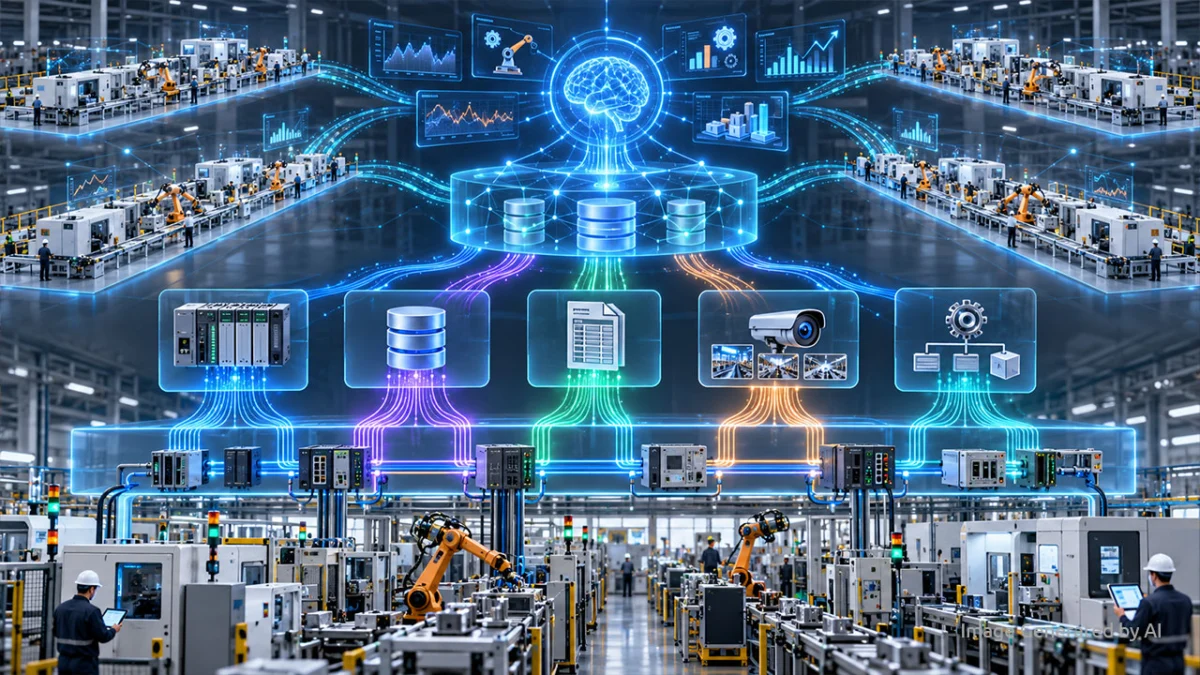
Modern AI applications require more than just real-time sensor data; they demand a convergence of disparate data types, including SQL database records, CSV logs, unstructured images, and high-bandwidth video feeds. In a facility housing hundreds of machines, managing these diverse streams manually is not only inefficient—it is unsustainable.
The Architectural Shift
The transition from a "Dashboard Architecture" to an "AI-Ready Architecture" represents a fundamental change in philosophy. In the legacy model, data integration was application-specific; if a plant manager wanted to add a new AI tool, they had to repeat the process of connecting to machines and writing custom code. In the AI-ready model, data is contextualized once and made available to any authorized consumer.
| Feature | Dashboard Architecture | AI-Ready Architecture |
|---|---|---|
| Primary Sources | PLC Tags | PLC Tags, SQL, CSV, Images, Video |
| Calculations | Application-specific | Contextualized once, shared by all |
| Effort | High (Custom integration per app) | Low (Replicate standardized model) |
| Scaling | Manual (Line by line) | Propagation (Model once, deploy everywhere) |
Building the Data Foundation: The Role of Industrial DataOps
The heavy lifting of modern industrial intelligence happens in the "DataOps" layer. According to Aron Semle, Chief Technology Officer at HighByte, Industrial DataOps handles roughly eighty percent of the labor required to prepare data for AI consumption.
Contextualization: The Secret Sauce
Data without context is merely noise. A raw tag value reading "450" is meaningless to an AI model unless it is paired with metadata: Which machine? Which line? What product? DataOps processes pull this information from the shop floor, attach the necessary context, and publish it into a Unified Namespace (UNS).
The UNS acts as a single source of truth for the entire enterprise. As Semle noted during the summit, the technology used to host a UNS—whether an MQTT broker, a data lake, or an OPC UA server—is secondary to the goal of consistency. By making contextualized data available in a standardized format, manufacturers eliminate the "data silo" effect, allowing teams to repurpose existing data streams for new business initiatives without re-engineering the connectivity layer.
A Two-Layer Model for Global Scalability
The success at the Goiana plant was rooted in a strategic decision to divide the DataOps layer into two distinct levels.
1. The Protocol Layer
The lower level focuses on the "how"—managing the heterogeneous protocols and file formats inherent in a modern factory. Whether a machine speaks Modbus, Profinet, or generates proprietary CSV files, this layer normalizes the raw communication into a structured format.
2. The Modeling Layer
The upper level focuses on the "what"—the business meaning of the data. At Stellantis, the engineering team had to move beyond the simple tag-to-meaning mapping common in process industries (like oil and gas) and adopt a structure suitable for discrete manufacturing. This involved modeling the movement of parts, assembly sequences, and material flow.
By designing these models to be modular, the team ensured that once a model was perfected for one production line, it could be propagated to others with minimal effort. This "model once, deploy everywhere" strategy is the primary driver behind the transition from months-long integration projects to deployments that take only days.
Chronology of Implementation and Real-World Results
The timeline for deploying such an architecture is highly variable, depending on the maturity of the existing plant documentation and the complexity of its systems.
- The Plastics Facility Case: In a high-speed plastics manufacturing environment, the team was able to connect disparate machines and achieve live Statistical Process Control (SPC) within one week.
- The Process Industry Migration: At a site with thousands of legacy tags, the team established a foundation in a few weeks, with full, seamless migration of all AI applications completed within a few months.
- The Gousto Benchmark: Food manufacturer Gousto, utilizing the same HighByte Intelligence Hub technology, reported an increase in mechanical availability from 70% to 95% in just six months—a testament to the impact of data-driven visibility.
Implications for the Future of Manufacturing
The gap between "beginners" and "leaders" in industrial AI is shrinking rapidly. In 2021, a company starting its digital transformation journey could expect to be years behind the industry leaders. Today, due to the widespread sharing of architectural blueprints and the maturation of DataOps software, that gap has narrowed to mere months.
Official Perspectives
Denis Leite, Director of Digital Transformation at Mekatronik, emphasized that the transition is as much about human workflow as it is about software. "Developing the model required careful planning," Leite noted, "but it also needed to be flexible enough to accommodate the natural evolution of our production processes over time."
The scalability is evidenced by the adoption of the underlying software, HighByte Intelligence Hub, which is now operational in over 400 sites across 25 countries. This widespread deployment proves that the "Stellantis approach" is not a bespoke solution for a single automotive plant, but a repeatable framework for the global manufacturing sector.
Conclusion: The Path Forward
The experience at the Goiana plant serves as a blueprint for the modern factory. By prioritizing a standardized data foundation over short-term "quick fix" dashboard projects, manufacturers can build an ecosystem that is inherently future-proof.
As we look toward the remainder of the decade, the focus of the industrial sector will move away from "connecting things" toward "modeling intelligence." The ability to scale AI from a single machine to an entire multinational fleet is no longer a technological impossibility; it is a matter of discipline, standardization, and the adoption of a robust Industrial DataOps strategy.
The message from the Industrial AI Summit 2026 is clear: stop treating data as a byproduct of production and start treating it as the most critical infrastructure on the factory floor. Those who do will find that the path from a raw data point to an actionable, automated insight is much shorter than they ever imagined.