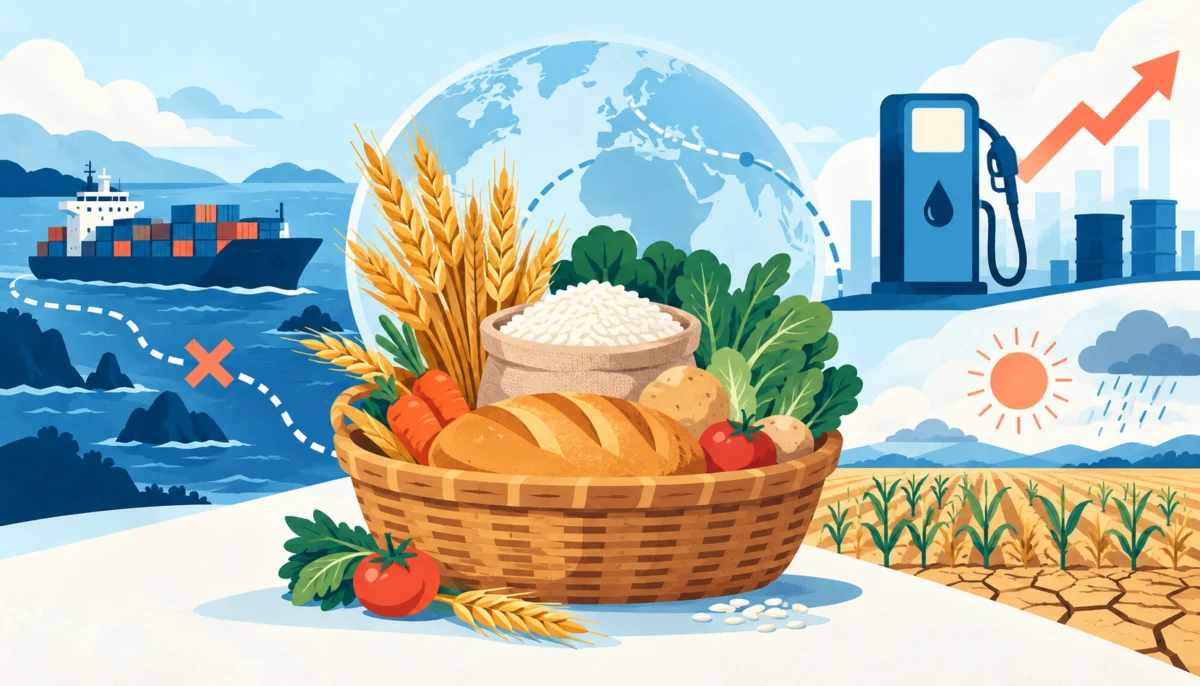
The global food system is currently navigating a period of profound turbulence. A confluence of renewed shipping disruptions, escalating energy costs, and erratic weather patterns has placed significant upward pressure on international food prices, threatening to exacerbate household food insecurity across both developed and emerging economies. While global commodity harvests remain relatively robust in volume, the mechanism of moving that food from farm to fork has become increasingly expensive and precarious.
The Current State of Global Food Inflation
The most recent data from the United Nations Food and Agriculture Organization (FAO) paints a concerning picture. As of the October 2 release, the FAO Food Price Index—a barometer for internationally traded food commodities—climbed to 136.0 points. This represents a 1.5% month-on-month increase and a notable 5.8% rise compared to the same period last year.
Maximo Torero, Chief Economist at the FAO, has issued a stark warning: the sustained pressure on energy, transport, and agricultural input costs is likely to permeate retail food prices. For import-dependent nations, this is not merely a macroeconomic statistic but a looming humanitarian and fiscal crisis. While commodity quotations represent an early stage in the supply chain, the lag effect suggests that households—already grappling with diminished purchasing power—should brace for higher grocery bills in the coming quarters.
Chronology of a Mounting Crisis
The current inflationary spike is not an isolated event but the culmination of several overlapping factors that have gained momentum throughout 2026.
- Q1-Q2 2026: Initial stability in global grain markets was disrupted by localized weather events and the first signs of tightening shipping routes in the Black Sea.
- August 2026: Energy markets began to show significant volatility, with natural gas and crude oil prices starting a steady climb, impacting the entire agricultural value chain from fertilizer production to refrigerated distribution.
- September 2026: The FAO index recorded a significant jump in cereal (5.1%) and sugar (6.1%) prices. Simultaneously, the World Bank reported a massive 25.7% spike in energy indices.
- October 2026: The convergence of these factors led to the current climate of uncertainty, with the World Meteorological Organization (WMO) confirming that the El Niño phenomenon is expected to persist through early 2027, casting a long shadow over future crop yields.
Supporting Data: Dissecting the Commodity Mix
The FAO Food Price Index reveals a nuanced, albeit concerning, reality across different sectors. The index tracks five key groups, each reacting differently to current market stressors:
- Cereals (Up 5.1%): Wheat and maize, the bedrock of global diets, have seen the sharpest increases due to restricted transport capacity and export bottlenecks.
- Sugar (Up 6.1%): Significant production concerns and trade logistics have driven the cost of sweeteners to a year-to-date high.
- Vegetable Oils (Up 0.9%): A modest increase, but one that continues to burden the processed food sector.
- Meat and Dairy (Marginal declines of 1.1% and 0.1%, respectively): These sectors have provided minor relief, though experts warn that feed costs may soon reverse these minor downward trends.
From a business perspective, these figures are critical. A bakery’s cost structure is fundamentally different from that of a meat processor. As input costs rise unevenly, businesses are forced into a difficult game of "substitution"—altering recipes or sourcing strategies to maintain margins. However, these adjustments have hard limits; when staples like wheat and sugar rise in tandem, the room for maneuver vanishes.
The Logistics and Energy Bottleneck
A critical takeaway from the current crisis is that adequate global harvests do not necessarily equate to food security. The FAO’s October Cereal Supply and Demand Brief projects global production at 2,979 million tonnes—the second-largest harvest on record. Despite this abundance, the trade outlook is grim.
Trade volumes for cereals are projected to drop 3.5% in 2026/27. The culprit is not a lack of grain, but a lack of delivery. Constraints on Black Sea shipping and insufficient alternative rail and port capacity mean that food is often stranded in producing regions while importers face empty shelves.
Furthermore, the energy-food nexus remains the primary driver of secondary inflation. As the World Bank’s October update noted, crude oil and natural gas prices have surged, inflating the cost of:
- Farm Inputs: Fertilizer production is heavily dependent on natural gas.
- Operations: Fuel for agricultural machinery and irrigation systems.
- Logistics: The cost of ocean freight, trucking, and cold storage, which are all highly energy-intensive.
Climate Forecasts and the "El Niño" Variable
The WMO’s seasonal update provides the most significant long-term risk factor. The strengthening of El Niño, with a nearly 100% probability of persistence through February 2027, introduces extreme weather uncertainty into the agricultural planning cycle.
While these forecasts are not direct indicators of crop failure, they signal high risks for water-stressed regions. The primary danger for governments and lenders is the "planning trap": countries may be forced to pay premium prices for current food imports while simultaneously needing to subsidize local farmers for the next planting season. If farmers, fearing a bad harvest, reduce fertilizer use or delay planting to save cash, it could trigger a supply-side shock in 2027, further compounding the inflationary cycle.
Official Responses and Policy Implications
Governments are currently in a reactive posture, struggling to balance the competing needs of their populations and their treasuries.
- Fiscal Challenges: Countries in Eastern/Southern Africa, the Middle East, and South Asia are seeing food inflation rates exceeding 5%. Many governments are attempting to use subsidies and import duty cuts to shield citizens. However, with interest rates high and debt levels rising, these measures are fiscally unsustainable for many.
- Monetary Policy: Central banks find themselves in a precarious position. Since monetary policy cannot "produce" rain or open a blocked port, raising interest rates to combat food-induced inflation risks stifling domestic growth without effectively addressing the root supply-side causes.
- Strategic Diversification: The most successful importers are those currently pivoting toward supply chain diversification. By moving away from reliance on single transit corridors or singular suppliers, these entities are insulating themselves, though at the cost of higher immediate procurement expenses and the need for rigorous new quality control standards.
Analyst’s Outlook: Credit and Market Risk
For investors and credit analysts, the current environment necessitates a shift in focus.
Credit Risk Assessment
The primary metric for food processors and importers is the "cash conversion cycle." With shipping times lengthening and inventory costs rising, companies require more working capital to sustain the same level of operations. Firms with thin cash buffers and limited supplier terms are at the highest risk of insolvency, regardless of the strength of their underlying demand.
Sovereign Risk
Sovereign risk is now inextricably linked to the food-energy-currency triad. Analysts must evaluate a nation’s foreign exchange reserves alongside its food import obligations. A country that relies on imported fuel to transport imported food, while holding debt in a weakening local currency, is a primary candidate for default risk.
Market Positioning
In the equities market, the divide is widening between those who can pass costs to the consumer and those who cannot. Producers—particularly those who own their supply chains—may benefit from higher commodity prices. Conversely, downstream retailers are caught in a pincer movement between rising replacement costs and a consumer base that has reached its limit.
The path forward remains murky. While global stocks-to-use ratios remain reasonably healthy at 31.7%, the "practical" availability of food—governed by ports, insurance, and currency access—is the true arbiter of the coming months. Until shipping corridors stabilize and the impact of the current El Niño cycle is quantified at the harvest level, food inflation will remain a persistent, unpredictable, and highly volatile feature of the global economy.