





Vision has become the foundational sensing modality for modern robotics. As robotic systems transition from simple, task-oriented machines to highly autonomous agents capable of navigating dynamic environments—such as warehouses, hospitals, and public urban spaces—the demand for richer, faster, and more reliable perception has surged. This evolution in robotic capability necessitates a parallel evolution in the underlying connectivity technologies used to transport massive volumes of image data.
For years, engineers relied on traditional interfaces like USB and Ethernet to bridge the gap between camera sensors and processing units. However, as robot architectures become increasingly complex, these legacy systems are hitting significant technical ceilings. Today, Gigabit Multimedia Serial Link (GMSL), a high-speed technology originally engineered for the rigorous demands of automotive safety, is emerging as the new standard for next-generation robotic vision.
The Chronology of Connectivity: A Technical Retrospective
The USB Era: Prototyping and Accessibility
In the early days of robotics, USB (Universal Serial Bus) emerged as the de facto interface for vision systems. Its ubiquity, low cost, and plug-and-play compatibility with PC architectures made it an ideal choice for research labs and initial commercial prototypes. By allowing developers to stream image data directly into standard CPUs or GPUs with minimal hardware integration effort, USB democratized robotic vision development.
However, USB was never intended to be the backbone of a high-performance, real-time sensor network. It is fundamentally a host-centric interface with significant cable length constraints and a non-deterministic nature. As robots grew in physical scale, the limitations of USB—such as signal degradation over longer distances and high CPU overhead caused by interrupt-driven data transfers—began to compromise system reliability. For developers, USB transitioned from an enabler of speed to a bottleneck that threatened the stability of complex, multi-camera arrays.
The Ethernet and GigE Vision Transition
To address the shortcomings of USB, the robotics industry pivoted toward Ethernet, specifically the GigE Vision standard. Ethernet provided the "industrial grade" reliability that USB lacked, offering significantly longer cable runs and a mature, standardized ecosystem. GigE Vision allowed for better interoperability between disparate hardware components, facilitating a modular design approach that was attractive for large-scale industrial deployment.
Despite these advantages, Ethernet introduced a new set of challenges. To manage the packetization of image data, Ethernet-based cameras typically require onboard processors. This adds cost, power consumption, and thermal complexity to the camera module itself. Furthermore, the inherent latency and non-determinism of standard network protocols can hinder real-time performance. In tasks where millisecond-level precision is required for obstacle avoidance or dexterous manipulation, the buffering and packet management required by Ethernet can introduce unacceptable lag, forcing engineers to choose between robust connectivity and real-time performance.
Rising Demands: The Modern Robotic Environment
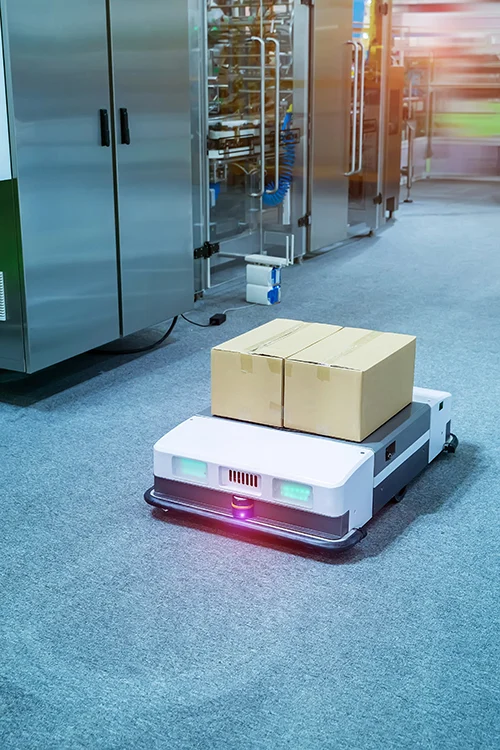
Modern robots, particularly Autonomous Mobile Robots (AMRs) and humanoids, are becoming increasingly reliant on dense, multi-camera perception systems. These systems are no longer just "seeing"; they are interpreting the world in real-time to facilitate human-robot interaction (HRI), safe navigation in crowded spaces, and high-precision manipulation.
The shift toward these advanced use cases has created a new set of requirements for connectivity:
- Deterministic Latency: The ability to guarantee that image data reaches the processor within a fixed, predictable time window.
- Mechanical Robustness: The physical durability to withstand the vibrations, constant movement, and environmental hazards typical of industrial and outdoor settings.
- Thermal Efficiency: Reducing the heat signature of camera modules to allow for smaller, more compact designs without the need for active cooling.
- Scalability: The ability to easily aggregate data from multiple high-resolution cameras without significantly increasing cable mass or power consumption.
GMSL: The Automotive-Grade Solution for Robotics
Gigabit Multimedia Serial Link (GMSL) was designed to solve the "mission-critical" data transport problem for the automotive industry. In modern vehicles, cameras must provide high-definition, uncompressed video to Advanced Driver Assistance Systems (ADAS) with zero latency and absolute reliability. The transition of this technology into the robotics sector represents a strategic alignment between automotive safety standards and the needs of sophisticated autonomous machines.

Technical Advantages of GMSL
GMSL functions as a high-speed point-to-point link, transmitting uncompressed image data, bidirectional control signals, and power over a single coaxial cable or shielded twisted pair (STP).
- Deterministic, Low-Latency Transport: By bypassing the complex network arbitration required by Ethernet, GMSL delivers raw data directly to the compute engine (FPGA or GPU). This point-to-point architecture eliminates buffering, ensuring microsecond-level latency that is critical for real-time safety functions.
- Simplified Camera Design: Because GMSL handles the serialization of raw data at the sensor source, the camera module itself does not require a local processor. This drastically reduces the size, power, and thermal footprint of the camera, allowing for more distributed sensor placements on the robot’s frame.
- EMI/EMC Resilience: Robotic environments are often electrically noisy. GMSL is engineered to maintain high signal integrity in these harsh conditions, meeting the stringent ASIL-B (Automotive Safety Integrity Level) standards. This ensures that even in environments with significant electromagnetic interference, the vision data remains stable and reliable.
- Long-Reach Capabilities: Unlike USB, which is limited by distance, GMSL supports cable lengths that allow for flexible, scalable, and complex robot chassis designs without compromising signal quality.
Supporting Data: Scalability and Performance
The scalability of GMSL is perhaps its most compelling feature for modern robotics. By utilizing dual or quad-channel serializers and deserializers, engineers can aggregate multiple high-definition sensor streams into a single compute path. This architecture significantly reduces the physical complexity of the robot’s "nervous system"—minimizing cable clutter and reducing the weight and power overhead of the connectivity harness.
For developers, this means the difference between a prototype that requires a massive, power-hungry PC cluster to manage camera data, and a sleek, optimized, and energy-efficient system that can sustain its mission for longer periods. The reduction in component count also leads to higher MTBF (Mean Time Between Failures) metrics, a vital consideration for commercial robots intended for 24/7 deployment.
Official Perspectives: Industry Implications
As industry leaders at Analog Devices and other key component manufacturers have noted, the shift toward GMSL is not merely a technical upgrade; it is a fundamental shift in design philosophy. Connectivity is no longer a peripheral afterthought—it is a core pillar of the robot’s architectural performance.
The implications are clear: robots that utilize GMSL are better positioned to handle the demands of the "next-gen" autonomous landscape. By offloading the complexity of data transport to a dedicated, high-performance link, engineers can focus their efforts on refining perception algorithms and AI models. This separation of concerns—transporting the data reliably versus processing it intelligently—is the hallmark of mature, scalable robotics platforms.
Implications for the Future of Robotics
The transition from USB and Ethernet to GMSL signals the "professionalization" of the robotics industry. As robots move out of the lab and into the real world, the tolerance for system failures, latency issues, and bulky cabling disappears.
Key Takeaways for System Designers:
- Design for Autonomy: Move away from host-centric connectivity toward architectures that prioritize deterministic data flow.
- Prioritize Safety-Certifiable Links: As robots interact more frequently with humans, the reliability of the vision system becomes a matter of safety, not just performance.
- Embrace Modularity: Leverage the high-density aggregation capabilities of GMSL to build modular, multi-sensor systems that can be upgraded without a total architectural overhaul.
In conclusion, the evolution of connectivity is intrinsically linked to the evolution of robotic intelligence. As we demand more from our machines, we must demand more from the hardware that allows them to "see." GMSL provides the robust, low-latency, and scalable foundation required for the next decade of robotic innovation.
For a deeper technical exploration of how GMSL enables these capabilities, including specific camera deployment models and system-level integration considerations, read Kainan Wang’s "Building High Performance Robotic Vision with GMSL" available on the Analog Devices website.