





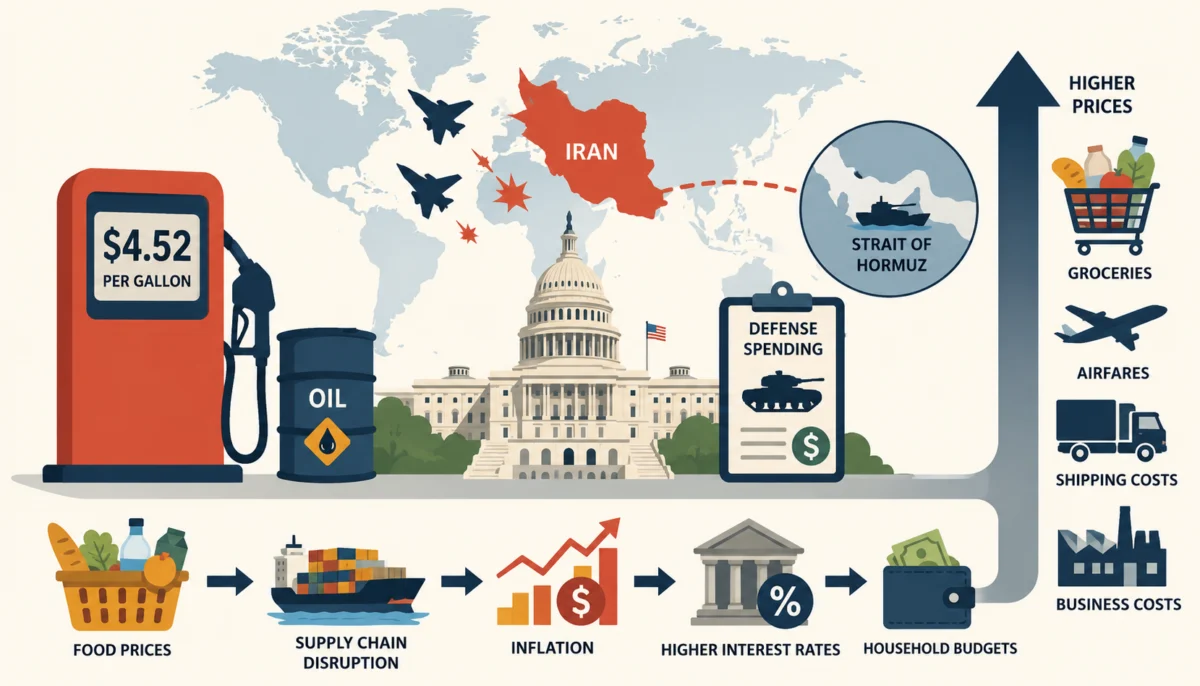
The first tremors of the Iran conflict did not begin in a military command center, but at the corner gas station. As of May 11, the national average for regular gasoline hit $4.52 a gallon—a staggering figure marking the highest price point since the energy volatility of 2022. While pump prices have dominated the morning news cycles, they are merely the most visible symptom of a profound, structural economic shift.
The conflict is no longer confined to the Middle East; it is currently permeating airline balance sheets, grocery aisles, factory floors, and the inner sanctums of the Federal Reserve. What began as a localized geopolitical confrontation has morphed into a sprawling, multi-sector economic contagion that threatens to erode the purchasing power of the American consumer and derail the nation’s fiscal recovery.
The True Cost: Beyond the Pentagon’s Invoice
In Washington, the initial direct-cost estimate for the Iran campaign is pinned at approximately $25 billion. To the casual observer, this is a substantial sum. However, to seasoned economists, this figure is a gross understatement—a mere rounding error in the broader scope of the national economy.
Linda Bilmes of Harvard University, a leading authority on the fiscal impact of conflict, characterizes the $25 billion estimate as "just the tip of the iceberg." When one accounts for the secondary and tertiary ripples—skyrocketing fuel costs, heightened interest rates, persistent supply-chain bottlenecks, and lost economic output—the true burden to the United States economy swells into the hundreds of billions.
The chasm between what the U.S. Treasury spends on munitions and what the broader economy loses in productivity is the defining story of this conflict. It is a war of attrition, not just on the battlefield, but in the wallets of everyday citizens.
Chronology of a Crisis: From Strait to Street
The vulnerability of the American economy is rooted in geography. The Strait of Hormuz, the critical maritime chokepoint between Iran and Oman, serves as the jugular vein of the global energy market, carrying roughly 20% of the world’s daily oil supply.
- Pre-Conflict (Late Winter): Energy markets remained stable, with oil prices hovering within predictable ranges.
- The Onset of Hostilities: Following the initiation of the U.S.-Israeli campaign, traffic through the Strait of Hormuz was effectively paralyzed. Global markets reacted instantaneously.
- The First Shock (April): The sudden removal of millions of barrels of oil from the daily supply chain forced a scramble for replacement crude, necessitating longer, more expensive shipping routes and creating immediate upward pressure on prices.
- The Second-Round Ripple (May): By mid-May, the shock moved beyond crude oil, manifesting in diesel shortages, airline insolvencies, and the first significant inflationary spikes in consumer goods.
The Transmission Channels: Where the Pain is Felt
The economic shock fans out through three primary channels, each with its own set of debilitating consequences.
1. Gasoline and the Household Budget
For the American household, the $4.52-per-gallon price tag is the primary indicator of economic distress. It is a tax on mobility that reduces discretionary spending, forcing families to make difficult trade-offs between essential goods and services.
2. Diesel: The Quiet Killer of Margins
Diesel is the lifeblood of the American economy, fueling the heavy-duty trucking, rail, and farm equipment industries. When diesel prices spike, the cost of moving goods—from farm-to-table food transport to construction materials—surges. Because diesel is an input cost for almost every sector, this price hike is guaranteed to show up in the price of finished goods, creating a persistent, sticky inflation that is far harder to extinguish than gasoline price fluctuations.
3. Aviation and the Jet Fuel Squeeze
Perhaps the most dramatic casualty has been the aviation sector. Jet fuel is the single largest variable cost for airlines. The current price environment has proven insurmountable for smaller carriers. Spirit Airlines ceased operations on May 2, citing unsustainable fuel costs that rendered their long-term restructuring plans impossible. The industry has already petitioned Washington for a $2.5 billion bailout, a signal that if energy prices remain high, a wave of consolidation or bankruptcy may be on the horizon.
Official Responses: A Strategy of Band-Aids
The administration’s response to the crisis has been a mix of symbolic relief and tactical mitigation. President Trump has signaled support for a suspension of the federal gasoline tax—18.4 cents per gallon for gasoline and 24.4 cents for diesel. However, such a measure requires Congressional approval and, even if passed, offers only marginal relief.
Additionally, the Treasury and the Department of Energy have initiated a plan to release 53.3 million barrels from the Strategic Petroleum Reserve (SPR). While this helps calm physical markets, experts like Bob McNally of the Rapidan Energy Group warn that these measures are insufficient. If the Strait of Hormuz remains disrupted, a few cents off at the pump will not offset the systemic cost of global supply chain paralysis. The SPR is a buffer, not a solution; once depleted, the nation’s ability to withstand future shocks is significantly compromised.
The Inflationary Feedback Loop
The April inflation reading served as a sobering wake-up call. Consumer prices rose by 0.6% on a monthly basis, resulting in a 3.8% annual increase—the sharpest jump in nearly three years. While energy prices were the primary driver, economists are increasingly worried about "second-round effects."
These effects represent the transition from a temporary energy spike to generalized inflation. When trucking companies raise rates to cover diesel costs, and airlines pass on the price of jet fuel to passengers, these costs eventually embed themselves in the economy. Workers, facing higher costs for food, travel, and heating, begin demanding higher wages to maintain their standard of living. This creates a wage-price spiral, the very scenario central bankers fear most.
The Federal Reserve’s Dilemma
The Federal Reserve is currently trapped in a "no-win" scenario. The inflation originating from the Iran conflict is exogenous—it is not caused by an overheating domestic economy that can be cooled by raising interest rates. Higher borrowing costs do not magically produce more oil or reopen the Strait of Hormuz.
The benchmark overnight rate remains in the 3.50%–3.75% range, and the window for interest rate cuts is closing rapidly. With futures markets pushing expectations for a rate cut into 2027, the prospect of "higher for longer" interest rates is becoming the new baseline. As Chicago Fed President Austan Goolsbee noted, the current environment is an "inflationary shock." If it evolves into a "stagflationary shock"—where growth stalls while prices continue to climb—the Federal Reserve will be forced to choose between crushing the economy with further rate hikes or allowing inflation to spiral out of control.
Defense Spending: The Multiplier with a Price Tag
While the civilian economy struggles, the defense industrial base is operating at peak capacity. Munitions production and military contracts act as a form of fiscal stimulus, creating jobs and economic activity in specific industrial hubs.
However, this stimulus comes with a hidden cost. Every dollar spent on replacing a Tomahawk missile or funding a deployment is a dollar diverted from public infrastructure, education, or tax relief. Furthermore, with the national deficit already elevated, the government is borrowing at higher interest rates to fund these defense expenditures. This increases the long-term debt-servicing burden, essentially asking future taxpayers to subsidize the current conflict.
The Political Calculus of Affordability
With the November midterms looming just six months away, the economic fallout of the Iran war is rapidly becoming a domestic political nightmare. An administration that campaigned on bringing costs down is now overseeing the highest energy prices in years.
The public does not experience foreign policy through strategic maps or diplomatic successes; they experience it through the receipts they receive at the grocery store and the gas pump. The risk for the White House is that the national discourse will pivot entirely from the morality or necessity of the war to the immediate issue of domestic affordability. If the administration cannot stabilize the economic environment, the perceived "victory" of a military campaign may be overshadowed by the political failure of a cost-of-living crisis.
Conclusion: Watching the Data, Not the Strikes
The temptation to measure this war through military milestones—missile strikes, ship movements, and territorial control—is profound. Yet, the true historical significance of this conflict will be measured in economic terms.
The Iran war’s true bill is being paid in fuel receipts, deferred mortgage-rate relief, airline insolvencies, and the slow, steady erosion of household purchasing power. As the conflict continues, the most important metric for the American public will not be the next military engagement, but the next Consumer Price Index report. We are witnessing an economic transformation in real-time, one where the front lines have moved from the desert to the household ledger.