




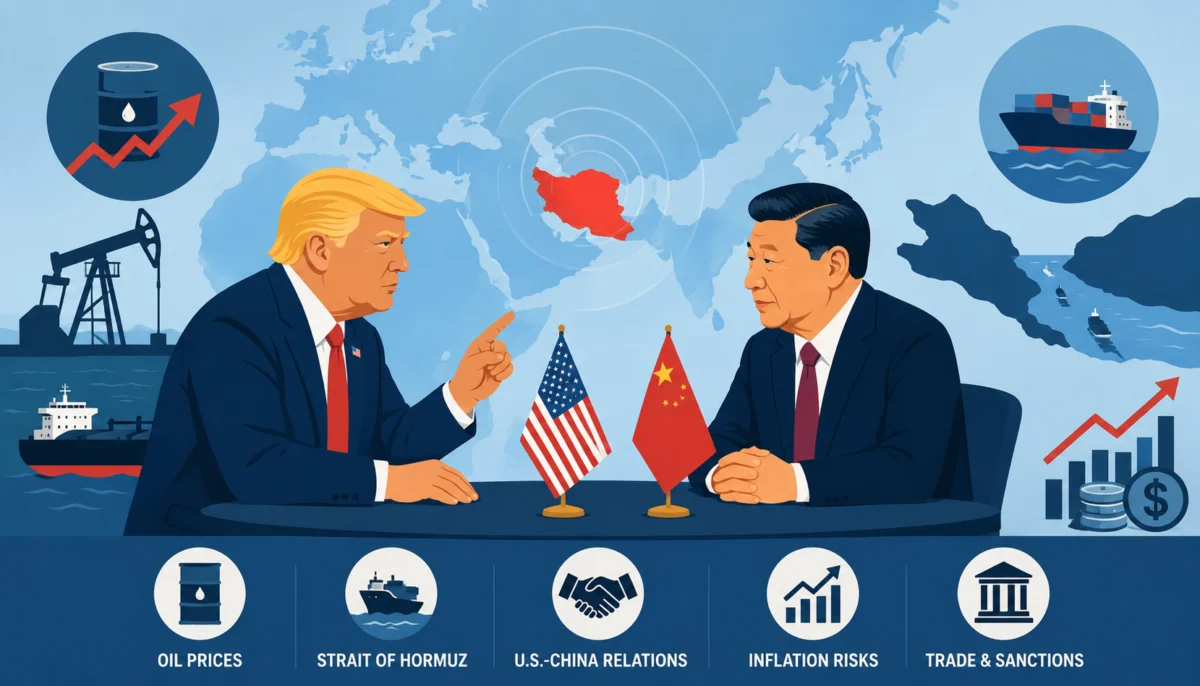
For years, the architecture of U.S.-China summits was defined by a predictable, if tense, menu: the friction of tariffs, the race for semiconductor supremacy, the status of Taiwan, and the imposition of technology export controls. However, when Donald Trump and Xi Jinping convene in Beijing on May 14–15, the traditional playbook will be discarded. The third month of the ongoing Iran war has fundamentally recalibrated the bilateral agenda, transforming a routine diplomatic engagement into a high-stakes crisis-management summit.
Main Facts: A Geopolitical Shift
The pivot from economic policy to regional conflict management is absolute. U.S. Treasury Secretary Scott Bessent has confirmed that the war in the Middle East—precipitated by the closure of the Strait of Hormuz—will occupy the center of the dialogue.
Washington’s objectives are stark. The U.S. administration is pressuring Beijing to leverage its unique position as a primary buyer of Iranian crude to force Tehran toward a ceasefire. The U.S. remains deeply concerned about the "dual-use" nature of Chinese exports to Iran, fearing that Chinese components are finding their way into the Iranian military supply chain. For the U.S., China is no longer just a trade rival; it is a critical, albeit reluctant, stakeholder in the stability of the global energy supply.
Chronology: From Trade Tensions to War Footing
The Beijing summit, originally slated for March, was delayed as the conflict in the Middle East intensified. The current timeline of the crisis is as follows:
- Late February: The conflict erupts following an exchange of fire between Israeli and U.S. forces and Iran. Iranian counter-attacks effectively shutter the Strait of Hormuz to commercial traffic.
- March: The planned U.S.-China summit is postponed as both nations scramble to address the immediate fallout of the energy supply shock.
- Early May: Violent skirmishes in the Strait of Hormuz drive Brent crude prices above $114 per barrel, creating acute inflationary pressure globally.
- May 12–13: Vice Premier He Lifeng meets with U.S. counterparts in South Korea. These talks serve as a pre-summit "de-risking" exercise, aimed at securing trade progress before the leaders arrive in Beijing.
- May 14–15: The Trump-Xi summit in Beijing commences, with the Iran crisis and broader strategic competition on the agenda.
Supporting Data: The Cost of Disruption
The closing of the Strait of Hormuz is not merely a regional security issue; it is a systemic threat to the global economy. As the world’s most vital oil chokepoint, the Strait facilitates the movement of approximately 20% of the world’s seaborne crude. When this route is severed, the market does not just see a price increase; it experiences an immediate, structural supply void.
The Inflationary Channel
The economic transmission mechanism from the Strait to the consumer is direct and painful. Higher crude prices ripple through the supply chain:
- Transport and Logistics: Increased costs for diesel and jet fuel spike shipping rates.
- Petrochemicals: Feedstocks like naphtha and LPG become scarcer, driving up costs for manufacturing, plastics, and electronics.
- Food and Agriculture: Fertilizer prices and freight costs for food commodities inflate grocery bills globally.
According to Goldman Sachs, buffers of refined products are being depleted at an unsustainable rate. Central banks, already struggling to tame "sticky" service-sector inflation, are now facing an energy-driven supply shock that monetary policy is ill-equipped to handle. With Brent currently trading at a $30 "war premium" compared to pre-war levels, the market is no longer just pricing oil—it is pricing the risk of a persistent global inflation shock.
Official Responses and Diplomatic Friction
The diplomatic gap between Washington and Beijing remains wide. Washington expects China to act as a partner in enforcing regional stability, implicitly acknowledging that Beijing’s influence over Tehran is indispensable.
Beijing, however, is walking a tightrope. While China has a vested interest in ending a war that complicates its Belt and Road Initiative and drives up its own energy import costs, it refuses to be seen as an agent of U.S. foreign policy.
The Stance on Sanctions
The tension is most visible in China’s reaction to U.S. sanctions. Recent reports confirm that China has formally opposed Washington’s sanctions on three Chinese firms accused of supporting Iran’s military. Beijing has labeled these measures "illegal and unilateral," pledging to protect its companies. Furthermore, sources suggest Beijing has explicitly ordered domestic refiners to ignore U.S. directives regarding the purchase of Iranian oil. This creates a "dual-track" reality: Beijing will host diplomatic missions to signal interest in "stability," but it will simultaneously undermine U.S. sanctions enforcement to protect its domestic economic interests.
Implications: The Risk of Contamination
The most significant danger of the upcoming summit is "track contamination." The U.S.-China relationship is currently governed by a precarious truce established last October in Busan. However, if the Iran talks fail, the risk of a retaliatory spiral is high:
- Sanctions Escalation: If the U.S. perceives that China is shielding Tehran, Washington may move to sanction Chinese refiners, a move that would almost certainly trigger Beijing’s countermeasures in rare earth minerals and semiconductors.
- Economic Stagnation: A failure to reach an understanding on the Iran crisis could render the trade talks in South Korea moot, effectively freezing all progress on agricultural exports, AI cooperation, and intellectual property frameworks.
What Markets Will Be Watching
Investors are not looking for a "grand bargain" in Beijing. Instead, they are watching for "micro-signals" that could dictate the trajectory of the global economy for the remainder of the year.
- The Hormuz Language: Any joint communiqué referencing "freedom of navigation" or a "phased reopening" of the waterway will trigger an immediate and significant drop in oil prices.
- Beijing’s Public vs. Private Posture: If Beijing signals a shift in its public rhetoric regarding Iranian oil purchases, markets will interpret this as a sign that a deal has been struck behind closed doors.
- The Sanctions Barometer: Observers will monitor whether the U.S. offers any relief on the sanctioned Chinese firms or if it opts to tighten the screws on refiners. Any movement here serves as a proxy for the success of the Iran channel.
- The South Korea Readout: Success in the preceding meetings between He Lifeng and his American counterparts will determine whether the leaders in Beijing have the political capital to discuss the "hard" issues.
Ultimately, the goal of the May 14–15 summit is damage control. Can the world’s two largest economies manage a regional war without allowing it to mutate into a global inflationary catastrophe or a full-scale economic decoupling? The stakes are not just diplomatic; they are a test of whether the modern global order can survive a crisis that neither side fully controls, yet both sides are inextricably linked to. As the market prices in the risks of this meeting, the world waits to see if Washington and Beijing can choose stability over the allure of tactical victory.