





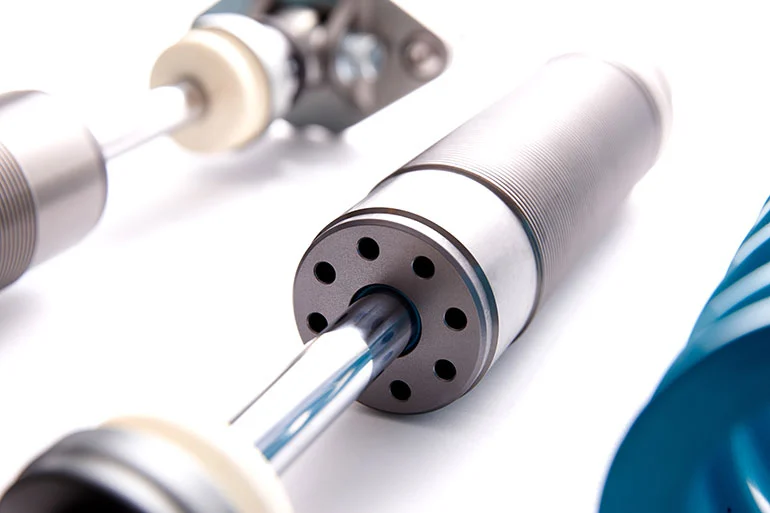
In the high-stakes environment of modern manufacturing, efficiency is often equated with speed. However, the pursuit of maximum velocity in automation, robotics, and material handling comes with a hidden, destructive cost: kinetic energy. When a massive robotic arm comes to an abrupt halt or a heavy-duty hydraulic press reaches the end of its stroke, the resulting shock loads act as a silent assassin, systematically degrading the structural integrity of the machine. Industrial shock absorbers, often overlooked as mere peripheral components, serve as the critical "invisible guardians" of industrial equipment, converting violent kinetic energy into harmless heat and ensuring that machines remain productive for years rather than months.
The Physics of Impact: Why Velocity is Not Enough
To understand the necessity of industrial shock absorbers, one must first understand the limitations of basic mechanical design. Consider the automotive analogy: driving a vehicle without a suspension system over rugged terrain would not only be physically painful for the passengers, but it would also lead to the rapid failure of the chassis, wheels, and fasteners. The vehicle would essentially vibrate itself into disrepair.
In the industrial world, this is the reality for machines operating without proper damping. Springs, while useful for storing energy, are fundamentally reactive; they store the energy of an impact only to release it in an oscillating "rebound" effect. While this bounce might be acceptable in a mattress, it is detrimental in precision engineering. Oscillations reduce accuracy, compromise repeatability, and increase cycle times, as the machine must wait for the system to settle before the next movement can safely commence.
Chronology of Mechanical Degradation
The failure of machinery due to shock loads does not happen in a single, dramatic explosion. It is a slow, cumulative process of material fatigue that follows a predictable timeline:
- The Initial Impact: The machine component reaches the end of its stroke or hits a mechanical stop. The instantaneous deceleration generates a massive "G-force" spike, transmitted directly through the rigid structure of the machine.
- Structural Stressing: This force is concentrated at pivot joints, bearings, welds, and fasteners. While the components may appear robust, they are subject to microscopic deformations at the molecular level.
- Material Fatigue and Fissuring: Repeated cycles lead to "mushrooming" of contact surfaces, where the metal physically deforms under the constant, high-velocity hammering. Fissures begin to propagate within the grain structure of the steel.
- Component Failure: Bearings develop excessive play, bushings wear unevenly, and welds begin to crack. At this stage, the machine loses its precision, producing out-of-tolerance parts, and eventually suffers a catastrophic mechanical failure that halts production.
Supporting Data: The Case for Controlled Deceleration
Standard hydraulic or pneumatic cylinder cushions—while common—are often insufficient for modern high-speed requirements. These cushions are designed to operate only over the final inch of piston travel. In high-velocity applications, this one-inch buffer is rarely enough to safely dissipate the total kinetic energy of the system.
The "ideal" shock absorber operates on a different principle: it spreads the deceleration over the entire length of the stroke. By converting linear motion energy into heat through the displacement of hydraulic fluid via an orifice, the shock absorber ensures a linear, predictable deceleration curve.
Calculating the Load
Engineers must perform rigorous calculations to select the correct damping solution. The variables involved include:
- Mass (M): The weight of the moving load.
- Velocity (V): The speed at which the load is moving at the moment of impact.
- Driving Force (F): The force provided by the cylinder or actuator during the stroke.
- Equipment Fragility: The maximum allowable deceleration (G-load) that the machine structure can endure before permanent deformation occurs.
By balancing these factors, engineers can select dampers with the appropriate orifice geometry to ensure the load is brought to a rest smoothly, avoiding the "deadheading" effect where a machine component strikes a hard metal stop.
Professional Perspectives: Engineering for Longevity
Industry experts emphasize that the incorporation of shock absorbers is not merely a safety measure; it is a fundamental design philosophy for "future-proofing" a facility.
"When you remove the shock, you remove the stress," says one lead systems integrator. "Many plant managers focus on the cost of the shock absorber itself, but they fail to look at the total cost of ownership. A machine that is shielded from impact forces will see an exponential increase in the time between required maintenance cycles. The bearings last longer, the fasteners stay tight, and the entire structural frame retains its factory-spec alignment."
Furthermore, modern shock absorbers are highly customizable. They are available in various mounting styles—rigid, trunnion, or clevis—allowing them to be retrofitted into existing systems that may have been designed before the need for high-speed operation was realized.
The Broader Implications: Safety, Noise, and Efficiency
The implications of installing high-quality industrial shock absorbers extend far beyond the mechanical longevity of the machine.
1. Noise Reduction
The "clanging" or "banging" often heard in factory settings is, in fact, the sound of energy being wasted. It is the acoustic manifestation of structural damage. By eliminating the metal-on-metal impact, shock absorbers contribute to a quieter, more compliant, and more professional working environment.
2. Operational Safety
High-speed automated equipment carries significant risk to human operators. When a machine is properly damped, it behaves predictably. Uncontrolled oscillations or the premature failure of a structural member (like a support bracket) can lead to flying debris or unexpected machine movement, posing a serious safety hazard. Damping keeps the machine within its designed operational parameters.
3. Throughput and Productivity
There is a common misconception that shock absorbers slow down a machine. In reality, they enable higher speeds. Without a shock absorber, a machine operator or programmer must cap the maximum velocity of the system to prevent the "bang" at the end of the stroke. With a shock absorber installed, the machine can operate at its peak design speed for the majority of the stroke, using the absorber to safely transition to a halt at the final position. This increases the total number of cycles per hour, directly impacting the bottom line.
Conclusion: Investing in Reliability
The industrial shock absorber is an essential component for any operation looking to maximize the return on its machinery investment. Whether the application involves small-scale material handling or massive, multi-ton coil cars, the principles of physics remain the same: uncontrolled kinetic energy is the enemy of longevity.
By transitioning from rigid stops to fluid-based damping, manufacturers can stop the cycle of material fatigue, reduce the frequency of unplanned maintenance, and create a safer, more predictable production environment. As automation continues to accelerate, the role of the humble shock absorber will only become more critical—serving as the silent, reliable buffer that allows modern industry to move faster, work harder, and last longer.
If your facility is experiencing excessive vibration, high-impact noise, or recurring premature failure of joints and fasteners, the solution may not be to slow down, but to upgrade your damping technology. Investing in the right shock absorbers is an investment in the long-term health of your entire operation.