By William G. Wong, Senior Content Director
Main Facts
The recently concluded Embedded World North America (EWNA) 2026 proved to be a milestone event for the global electronics and embedded systems community. Exhibiting a noticeable expansion in scale, foot traffic, and exhibitor participation compared to previous iterations, EWNA 2026 delivered a comprehensive showcase of next-generation hardware, specialized software, and architectural frameworks tailored for the demands of modern edge computing.
While artificial intelligence (AI) remained the overarching narrative threading through the exhibition halls, the hardware floor was heavily dominated by innovations designed to survive harsh environments. Manufacturers increasingly focus on ruggedized form factors, enhanced peripheral expansion via M.2 slots, high-speed Ethernet connectivity equipped with time-sensitive networking (TSN), and natively integrated AI processing units.
Key product unveilings at the convention highlighted several distinct industry trends:

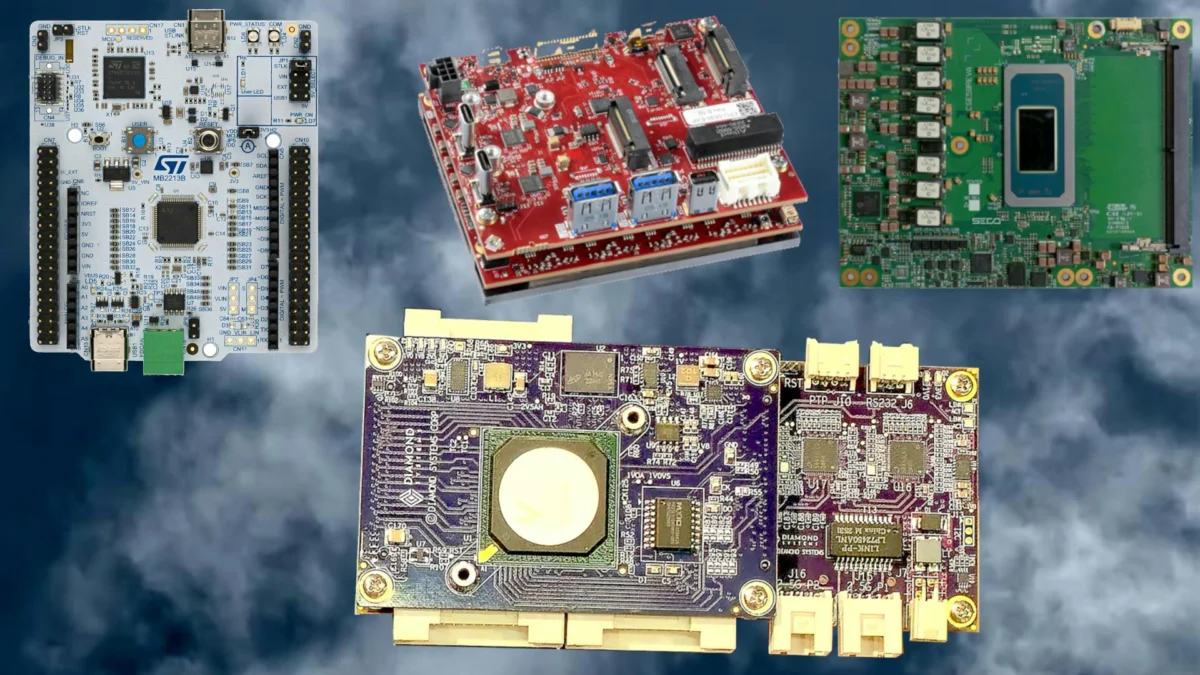
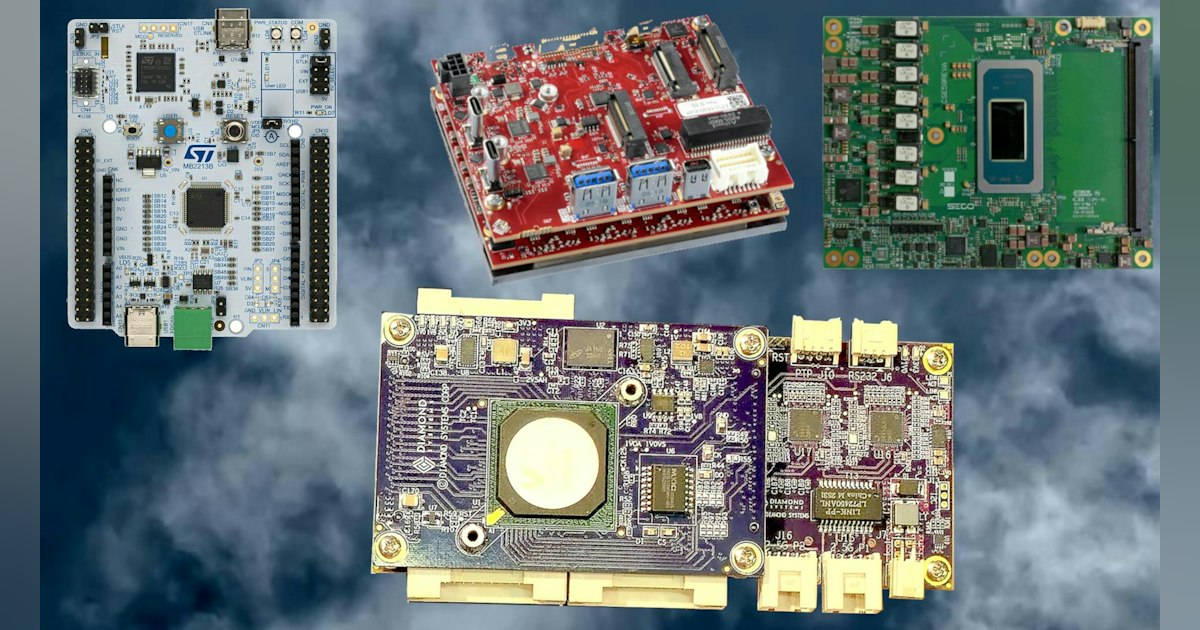
- STMicroelectronics introduced its low-power, high-efficiency STM32C5 microcontroller, designed to optimize system bills-of-materials (BOM) without sacrificing cryptographic security or connectivity.
- Diamond Systems expanded its rugged networking lineup with the EPS-12002C managed Ethernet switch, built specifically to withstand extreme industrial and transportation environments.
- SECO revealed its high-performance SOM-COMe-BT6-PTL COM Express module, harnessing Intel’s Core Ultra Series 3 (Panther Lake-H) processors to bring massive on-device AI acceleration to edge applications.
- VersaLogic debuted the Raptor, an ultra-compact COM-HPC Mini single-board computer (SBC) combining high-end Intel processing with robust MIL-STD-202H shock and vibration resilience.
Chronology of the Event and Industry Context
The trajectory leading up to Embedded World North America 2026 has been defined by a rapid acceleration in edge intelligence and the industrial Internet of Things (IoT). Over the past several years, embedded developers have transitioned from experimenting with machine learning proofs-of-concept to demanding fully integrated, silicon-level AI accelerators capable of operating under strict thermal and power envelopes.
In the months preceding the 2026 conference, supply chain stabilization allowed semiconductor vendors and hardware board manufacturers to accelerate product roadmaps that were previously delayed or constrained. As industries ranging from automotive and aerospace to industrial automation and smart infrastructure demand higher data throughput, the conference served as the premier venue for vendors to debut components capable of meeting these stringent timelines.
During the event itself, the cadence of product announcements followed a clear progression:
- Day One: Focus heavily centered on foundational silicon. Manufacturers rolled out microcontrollers and microprocessors engineered for ultra-low power consumption and embedded security, setting the stage for edge deployments.
- Day Two: Attention shifted toward high-speed interconnects, carrier boards, and modular computing standards. Companies emphasized the need for determinism in industrial networks, spotlighting TSN and multi-gigabit Ethernet architectures.
- Day Three: The exhibition floor culminated in specialized, highly ruggedized single-board computers and Computer-on-Modules (COMs) designed to integrate these cutting-edge processors into mission-critical, deployable systems.
Supporting Data and Technical Breakdown
The hardware items highlighted at EWNA 2026 underscore a broader shift toward greater functional integration, higher peripheral bandwidth, and uncompromising durability. Below is a detailed technical breakdown of the standout hardware items presented at the show.

STMicroelectronics STM32C5 Microcontroller
Targeting developers seeking a balance between cost, performance, and power efficiency, the STM32C5 is built around a 144-MHz Arm Cortex-M33 core.
- Memory and Processing Architecture: The chip features 1 MB of flash memory, 256 kB of RAM, 64 kB of data flash, and 4.5 kB of one-time programmable (OTP) memory. It also includes a dedicated floating-point unit (FPU) and a CORDIC math processor designed to accelerate trigonometric functions at the hardware level.
- Power Efficiency: Engineered as a low-power solution, the device exhibits a dynamic power consumption profile of under 80 µA/MHz. System-level BOM costs are further reduced by an integrated 1% calibrated RC oscillator operating across a –20 to 105°C temperature range. Packages are available in footprints as small as 3 × 3 mm.
- Connectivity and Peripherals: The STM32C5 supports 10/100 Ethernet, a pair of FD-CAN interfaces, USB 2.0 host/device capabilities, and an octal SPI interface compatible with HyperFlash and HyperRAM. Peripheral communication is rounded out by one I3C port and two I²C ports. For analog data acquisition, three 12-bit analog-to-digital converters (ADCs) support up to 30 channels at 2.25 MSPS—or up to 4.5 MSPS when configured in dual interleaved mode—alongside a single 12-bit DAC and an onboard comparator.
- Security Framework: Security is a central pillar of the STM32C5, featuring two AES coprocessors with differential power analysis (DPA) resistance. Hardware accelerators manage hash functions and public keys, supported by a true random number generator and a unique 96-bit identification number.
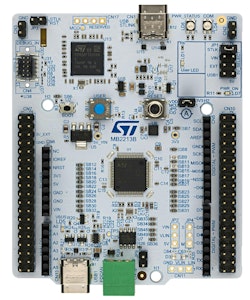
- Development Ecosystem: STMicroelectronics supports the chip via its STM32C5 Nucleo development board, which includes Arduino Uno V3 headers and ST Morpho headers, all fully integrated into the STM32Cube IDE and ecosystem.
Diamond Systems EPS-12002C Managed Ethernet Switch
Designed specifically for rolling stock, defense, and other rugged transportation environments, Diamond Systems introduced the EPS-12002C Managed Ethernet Switch.
- Physical and Thermal Design: Built to operate reliably in extreme conditions, the switch functions seamlessly across a wide operating temperature range of –40 to +85°C. It utilizes latching I/O connectors that comply with MIL-STD-202G shock and vibration resistance standards. Power input flexibility ranges from 5 to 36 V, and the system is designed to dissipate heat efficiently via a dedicated heatsink or heat spreader.
- Switching and Networking Performance: The module functions as a Layer 2+ switch while also supporting Layer 3 routing and switching capabilities. It is equipped with up to two 2.5G ports and either eight or twelve 1G ports. For ultra-high-speed backbones, the related EPS-12002L variant introduces support for 10G SFP+ sockets.
- Timing and Management: The device includes native support for the IEEE-1588 precision time protocol, making it ideal for synchronized industrial networks. Configuration is managed via an RS-232 port or through a comprehensive, user-friendly GUI-based configuration software suite provided by the manufacturer.
SECO SOM-COMe-BT6-PTL COM Express Module
Modular computing standards continue to evolve rapidly to meet the insatiable appetite for edge AI compute. SECO’s entry at the show—the SOM-COMe-BT6-PTL—demonstrates how high-performance desktop-class architectures are migrating into modular embedded formats.
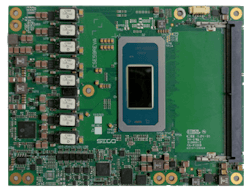
- Processor and AI Acceleration: Formulated around the COM Express Type 6 compact form factor, the module supports Intel’s Core Ultra Series 3 (code-named Panther Lake-H) processors. The onboard Intel GPU integrates a dozen Xe cores capable of delivering up to 180 TOPS of compute power, while the dedicated low-power Neural Processing Unit (NPU) contributes an additional 50 TOPS.
- Memory and Expansion: The board features a pair of DDR5 SO-DIMM slots capable of accommodating up to 96 GB of memory using DDR5-5600 modules. Expansion capabilities are expansive, exposing 20 PCI Express lanes, eight high-speed USB ports, four 10-Gb/s SuperSpeed ports, and two 40-Gb/s USB 4 ports. Networking is anchored by a 2.5G Ethernet port with time-sensitive networking (TSN) support. For high-reliability storage, orders can be customized with a soldered 1 TB NVMe SSD.
- Operating System Support: The module offers broad OS compatibility, supporting mainstream Linux distributions (including SECO’s proprietary Clea OS) as well as Windows 10 IoT Enterprise.
VersaLogic Raptor Single-Board Computer
Representing the cutting-edge of ultra-small-form-factor design, VersaLogic showcased the Raptor, an 80- × 95-mm COM-HPC Mini single-board computer engineered to meet rigorous MIL-STD-202H shock and vibration specifications.
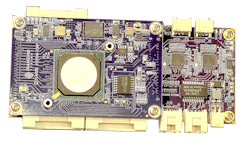
- Processing Core: The Raptor can be configured with either an Intel U300e processor featuring Intel UHD Graphics or a more powerful Core i5-1345URE paired with Iris Xe graphics.
- Storage and Expansion: Despite its diminutive footprint, the board features robust storage capabilities, integrating a pair of M.2 2242 slots and a single M.2 2280 slot, which can accommodate NVMe SSDs or specialized expansion cards.
- Connectivity: Communication interfaces include magnetically isolated dual 2.5G Ethernet ports equipped with latching sockets and full time-sensitive networking (TSN) support. USB connectivity is extensive, offering eight USB 2.0 ports, two USB 3.2 ports, and two USB 4.0 ports, alongside dual serial ports. Additional modular expansion for ADCs and CAN bus interfaces is accessible via the board’s M.2 M-key slots.
Official Responses and Industry Perspectives
Engineering leaders and product directors at EWNA 2026 emphasized that the conversation surrounding edge computing has matured significantly. Rather than viewing AI as a standalone software add-on, developers are demanding hardware solutions where intelligence, security, and deterministic networking are baked directly into the silicon and board architecture.
Industry stakeholders noted that the convergence of M.2 expansion slots, high-speed multi-gigabit Ethernet, and TSN across microcontrollers, COM modules, and single-board computers is no longer a luxury—it is an operational requirement. As industrial automation systems, autonomous vehicles, and smart grid infrastructures demand tighter synchronization and lower latency, component manufacturers are responding with hardware platforms that balance extreme environmental durability with high-density data processing capabilities.
Implications for the Embedded Systems Industry
The hardware trends solidified at Embedded World North America 2026 carry several critical implications for engineers, developers, and original equipment manufacturers (OEMs):
- Mainstream Adoption of Edge AI: With NPUs and high-performance GPUs becoming standard features on modules like SECO’s COM Express boards and VersaLogic’s Raptor, running complex machine learning models directly at the endpoint is becoming frictionless. Developers no longer need to rely exclusively on cloud connectivity for real-time inference.
- Elevated Standards for Rugged Reliability: The widespread integration of MIL-STD shock/vibration compliance, latching connectors, and extended temperature ranges highlights that industrial and transportation markets are setting the baseline for hardware quality. Consumer-grade tolerances are increasingly inadequate for deployed industrial assets.
- The Rise of Deterministic Networking: The widespread inclusion of 2.5G and 10G Ethernet ports featuring Time-Sensitive Networking (TSN) signals a clear industry shift toward unified, deterministic communication protocols. This is crucial for applications requiring absolute time synchronization across distributed nodes, such as factory automation and robotics.
- Simplifying System Architecture via Modular Design: The continued popularity of standardized modules (such as COM Express Type 6 and COM-HPC Mini) allows OEMs to customize carrier boards rapidly while future-proofing their core processing investments against rapid silicon generational cycles.
As these hardware components transition from trade show floors into commercial deployment, they will empower engineers to build smarter, faster, and remarkably resilient embedded systems capable of thriving in the world’s most demanding operational environments.