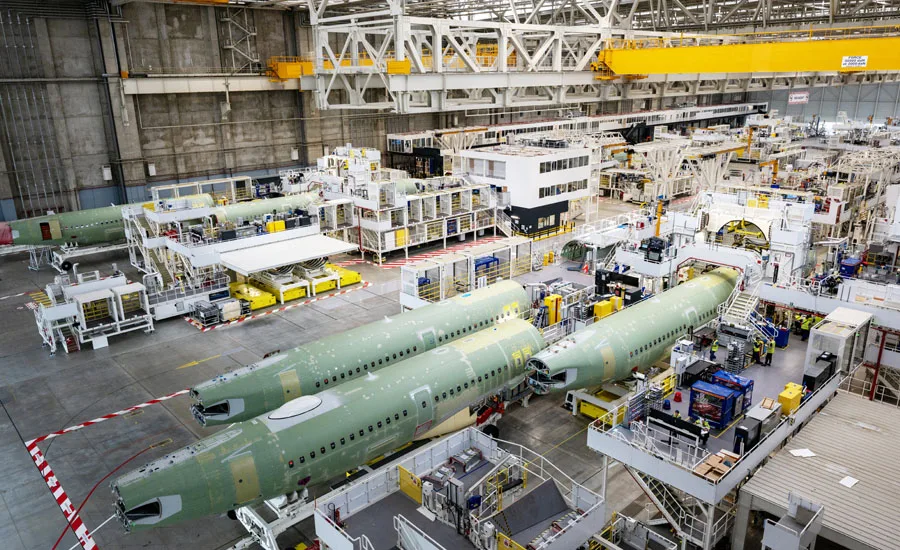
TIANJIN, China — In a landmark development for international aerospace manufacturing and commercial aviation, European aviation giant Airbus has officially delivered its first A320 narrowbody passenger jet produced at its newly operational final assembly line (FAL) in Tianjin, China. The milestone aircraft was handed over to Shanghai-based carrier China Eastern Airlines, further solidifying a decades-long partnership between the airline and the manufacturer while underscoring Airbus’s aggressive strategy to deepen its footprint in the world’s second-largest aviation market.
The delivery represents far more than a routine handover; it serves as tangible evidence of Airbus’s expanding industrial capacity in Asia at a time when global aerospace supply chains are under immense pressure to meet surging post-pandemic travel demand. As aviation markets rebound and expand, localized manufacturing hubs have become essential tools for aerospace companies aiming to mitigate geopolitical risks, reduce logistics overhead, and align more closely with regional airline customers.
Main Facts
The milestone delivery involves an Airbus A320 single-aisle aircraft assembled entirely at the manufacturer’s second final assembly facility in Tianjin, a cutting-edge industrial hub located in northern China. The recipient, China Eastern Airlines, is one of the "Big Three" state-owned carriers in the People’s Republic of China and a foundational partner for Airbus in the region.
The new Tianjin facility—officially inaugurated in October 2025—is Airbus’s second assembly line in the Chinese port city and its tenth final assembly line worldwide. With this addition, Airbus continues to distribute its manufacturing footprint across strategic global locations, joining a network that includes four assembly lines in Hamburg, Germany; two in Toulouse, France; and two in Mobile, Alabama, in the United States.
This localized production capability is critical as Airbus aggressively ramps up its global output. The company has set a formidable production target of 75 A320-family aircraft per month, a rate that requires seamless synchronization across its global supply chain, workforce training programs, and final assembly plants. By expanding capacity in Tianjin, Airbus not only boosts its overall production volume but also positions itself strategically inside a vital domestic market that is projected to experience exponential growth over the next two decades.
Chronology: Building a Partnership and a Manufacturing Hub
To fully understand the weight of this recent delivery, it is necessary to examine the historical trajectory of Airbus in China, a relationship that spans four decades and mirrors the country’s rise as an economic and aviation superpower.
The Foundation: 1985
Airbus’s history in China dates back to 1985, a pivotal year that marked the beginning of commercial aviation modernization in the country. It was then that China Eastern Airlines—operating under its earlier regional structures—took delivery of China’s very first Airbus aircraft, an A310 widebody jet. This initial purchase broke the monopoly of domestic and Soviet-built aircraft in Chinese skies, opening the door for Western aerospace manufacturers to establish a foothold in a burgeoning market.
The First Tianjin Breakthrough: 2008
For more than two decades, Airbus aircraft delivered to Chinese carriers were imported entirely from European assembly lines. However, recognizing the strategic importance of localizing production, Airbus broke ground on its first Asia-based final assembly line in Tianjin in 2005, officially opening the facility in 2008. The Tianjin A320 Family Final Assembly Line (FALC) was the first of its kind outside of Europe, proving that complex, high-precision aerospace manufacturing could be successfully executed in China to the exact same stringent quality and safety standards maintained in Toulouse and Hamburg.
Scaling Up: The October 2025 Inauguration
Building on nearly two decades of operational success at the first Tianjin plant, Airbus broke ground on a second assembly line in the city to meet unrelenting regional demand. Inaugurated in October 2025, this second line expands Tianjin’s capacity to build A320-family aircraft, effectively doubling Airbus’s industrial footprint in northern China. The rapid construction and commissioning of this second line reflect both local government backing and Airbus’s confidence in the Chinese aerospace manufacturing ecosystem.
The Milestone Delivery: Current Operations
Just months after the inauguration of the second assembly line, the facility has rolled out and delivered its first completed A320 aircraft to China Eastern Airlines. This rapid turnaround from line inauguration to first delivery demonstrates the maturity of the local supply chain, the proficiency of the Tianjin workforce, and the seamless integration of advanced automation and digital manufacturing tools deployed by Airbus.
Supporting Data: Fleet Strengths and Market Projections
The partnership between Airbus and China Eastern Airlines is defined by staggering scale. According to operational data finalized at the end of August, China Eastern operates the largest Airbus fleet among all airlines on the Chinese mainland.
The carrier’s massive fleet composition includes:
- 393 A320-family aircraft: Serving as the backbone of China Eastern’s domestic and regional short-to-medium-haul network.
- 56 A330 aircraft: Providing widebody capacity for high-density domestic routes and regional international flights.
- 20 A350-900 aircraft: Acting as the flagship long-haul fleet, connecting major Chinese hubs like Shanghai with global financial capitals in Europe, North America, and beyond.
Beyond individual airline statistics, broader macroeconomic projections paint an exceptionally bright picture for the aerospace sector in China. According to long-term market forecasts by Airbus, China is expected to require 8,830 new passenger and freighter aircraft over the next two decades (spanning from 2026 through 2045).
To put this into a global perspective:
- Global demand for new aircraft over the same 20-year period is projected to reach 42,060 units.
- China alone will account for more than 20 percent of the entire global demand for commercial aircraft.
This massive appetite for new planes is driven by a rapidly expanding middle class, increasing urbanization, the liberalization of airspace, and the ongoing need for Chinese carriers to modernize their fleets with more fuel-efficient, lower-emission narrowbody jets like the A320neo family.
Official Responses and Industry Perspectives
Executives from both Airbus and China Eastern Airlines have hailed the successful delivery as a testament to deep bilateral industrial cooperation and a shared vision for the future of commercial aviation.
Senior leadership at Airbus emphasized that expanding production in Tianjin is a cornerstone of the company’s globalization strategy. "Delivering the first A320 from our newest assembly line in Tianjin to our historic partner, China Eastern Airlines, marks a proud chapter in our long-term commitment to China," an Airbus spokesperson noted. "By building aircraft where the demand is strongest, we not only optimize our global supply chain and support our goal of reaching 75 aircraft per month, but we also ensure that we remain deeply integrated into the local aviation ecosystem."
Representatives from China Eastern Airlines echoed these sentiments, highlighting the operational advantages of acquiring locally manufactured aircraft that meet the highest international safety and efficiency benchmarks. "Our relationship with Airbus spans forty years, starting with the pioneering introduction of the A310 in 1985," a China Eastern executive stated. "Taking delivery of this locally assembled A320 symbolizes the evolution of our fleet. With nearly 400 Airbus narrowbody aircraft now in our service, this modern, fuel-efficient jet will play a vital role in maintaining our operational reliability, reducing our carbon intensity, and meeting the travel needs of millions of passengers across China."
Industry analysts point out that the successful operation of two final assembly lines in Tianjin provides Airbus with a distinct competitive advantage in the Asia-Pacific region. While geopolitical tensions and trade friction have complicated manufacturing operations in other sectors, aerospace manufacturing in China—anchored by joint ventures and rigorous quality control—continues to thrive, serving as a model for international industrial collaboration.
Implications for the Global Aerospace and Assembly Industry
The successful launch and initial delivery from Airbus’s second Tianjin assembly line carry profound implications for the global manufacturing, assembly, and aviation sectors.
1. Supply Chain Resilience and Decentralization
For decades, final assembly of commercial airliners was concentrated heavily in Western Europe and the United States. The maturation of Airbus’s Tianjin facility—alongside its Mobile, Alabama plant—proves that decentralized final assembly is not only viable but essential for modern aerospace operations. By building aircraft closer to major end-user markets, Airbus reduces transportation logistics costs, lowers carbon emissions associated with ferry flights, and hedges against regional supply chain disruptions.
2. Adoption of Advanced Assembly Technologies
The expansion in Tianjin is not merely about square footage; it represents a leap forward in manufacturing technology. Airbus has increasingly integrated advanced robotics, automated guided vehicles (AGVs), digital twins, and AI-driven quality inspection tools into its assembly lines worldwide—including seat installation automation and precision fuselage joining. The Tianjin facilities serve as testbeds for smart manufacturing techniques that are being shared across Airbus’s global network to hit the ambitious target of 75 A320s per month.
3. Workforce Development and Engineering Expertise
High-stakes aerospace manufacturing requires an exceptionally skilled workforce. The success of the Tianjin assembly lines underscores the rapid advancement of aerospace engineering and vocational training programs in China. Thousands of local technicians, engineers, and quality assurance specialists have been trained to meet European Aviation Safety Agency (EASA) and Civil Aviation Administration of China (CAAC) standards, setting a high benchmark for industrial manufacturing talent in the region.
4. Environmental Sustainability Goals
With airlines facing immense regulatory and public pressure to achieve net-zero carbon emissions by 2050, the introduction of newer, more fuel-efficient aircraft is paramount. The A320 aircraft delivered to China Eastern features advanced aerodynamics and modern powerplant options that significantly reduce fuel consumption and noise footprints compared to older-generation narrowbodies. By ramping up production of these eco-efficient aircraft in local facilities, Airbus and its airline partners are accelerating the green transition of China’s massive commercial aviation fleet.
Conclusion
As the first locally produced A320 from Airbus’s second Tianjin assembly line takes to the skies under China Eastern livery, the global aerospace industry is witnessing a shifting paradigm. Through strategic investments, technological innovation, and enduring international partnerships, Airbus has cemented its position in the world’s most dynamic aviation market. With thousands of aircraft needed in the region over the coming decades, Tianjin is poised to remain a vital engine of global aerospace manufacturing for generations to come.