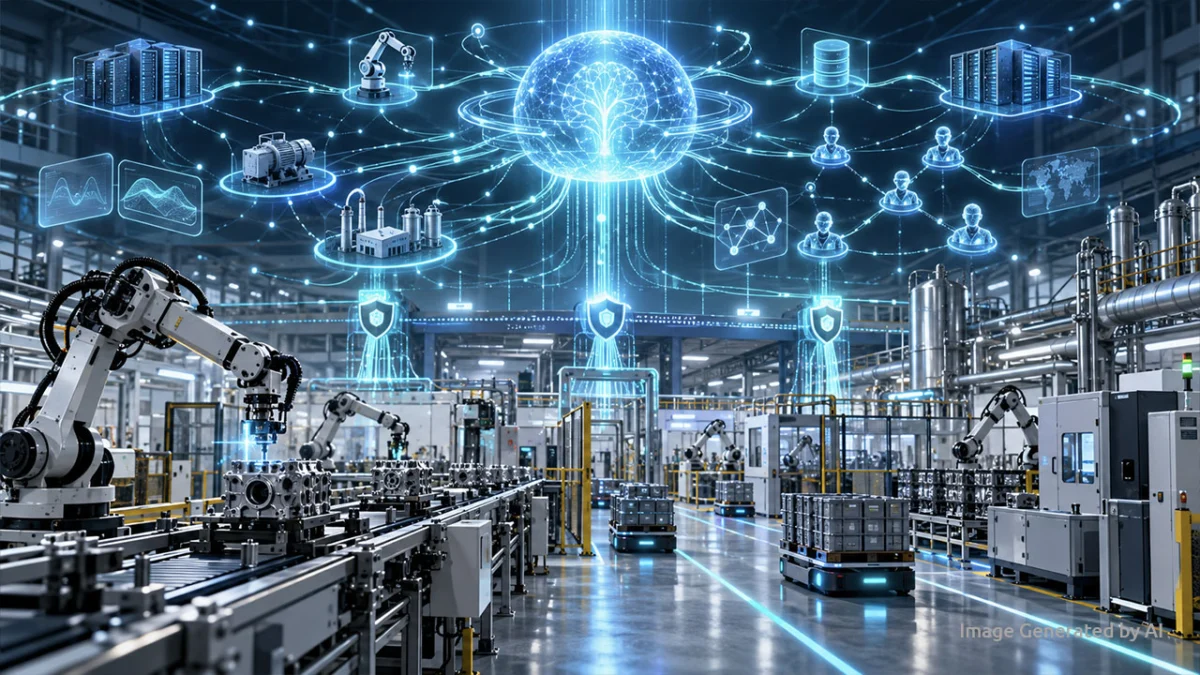
The transition toward the "autonomous factory" is no longer a futuristic pipe dream; it is an active engineering challenge currently being solved on the shop floors of the world’s most advanced manufacturers. Following the highly attended "From Data Streaming to Autonomous Action" session at the Industrial AI Summit 2026, a critical discourse has emerged regarding how Large Language Models (LLMs) can be integrated safely, effectively, and scalably into industrial environments.
This is the second of a three-part series exploring the unanswered questions from that session. While our first installment focused on the foundational layers of data and context, this article pivots to the technical architecture of the future. We examine the mechanics of connecting AI to operational technology (OT), the state of the industrial software stack, the looming necessity of governance standards, and the shifting role of the LLM from a simple interface to an intelligent orchestrator.
To unpack these complexities, we turn to the insights of Peter Sorowka, CEO of Cybus, who addresses the critical architecture hurdles facing Industry 4.0 today.
The MCP Concept: Giving LLMs a "Front Door" to the Factory
At the heart of the current architectural debate is the Model Context Protocol (MCP). As LLMs become more agentic, they require a standardized way to perceive and interact with the physical world. In a factory setting, that world consists of complex namespaces, intricate asset hierarchies, and high-frequency live data streams.
According to Sorowka, the MCP serves as a universal translator—a standardized interface that allows an LLM to discover, interpret, and call tools within the plant. "Applied to a factory, the tool is the factory model itself," Sorowka explains. "The MCP allows any LLM, whether chat-based or fully agentic, to understand available data, its relations, its context, and its meaning, enabling it to both read and act upon it with the same access rules that apply to human operators."
By providing this structured "entry point," the MCP solves the problem of siloed data. Rather than building custom integrations for every specific AI model, the MCP allows a manufacturer to expose their data once, ensuring that any authorized AI agent can navigate the plant’s digital twin with precision.
The Landscape of Industrial AI Platforms
A recurring question from the summit attendees concerned the "what" and "where" of AI implementation. Manufacturers are currently caught between three distinct deployment patterns, each with its own trade-offs regarding security, latency, and capability.
- Hosted Assistants: Organizations are leveraging platforms like Microsoft Copilot Studio, which reach into the factory environment via API keys. This is the path of least resistance for many, utilizing mature, enterprise-grade AI interfaces.
- In-House GPT Front-Ends: Some companies are building custom wrappers around established models from OpenAI, Anthropic, or Google. This allows for greater control over the user experience and the specific prompts sent to the model.
- Self-Hosted/On-Premise Models: For industries with stringent security requirements—such as aerospace, defense, or high-end pharmaceutical manufacturing—the data must never leave the plant. These organizations are increasingly deploying local models that offer the intelligence of LLMs without the risks associated with cloud transmission.
"Cybus does not run the models themselves," Sorowka notes. "Our design commitment is that our Connectware platform behaves consistently, regardless of which model sits on the other end. We use Claude and Copilot internally, but our architecture is model-agnostic, allowing our customers to choose the deployment pattern that fits their unique security and operational requirements."
The Great Standards Gap: Connectivity vs. Contextualization
The industrial sector is currently in a "standards limbo." While connectivity—the ability to extract data from machines—is largely a solved problem thanks to established protocols like OPC UA and MQTT, the meaning of that data remains elusive.
"Connectivity is solved, but contextualization is not," Sorowka observes. "We see AAS (Asset Administration Shell), i3X, and various UNS (Unified Namespace) conventions all competing for dominance. Most plants model their data differently even from one site to another, creating a massive barrier to global scaling."
The lack of an industrial standard for AI-to-machine governance is the most pressing issue. While the MCP helps with the "call" (the action), it does not solve the "permission" (the governance). Sorowka’s advice to manufacturers is pragmatic: "Don’t wait for a single standard to win. Declare your model in a form you can project into AAS or i3X later. Flexibility is your best defense against the current fragmentation."
The LLM: Orchestrator or Decision-Maker?
One of the most profound debates in modern automation is whether the LLM should be the primary decision-maker or merely an interface. Sorowka posits that the LLM is currently best suited as the orchestrator.
"The industrial value still comes from specialized models—anomaly detection, time-series forecasting, and optimization algorithms," he explains. "These models do not become obsolete; they are the experts in their domains. The LLM adds ‘reach.’ It provides a natural language layer that pulls the factory context, triggers those specialized models, and synthesizes the results for human consumption."
The danger lies in allowing LLMs to make autonomous physical decisions without guardrails. Sorowka emphasizes that in any high-stakes environment, the model should propose, and a separate policy layer should decide. "Decisions with physical consequences must be bound by declared rules and interlocks. The LLM coordinates, but the policy layer enforces the safety boundaries."
Agent-to-Agent Interactions and the Identity Crisis
As the industry moves toward autonomous systems, we are beginning to see a shift from human-to-agent interactions toward agent-to-agent chains. This evolution presents a complex identity challenge.
"Right now, an assistant reaches Connectware over an MCP server using a key that acts on behalf of a named person," says Sorowka. "However, when the caller is another agent, the ‘on behalf of a person’ model starts to break down. We are currently developing agent-identity frameworks where an agent has its own accountable owner. Our position is that the governance boundary must remain at the factory edge. Regardless of what protocol agents use to talk to each other, the plant must be able to audit and restrict every action taken by an agent."
The Evolution of Manufacturing: Tools vs. Processes
A historical parallel is often drawn between the introduction of electricity in factories and the current AI revolution. Much like early manufacturers who simply replaced steam engines with electric motors without redesigning their workflows, many modern firms are merely using AI as a "faster dashboard."
"Most projects today are still doing the ‘steam-to-electricity’ swap," Sorowka remarks. "They are replacing a human-read report with an AI-generated summary, but the process remains unchanged. The real gain comes when the decision loop shrinks. We are looking at a future where we have fewer handoffs and more direct, automated action."
This transition will inevitably change organizational structures. We are likely to see "hybrid org charts" where humans and agents collaborate in unprecedented ways. As these loops close, the role of governance will become paramount. Security, compliance, and approval flows must be baked into the architecture, not added as an afterthought.
Implications: Preparing for the Autonomous Future
The transition toward autonomous action is a multi-year journey that requires both technological agility and a fundamental rethink of governance. For industrial leaders, the key takeaways from the 2026 Summit are clear:
- Prioritize Interoperability: Do not tie your architecture to a single LLM provider. Use standard protocols like MCP to ensure your factory data remains accessible to whatever intelligence the future brings.
- Focus on Contextualization: Raw data is useless without context. Invest in creating a unified model of your assets that can be easily translated across evolving standards.
- Governance is the Bottleneck: The ability to execute a command is easy; the ability to prove that command is safe and authorized is hard. Build your policy layers with the assumption that AI agents will eventually have the authority to act.
- Redesign the Process: Do not just use AI to make old reports faster. Use it to eliminate the report entirely by enabling autonomous decision-making loops.
As we look toward the final installment of this series, we will examine the security implications of this transition and how manufacturers can protect their most sensitive data while embracing the benefits of the AI-powered factory.
These insights were derived from the "From Data Streaming to Autonomous Action" session at the Industrial AI Summit 2026. The panel featured experts including Kudzai Manditereza of HiveMQ, David Puron of Barbara, Jonathan Alexander of Albemarle, and Hamish Mackenzie of IIoT World. The session was proudly sponsored by Cybus, Barbara, and HiveMQ.