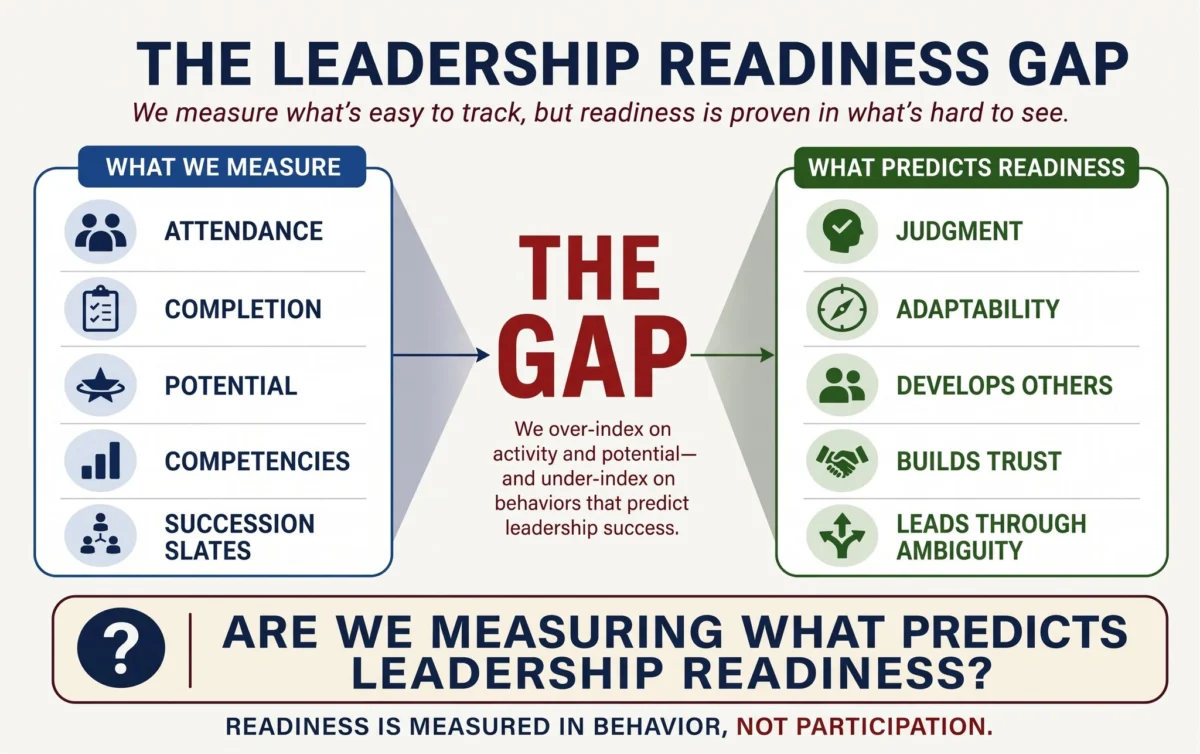
In the high-stakes world of corporate talent management, there is a recurring, uncomfortable moment that keeps executives awake at night. An organization spends years meticulously identifying high-potential talent, curating leadership development programs, and mapping out the "next generation" of executives. Yet, when a critical vacancy suddenly arises, the boardroom conversation inevitably shifts from the confident "Who is next?" to the desperate, whispered question: "Who is actually ready?"
This disconnect has become a defining challenge of the modern corporate era. While succession planning remains a staple of organizational strategy, the underlying assumption—that identifying high potential is synonymous with ensuring future success—is increasingly proving to be a fallacy. Many organizations are discovering that they do not have a succession planning problem; they have a leadership readiness problem.
The Core Problem: Potential vs. Readiness
The data suggests this issue is systemic. According to DDI’s Global Leadership Forecast 2025, a staggering 80 percent of organizations lack confidence in their leadership pipelines. If companies are investing more resources than ever in leadership development, why does the bench feel so thin?
The answer lies in a fundamental confusion between "potential" and "readiness." Potential is a projection; it is a forecast of what an individual might become given the right circumstances. Readiness, by contrast, is an assessment of what an individual can demonstrate today.
Too often, organizations promote employees based on their past performance in individual contributor roles, assuming that the skills that made them stars—technical expertise, high output, and personal ambition—will translate into leadership excellence. When the scope of their role shifts, however, the gap becomes painfully visible. The new mandate often requires them to influence through others, navigate organizational ambiguity, and measure success through the accomplishments of their team rather than their own technical output. When these leaders falter, the organization often blames the individual’s lack of "fit," when in reality, the system failed to provide the necessary developmental scaffolding to bridge the transition.
Chronology of a Failed Promotion
To understand the anatomy of this failure, one must look at the typical trajectory of a "high-potential" hire.
- The Identification Phase: The employee is identified as a rising star based on strong KPIs, credibility, and ambition. They are funneled into leadership workshops and networking cohorts.
- The Assumption Phase: Management assumes the formal training, combined with their track record, makes them "ready" for the next tier of leadership.
- The Promotion Phase: The employee is elevated. The transition is treated as an achievement rather than a new challenge requiring a different set of muscles.
- The Exposure Phase: The new leader struggles to delegate or influence across silos. The team’s performance dips, and the leader’s own motivation begins to wane as their previous "winning formula" stops working.
- The Retrospective Phase: The organization labels the promotion a mistake, often leaving a talented employee demoralized and the company with a significant leadership vacuum.
This cycle is the direct result of a system that treats succession planning as a static list of names rather than a dynamic process of cultivation.
The Leadership Readiness Gap
Leadership readiness is inherently contextual. A manager may be perfectly equipped to lead a stable, established team, but entirely unready to lead a massive digital transformation, a corporate turnaround, or a phase of hyper-growth.
True readiness asks a specific, hard-hitting question: Does this person possess the specific capability, judgment, and experience required for the next challenge the organization will face? If the answer is "not yet," the organization must be prepared to bridge that gap before the promotion happens. This requires a shift from viewing leadership as a destination to viewing it as a continuous cycle of: Succession decisions → Identifying readiness gaps → Targeted development experiences → Observation and feedback → Reassessment.
3 Strategic Shifts for Future-Proofing
To close the readiness gap, organizations must undergo a fundamental transformation in how they think about, build, and measure their leadership pipeline.
1. From Potential to Readiness
Organizations must stop viewing "high potential" as a green light for immediate advancement. Instead, the designation of high potential should trigger a new investigative phase. If an employee is earmarked for a promotion, leadership must ask: "What does this person still need to experience, practice, and demonstrate before we place them in that role?"

By framing the promotion as a goal that requires specific, proven evidence of capability, companies can move from a "gamble" approach to a "preparedness" approach. This removes the burden of failure from the individual and places it on the system, which is responsible for ensuring the leader is truly equipped to succeed.
2. From Leadership Programs to Leadership Systems
Formal training programs are useful, but they are insufficient. A "leadership system" is one where development is woven into the fabric of daily work. If a leader needs to master big-picture thinking, they shouldn’t just attend a seminar; they should be assigned a cross-functional project that demands that exact skill.
DDI’s research advocates for "lived performance" as the ultimate litmus test. Organizations that excel at this don’t just rely on theoretical assessments; they create opportunities for candidates to lead in low-stakes, high-learning environments. This systematic approach ensures that by the time a promotion is offered, the evidence of readiness is already in the record.
3. From Measuring Participation to Measuring Impact
For years, HR departments have relied on "vanity metrics"—attendance numbers, completion rates, and learning hours. While easy to track, these metrics rarely correlate with improved leadership effectiveness.
The shift must be toward measuring behavior and business impact. As practiced at organizations like BDO Canada, the core question to ask is: "What value are we adding?" This requires a shift from tracking activity to observing results. Are leaders better at navigating conflict? Are their teams more resilient? Are they developing talent beneath them? These questions require a qualitative, ongoing partnership between HR and business unit leaders, but they provide the only meaningful data that proves a leadership program is working.
Implications for the Modern Enterprise
The implications of this shift are significant. First, it requires a higher degree of transparency. When an organization acknowledges that a high-potential employee is not "ready" for a specific role, it must communicate this as a developmental opportunity rather than a rejection.
Second, it requires a more robust "system of record" for leadership. Organizations must document not just who attended which program, but the specific leadership challenges an individual has faced, how they responded, and the feedback they received. This creates a longitudinal view of a leader’s readiness that is far more reliable than a quarterly performance review.
Finally, it requires a change in culture. Leaders must stop viewing their job as "solving the problem" and start viewing it as "building the bench." When a leader is held accountable for the readiness of their successors, the entire organization becomes a laboratory for development rather than a pressure cooker for burnout.
Conclusion: The Path Forward
The question "Who is next?" is a trap. It encourages a focus on titles, hierarchies, and placeholders. The question "Who is actually ready?" is a catalyst. It forces an honest assessment of capabilities, a commitment to targeted growth, and an obsession with evidence.
If organizations want to stop the cycle of leadership turnover and the pervasive lack of confidence in their pipelines, they must stop treating succession as a planning exercise and start treating it as a performance discipline. Leadership readiness is not something you discover during a quarterly talent review; it is something you build, observe, and refine every single day. The future of the organization depends not on the names on the list, but on the depth of the experience that sits behind them.