By Dinesh Balasubramaniam, Director of Product Marketing, indie Semiconductor
Published by Electronic Design
Vision-based perception has rapidly evolved from a supplemental feature into the central nervous system for modern technology platforms. From advanced driver-assistance systems (ADAS) in automotive applications and autonomous mobile robots (AMRs) operating in warehouses to heavy-duty drones navigating dynamic urban environments, machines increasingly rely on cameras to interpret their physical surroundings.
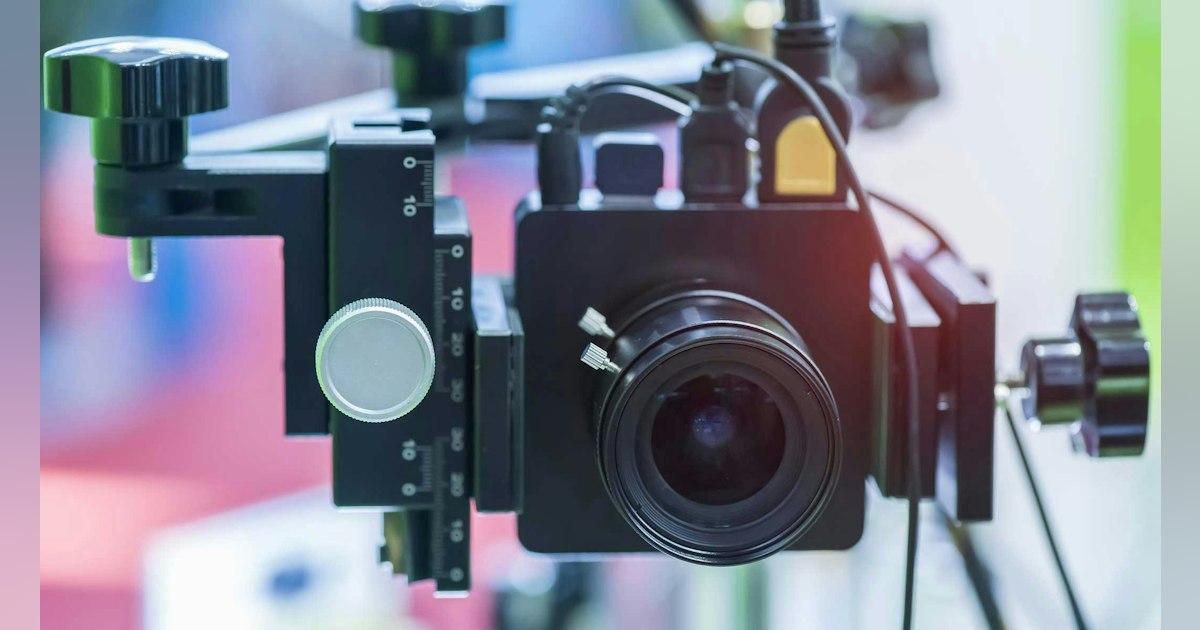
However, as these vision suites expand, the underlying electronic architecture is facing a severe scaling crisis. The traditional method of routing and processing raw pixel data directly through a central system-on-chip (SoC) is hitting a hard hardware wall. To keep pace with the demands of modern artificial intelligence (AI) and machine learning (ML), engineers are increasingly looking toward a decentralized paradigm: decoupling image processing via discrete image signal processors (ISPs).
Main Facts: The Scaling Crisis of Multi-Camera Systems
At the core of every intelligent vision system lies a common ingestion challenge: raw image streams from multiple camera sensors must be captured, processed, and channeled into AI inference pipelines with minimal latency. This data enables systems to detect objects, compute spatial awareness, and initiate split-second physical reactions.

Traditionally, this burden falls entirely on the system’s primary domain controller SoC. However, modern automotive platforms often require six to eight camera sensors to support 360-degree surround views, emergency braking, blind-spot detection, and in-cabin driver monitoring. Robotics and drone platforms face similar density scaling.
When a central SoC attempts to handle raw pixel ingestion, execute the ISP pipeline, and run intensive AI inference workloads simultaneously, it creates severe resource contention. Specifically, because all compute blocks within an SoC share the same dynamic random-access memory (DRAM), pixel-level processing consumes valuable memory bandwidth. Furthermore, DRAM access is inherently non-deterministic, introducing timing jitter that propagates down the entire perception pipeline and hampers system reliability.
Chronology: The Evolution of Vision Processing Bottlenecks
The progression toward current vision architectures highlights a clear trajectory of escalating hardware demands:
- The Single-Camera Era: Early embedded vision applications relied on isolated, single-camera inputs. Central SoCs could effortlessly manage pixel ingestion and image signal processing without straining shared DRAM or introducing noticeable latency.
- The Rise of Sensor Proliferation (AD Autos & Robotics): Driven by regulatory safety mandates and autonomy goals, vehicle camera counts expanded from backup-only sensors to complex, multi-directional arrays (6 to 8+ sensors). In robotics and drones, stereoscopic and multi-directional setups became standard for simultaneous localization and mapping (SLAM).
- The AI Inference Boom: As neural networks took over perception tasks, AI engines began demanding unprecedented memory bandwidth and clock cycles.
- The Architectural Breaking Point: The convergence of high-count camera streams and heavy AI workloads exposed the limitations of SoC-only architectures. Over-specifying expensive, ultra-high-end SoCs proved financially unsustainable, forcing a pivot toward architectural offloading and discrete ISP deployment.
Supporting Data: Discrete ISP vs. Integrated SoC Performance
To quantify the architectural advantages of decoupling image processing, engineers compare end-to-end system latency and resource allocation between integrated and discrete models.
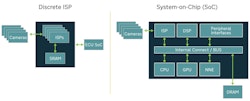
1. The SoC-Only Latency Penalty
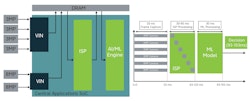
In a traditional SoC-integrated architecture, the internal ISP processes camera feeds sequentially (one at a time). The downstream AI/ML engine must wait until all individual frames are fully processed before inference can begin.
- DRAM Overhead: The ISP pipeline forces multiple read/write cycles directly through the central DRAM.
- Resulting Latency: End-to-end decision latency in a representative multi-camera system scales between 93 milliseconds and 153 milliseconds.
2. The Discrete ISP Advantage
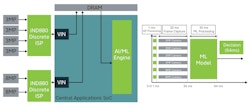
By shifting image processing to a discrete IC—such as the indie iND880 image signal processor—or grouping them into a dedicated sensor hub, the workflow changes dramatically.
- Line-by-Line Processing: A discrete ISP processes images line-by-line using localized static RAM (SRAM) rather than frame-by-frame via shared DRAM.
- Simultaneous Access: All camera streams are made available to the AI/ML engine concurrently, consuming zero DRAM bandwidth on the domain controller.
- Resulting Latency: End-to-end latency drops to approximately 64 milliseconds, reducing worst-case processing delays by up to 90 milliseconds.
Official Responses and Engineering Tradeoffs
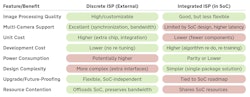
When designing safety-critical systems, engineering teams must weigh the tradeoffs between integrated and discrete architectures. According to industry analysis and hardware deployment data, the decision matrix relies heavily on scalability, predictable latency, and platform longevity.
Application-Specific Impacts of Latency
- Automotive (ADAS): At highway speeds (e.g., 60 mph / 88 ft/s), a reduction in latency from 150 ms to 60 ms translates to eliminating several feet of blind travel distance before emergency braking can physically initiate.
- Autonomous Mobile Robots (AMRs): In fast-moving factory and warehouse environments, sub-millisecond variations in sensor timing can disrupt sensor fusion loops, degrading path planning and obstacle avoidance reliability.
- Autonomous Drones: Operating in dynamic urban airspaces, drones require near-instantaneous visual feedback to maintain stable flight control and execute dynamic obstacle evasion within tight Size, Weight, and Power (SWaP) budgets.
Industry Perspectives on Hardware Freedom
By moving pixel-level processing out of the domain controller, the SoC is liberated to focus strictly on high-value computing: sensor fusion, AI inference, path planning, and executive decision-making.
Furthermore, a discrete ISP approach insulates the imaging pipeline from the SoC’s rapid silicon evolution. OEMs can upgrade their primary domain controller or AI accelerators without requiring a complete redesign of the camera sensor suite or optical pipeline. This modularity protects non-recurring engineering (NRE) investments and helps curb Bill of Materials (BOM) costs across multiple vehicle trims or robotic product tiers.
Implications: Preparing for the Future of Sensor Proliferation
The proliferation of high-resolution cameras across automotive, industrial automation, and aerial robotics is an accelerating reality, not a distant forecast. As systems transition toward full autonomy and humanoid robotics, relying on the central SoC as the default processor for image signals is no longer viable.
The adoption of discrete ISPs and dedicated sensor hubs addresses the three fundamental pillars of modern embedded design:
- Unbounded Scalability: Engineering teams can freely scale camera counts to meet evolving safety and spatial awareness requirements without overhauling the core compute architecture.
- Deterministic Reliability: Eliminating shared DRAM contention removes timing jitter, ensuring predictable, bounded data delivery to safety-critical AI pipelines.
- Optimized Cost and Efficiency: Reusing a standardized sensor hub platform across various product configurations lowers system-level development costs while staying strictly within tight thermal and power envelopes.
Ultimately, by decoupling the image pipeline from the domain controller, hardware developers can bypass the memory-bandwidth bottleneck, achieving the ultra-low latency, high efficiency, and safety compliance required for the next generation of autonomous machines.