By Global Transit Intelligence Desk
Published by CleanTechnica (Enriched & Expanded Edition)
Main Facts: The Decisive Victory of Battery-Electric Transit
Across hundreds of municipal procurement records, diverse global transit markets, and varying regulatory regimes, zero-emission mass transit has reached a definitive crossroads. Battery-electric propulsion has decisively transitioned from an experimental alternative to the undisputed baseline technology for modern municipal bus fleets.
For years, policymakers, transit executives, and public funding bodies framed the zero-emission transition as a protracted horse race between two parallel technologies: battery-electric buses (BEBs) and hydrogen fuel-cell electric buses (FCEBs). The narrative suggested that the market was biding its time, waiting for infrastructure to mature, fuel cells to drop in price, and operational data to declare a definitive winner.
That race is effectively over. After years of real-world deployments—rebuilding transit depots, installing multi-megawatt charging grids, putting up hydrogen refueling stations, training mechanical workforces, and discovering which theoretical assumptions survive the grueling realities of daily urban service—global transit operators have voted with their purchase orders.
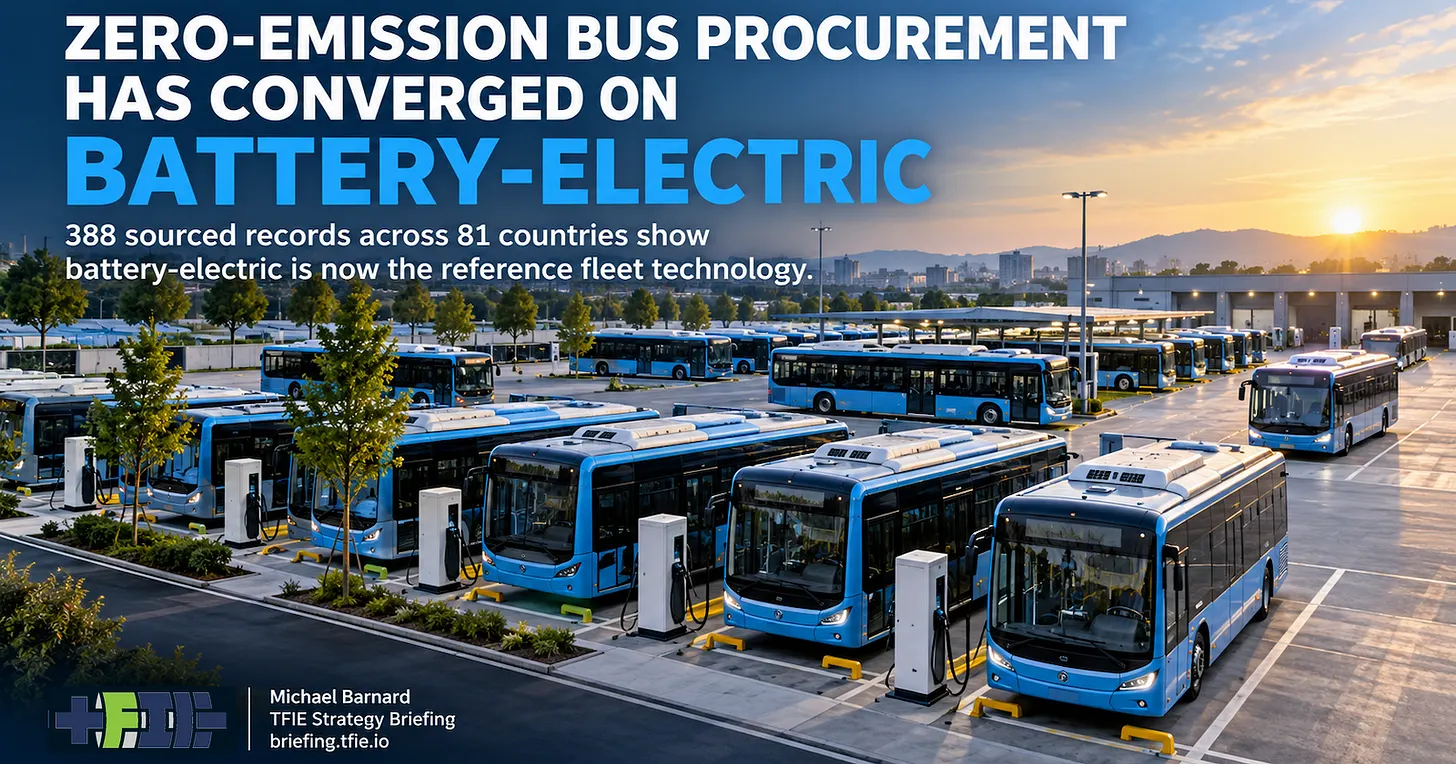
A comprehensive global procurement register tracking 388 sourced records across 81 countries reveals a staggering imbalance. When analyzing firm orders, confirmed awards, and verifiable acquisitions—while deliberately filtering out speculative tenders, unexercised framework options, and early-stage funding announcements—the market realities starkly favor battery-electric technology:
- Firm Battery-Electric Bus Orders: 13,165 units
- Firm Hydrogen Fuel-Cell Bus Orders: 65 units
- Global Purchasing Diversity (BEB): 55 distinct municipal and national purchasing bodies
- Global Purchasing Diversity (Hydrogen): Exactly 2 purchasing bodies globally
This represents a market split of roughly 200 battery-electric buses for every single hydrogen bus. Stated differently, battery-electric technology accounts for approximately 99.5% of all firm zero-emission bus acquisitions captured in this dataset. Far from being a neck-and-neck contest, the commercial reality shows an industry standardizing around a single, highly scalable architecture.
Chronology: How the Market Settled the Debate
To understand how battery-electric buses achieved near-total market dominance, it is necessary to retrace the evolutionary timeline of zero-emission public transit over the past two decades.
Phase 1: The Pilot Era and Ideological Neutrality (Early 2010s – Mid-2010s)
In the early days of transit decarbonization, cities faced mounting pressure to eliminate tailpipe emissions but lacked robust commercial options. Governments and transit authorities launched heavily subsidized pilot programs. Early hydrogen advocates argued that fuel-cell buses offered diesel-like ranges and rapid refueling times, making them ideal for long routes. Meanwhile, early battery-electric pioneers grappled with limited battery chemistries, range anxiety, and primitive overnight depot-charging setups. During this era, treating hydrogen and battery-electric as co-equal paths made strategic sense; both technologies were unproven at scale, and the capital expenditure risks were largely absorbed by public grants.
Phase 2: The Scaling of Battery-Electric Infrastructure (Late 2010s – 2020)
As lithium-ion battery energy densities improved and costs plummeted, battery-electric buses began moving out of the pilot phase and into commercial deployment. Cities in China—led by massive national electrification mandates, particularly in Shenzhen—proved that thousands of battery-electric buses could operate reliably within complex urban networks. Concurrently, European and North American transit agencies began placing multi-decade conversion roadmaps. Operators learned the hard way about depot power upgrades, but they also unlocked massive economies of scale. The supply chain for batteries, electric axles, and depot management software matured rapidly.
Phase 3: The Divergence of Theory and Practice (2021 – 2024)
While battery-electric buses scaled globally—penetrating diverse climates, topography, and municipal budgets—hydrogen buses remained largely confined to perpetual pilot projects and specialized regional subsidies. Despite considerable political interest, hydrogen infrastructure expansion stalled due to the high cost of green hydrogen production, specialized compression and storage requirements, and the low energy efficiency of converting electricity to hydrogen and back to electricity. While public relations campaigns continued to promote hydrogen as a "complementary" technology, actual procurement books told a different story.

Phase 4: The Definitive Consolidation (2025 – Present)
Today, transit agencies have moved past the era of treating procurement as a blank slate. Having absorbed years of hard-earned operational data, procurement officers are no longer willing to finance expensive, dual-pathway infrastructure. The forward procurement pipeline shows thousands of battery-electric buses embedded in multi-year municipal plans, while the hydrogen pipeline has shrunk to a statistical footnote. Procurement has officially pivoted from theoretical experimentation to operational pragmatism.
Supporting Data: Dissecting the Global Procurement Register
To ensure absolute analytical integrity, evaluating public transit procurement requires a careful methodology. Public announcements are notoriously prone to double-counting. A single bus purchase can easily generate three separate headlines: an initial municipal tender, a formal contract award ceremony, and a final delivery photo-op. Furthermore, framework agreements often grant agencies the option to buy vehicles over several years without any legal obligation to do so, while funding announcements frequently fail to convert into binding purchase orders.
The global procurement register circumvents this noise by focusing exclusively on firm orders and awards.
The Outliers: Examining the Hydrogen Holdouts
To maintain journalistic fairness, the two active buyers of hydrogen buses in the dataset must be examined objectively. Their existence proves that hydrogen is not physically impossible; rather, it demonstrates that it only functions under highly specific, localized conditions:
- Qingyang, China: This municipal purchase is part of a deliberate, top-down strategy to build a localized hydrogen ecosystem. Qingyang is simultaneously coordinating bus fleets, local chemical byproduct hydrogen supply, and refueling infrastructure as part of an integrated regional industrial development plan.
- Krefeld, Germany: A more commercial counterexample, Krefeld’s transit operator already had hydrogen fuel-cell buses running in daily service. Based on their specific operating experience, route profiles, and existing fueling arrangements, they opted for a repeat purchase.
What these two cases definitively do not show is replication. After more than a decade of international hydrogen promotion, extensive government subsidies, and robust lobbying by industrial gas and legacy automotive suppliers, the global firm procurement record shrinks down to one municipal ecosystem in China and one repeat municipal buyer in Germany.
In stark contrast, battery-electric procurement is wildly decentralized. It spans thousands of buyers operating under blistering desert heat in the Middle East, freezing winters in Scandinavia, sprawling suburban networks in North America, and densely packed megacities across Latin America and Europe.
Official Responses and Industry Perspectives
The structural shift from a dual-technology narrative to a battery-electric consensus has elicited varied reactions across the global transit ecosystem, industry associations, and municipal leadership.
Transit Agency Executives
Speaking on condition of anonymity, several chief procurement officers from major North American and European transit networks noted that the administrative burden of maintaining two distinct zero-emission fueling frameworks is untenable.
"When you are managing a fleet of 500 buses, you cannot afford to split your maintenance workforce, spare parts inventory, and depot engineering between two entirely different energy ecosystems," one European transit director explained. "Once our depot power upgrades were underway, the operational simplicity of battery-electric made further investments in hydrogen difficult to justify to our board of directors."
Fuel-Cell and Hydrogen Advocates
Proponents of hydrogen technology argue that focusing solely on municipal bus fleets ignores the broader energy transition. Representatives from hydrogen industry coalitions emphasize that fuel-cell buses retain theoretical advantages for long-distance, non-stop intercity coaches or in regions with severely constrained electrical grid capacities.

"While urban municipal routes are increasingly well-suited for overnight or opportunistic depot charging, hydrogen remains a critical hedge for heavy-duty applications where grid tie-ins are years away," notes a leading European clean energy trade analyst.
Independent Energy Strategists
Market analysts who track heavy-duty decarbonization point out that the financial realities of running a public transit agency ultimately dictate procurement trends. Because transit agencies operate under tight, taxpayer-funded municipal budgets, whole-system economics always override political experimentation. When the total cost of ownership—incorporating vehicle acquisition, maintenance, depot engineering, and energy input costs—is calculated over a 12-to-15-year bus lifecycle, battery-electric configurations consistently outperform hydrogen alternatives by wide margins.
Implications: A New Baseline for Public Policy and Urban Mobility
The realization that battery-electric buses represent 99.5% of firm global zero-emission procurement carries profound implications for transit planning, utility coordination, government subsidies, and decarbonization strategies.
1. Battery-Electric Becomes the Default Reference Technology
For normal urban and suburban bus procurement, transit authorities should no longer treat battery-electric and hydrogen as co-equal options requiring fresh, comparative trials. Battery-electric is now the default reference technology. It possesses the deepest procurement base, the broadest supplier ecosystem, the most mature maintenance networks, and the largest body of daily operating experience.
Agencies should approach future fleet planning by starting with the battery-electric architecture. Only if a specific, insurmountable local constraint—such as an absolute impossibility of securing depot grid capacity combined with an uniquely punishing duty cycle—should an agency evaluate alternatives. "Technology neutrality" in procurement should mean applying rigorous, equal standards for reliability, emissions, and cost; it does not require pretending that a technology with 65 global orders presents the same commercial risk as one with over 13,000.
2. Raising the Bar for Hydrogen
Moving forward, hydrogen fuel-cell buses should be treated as exceptions that bear the heavy burden of proof. Any serious proposal advocating for hydrogen in municipal transit must clear a rigorous checklist:
- Identify an explicit constraint: Prove that battery-electric buses and practical charging strategies cannot solve a specific operational duty cycle economically.
- Demonstrate whole-system cost parity: Show that hydrogen solves the problem at an acceptable cost, accounting for the entire infrastructure chain.
- Establish a credible fuel supply: Guarantee long-term, stable, and cost-effective hydrogen sourcing (ideally green hydrogen).
- Justify dedicated infrastructure: Prove that the operational advantage outweighs the massive capital expenditure required for dedicated production, transport, on-site storage, compression, and dispensing facilities.
If a hydrogen proposal clears these hurdles, an agency has a valid, localized reason to purchase fuel-cell buses. However, the evidence no longer supports resetting every municipal procurement cycle to zero and acting as though we are still in an exploratory research phase.
3. Reframing Policy and Subsidy Priorities
Government funding bodies and policymakers must realign their grants with empirical market evidence. Continuing to pour public capital into comparative demonstrations to answer basic technology questions that the global market has already resolved is an inefficient use of scarce public funds.
Instead, policy support and capital investments must pivot toward solving the real-world deployment challenges facing scaling battery-electric fleets:
- Grid Planning & Utility Interconnection: Accelerating multi-megawatt depot connections and sub-station expansions, which currently remain major bottlenecks for transit agencies.
- Charging Reliability & Depot Software: Enhancing smart-charging algorithms, fleet management software, and V2G (Vehicle-to-Grid) integration capabilities.
- Workforce Upskilling: Training the next generation of mechanical technicians and electrical engineers to maintain high-voltage commercial electric fleets safely and efficiently.
- Innovative Financing: Creating streamlined financing structures to help smaller, under-resourced municipalities overcome high upfront capital expenditure hurdles.
By shifting our collective policy focus away from endless technological debates and toward solving the pragmatic engineering challenges of scaling battery-electric infrastructure, cities can accelerate their transition to zero-emission public transit faster, more efficiently, and at a lower cost to taxpayers.