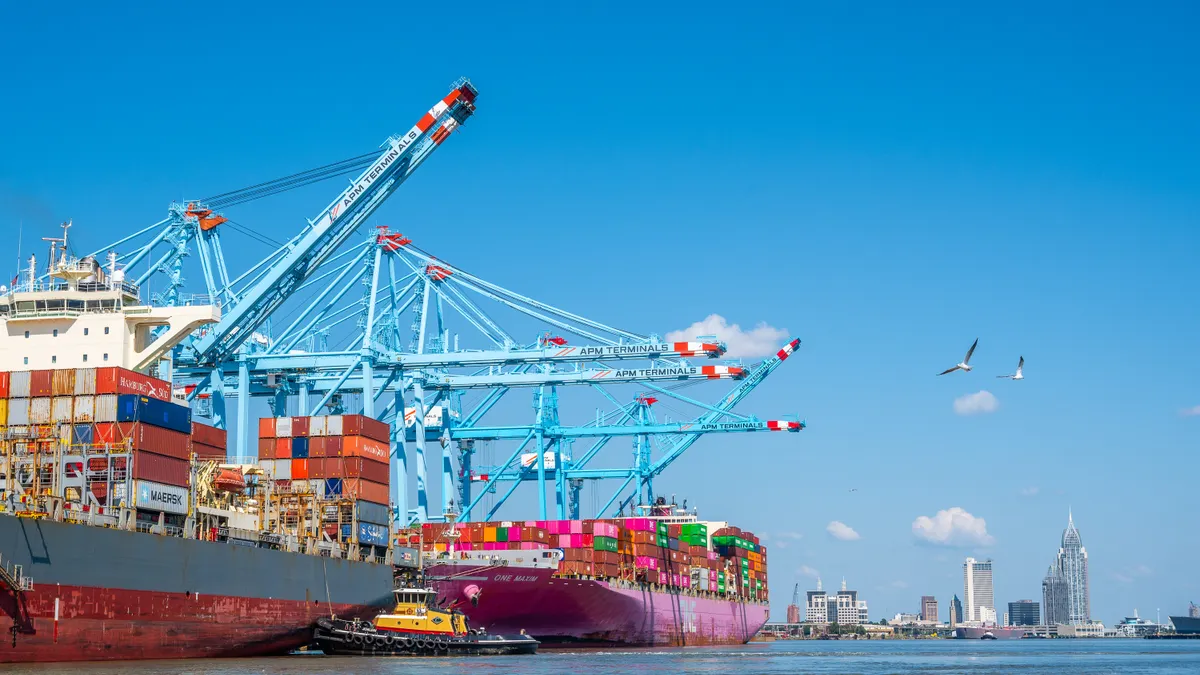
MOBILE, Ala. — The Port of Mobile has officially reopened and returned to regular operational scheduling, bringing a critical Gulf Coast logistics hub back online following a brief, weather-induced shutdown triggered by Hurricane Isaias.
The Alabama Port Authority confirmed the resumption of normal terminal and vessel activities after the fast-moving, powerful storm made landfall along the Gulf Coast. The brief closure—enacted to safeguard personnel, dock infrastructure, multi-million-dollar cargo-handling equipment, and incoming maritime traffic—tested the resilience of one of the Southeast’s most vital and rapidly expanding intermodal gateways.
While the storm delivered heavy rainfall and gale-force conditions to parts of southern Alabama and the Florida Panhandle, swift coordination between port operators, emergency management teams, and the U.S. Coast Guard limited long-term disruptions to regional and national supply chains.
Main Facts
- Operational Status: The Port of Mobile has fully reopened and returned to regular scheduling following a temporary suspension of vessel and terminal operations.
- The Trigger: Operations were initially suspended on Friday, Oct. 9, after the U.S. Coast Guard established Port Condition ZULU, signaling that gale-force winds were anticipated within a 12-hour window.
- The Storm: Hurricane Isaias struck as a dangerous Category 3 storm, packing maximum sustained winds near 120 mph near landfall and threatening the Florida Panhandle and Alabama coasts.
- Precautionary Measures: The Alabama Port Authority secured critical public berths, container yards, and specialized facilities—including the AutoMobile International Terminal—prior to the storm’s arrival.
- Strategic Importance: The port is a critical trade artery featuring robust multi-modal connectivity, linking container, general cargo, and bulk facilities to five Class I railroads, four short-line railroads, and an extensive inland waterway network.
Chronology of Events
The threat posed by Hurricane Isaias required a rapid, methodical response from port authorities, maritime pilots, and federal regulators to ensure zero loss of life and minimal physical damage to port infrastructure.
Thursday, Oct. 8: Monitoring and Early Preparation
As National Hurricane Center (NHC) forecasters tracked the strengthening system in the Gulf of Mexico, officials at the Alabama Port Authority began reviewing heavy-weather action plans. Terminal operators, including APM Terminals, alerted ocean carriers, trucking fleets, and rail partners to monitor forecasts and expedite the pickup of import containers before potential closures went into effect.
Friday, Oct. 9: Implementation of Port Condition ZULU
By Friday morning, the threat level escalated significantly. The U.S. Coast Guard Captain of the Port (COTP) officially set Port Condition ZULU for the Port of Mobile.
- All vessel movements were halted.
- Cargo-handling operations at public berths were suspended, save for essential emergency and Coast Guard-authorized activities.
- Staff secured ship-to-shore gantry cranes, tied down loose yard inventory, and evacuated non-essential personnel.
As Isaias approached the coast with maximum sustained winds touching 120 mph, public advisories warned that the major hurricane was on a direct trajectory to impact the Florida Panhandle, Alabama, and southwest Georgia. Forecasters predicted torrential rainfall totals ranging from 4 to 8 inches across the region, creating severe flood risks for low-lying coastal access points.
Friday Night, Oct. 9 – Saturday, Oct. 10: Landfall and Passage
Hurricane Isaias made landfall Friday evening near major hurricane strength, buffeting the coastline with severe winds and torrential downpours. Throughout the weekend, the storm system pushed inland, gradually dumping heavy rains across southern Alabama and the Florida Big Bend before weakening and transitioning into a post-tropical system by late Saturday.
Sunday, Oct. 11 – Monday, Oct. 12: Assessment and Reopening
With the storm tracking away from the immediate coastal zone, joint assessment teams from the Alabama Port Authority, maritime pilots, and the U.S. Coast Guard conducted rapid daylight surveys of the main shipping channels, turning basins, and terminal berths.
Finding no significant shoaling, structural damage, or power outages that would impede safe navigation, the Coast Guard lifted Port Condition ZULU. The Alabama Port Authority announced the official reopening of the port, allowing vessels waiting offshore to steam up the Mobile Ship Channel and landside operations to resume normal gate hours.

Supporting Data and Port Infrastructure Overview
The swift restoration of the Port of Mobile is of paramount importance to the U.S. supply chain, given the facility’s extensive capabilities and strategic role in international trade.
- Container Operations: The port’s premier container facility is managed and operated by APM Terminals. According to APM Terminals Mobile Managing Director Brian Harold, the terminal routinely handles approximately 600,000 Twenty-Foot Equivalent Units (TEUs) annually. However, continuous infrastructure investments have scaled the gateway’s ultimate throughput capacity up to 2.5 million TEUs, making it a primary relief valve for congested Southern and Eastern seaboard ports.
- Automotive Sector: Alabama is a powerhouse in the American automotive manufacturing landscape. To support this vital vertical, the Port of Mobile features the state-of-the-art AutoMobile International Terminal (AIT). Dedicated to roll-on/roll-off (RoRo) operations, AIT boasts an annual capacity of 150,000 vehicles, 7,000 on-site storage spaces, and a 40,000-square-foot processing center equipped for pre-delivery inspections (PDI), custom accessorization, and vehicle distribution.
- Intermodal Connectivity: The port offers seamless access to international markets via an integrated network comprising five Class I railroads, four short-line railroads, and nearly 15,000 miles of inland waterways. This multi-modal framework allows shippers to bypass congested trucking corridors and move heavy freight efficiently into the U.S. interior.
Official Responses and Stakeholder Coordination
The successful navigation of Hurricane Isaias highlights the efficacy of modern crisis management protocols among Gulf Coast maritime stakeholders.
In public updates released throughout the weather event, the Alabama Port Authority emphasized that safety remained the primary guiding principle. "Ahead of the Category 3 storm, the port worked to secure its facilities to protect personnel, cargo, and equipment," leadership stated, noting that reopening protocols were deliberately tied to rigorous joint damage assessments and official Coast Guard authorization.
Shippers, logistics providers, and motor carriers praised the transparent communication channels maintained by port officials. By providing real-time updates regarding the shift into Port Condition ZULU and the subsequent clearance for reopening, the port minimized trucker dwell times and prevented the chaotic staging of commercial vehicles along highway approaches to the terminal gates.
Supply Chain Implications and Economic Resilience
While the disruption caused by Hurricane Isaias lasted only a matter of days, severe weather events along the Gulf and Atlantic coasts carry profound lessons for modern supply chain management.

1. The Value of De-Risking via Diversification
In recent years, shippers have increasingly explored port-to-inland transit models through secondary and tertiary gateways like Mobile to de-risk their supply chains from major bottlenecks. Incidents like the Isaias closure demonstrate that while regional weather threats are inevitable, Gulf Coast ports have developed mature, highly coordinated emergency response systems that keep downtime to an absolute minimum.
2. Infrastructure Hardening
As severe weather events grow more frequent and intense, investments in terminal resilience—such as wind-rated crane tie-downs, elevated electrical substations, and automated drainage systems—pay immediate dividends. The Port of Mobile’s ability to absorb a direct hit from a major hurricane and return to full operation within 48 to 72 hours reinforces shipper confidence in the gateway’s long-term reliability.
3. Maintaining Flow for Critical Sectors
With major automotive assembly plants, agricultural exporters, and heavy manufacturing entities relying on the Port of Mobile for raw materials and finished goods distribution, every hour of uptime saved prevents cascading delays across factory floors. The seamless transition from storm preparation back to regular scheduling ensures that Alabama’s economic engine continues to hum without missing a beat.
As normal maritime traffic flows resume along the Mobile Ship Channel, the port stands as a testament to effective inter-agency cooperation, robust infrastructure design, and the enduring resilience of the American Gulf Coast logistics network.