The construction industry has long operated under a paradox: it is one of the largest and most economically vital sectors in the global economy, yet it remains intensely fragmented, labor-constrained, and technologically conservative. For decades, homebuilding has relied heavily on traditional, manual craftsmanship executed on unconditioned job sites, leaving it vulnerable to supply chain volatility, escalating labor shortages, and rising material costs.
Today, a paradigm shift is underway. Artificial intelligence is moving out of screens and into the physical world. In a landmark development for the housing sector, Toronto-based Promise Robotics has announced a multi-year partnership with D.R. Horton, America’s largest homebuilder by volume. Under this agreement, D.R. Horton will leverage Promise Robotics’ cutting-edge Factory-as-a-Service (FaaS) capabilities to produce more than 1,250 homes across the United States.
By marrying robotics, cloud-based simulation, and domain-specific AI reasoning models, the collaboration aims to transform how residential properties are conceptualized, manufactured, and assembled.
Main Facts: The Intersection of Physical AI and Housing Supply
At its core, the Promise Robotics and D.R. Horton partnership seeks to tackle the persistent structural housing deficit in North America by industrializing the homebuilding workflow.
- The Scale of the Agreement: D.R. Horton has committed to a multi-year agreement utilizing Promise Robotics’ FaaS model to manufacture over 1,250 homes in the U.S.
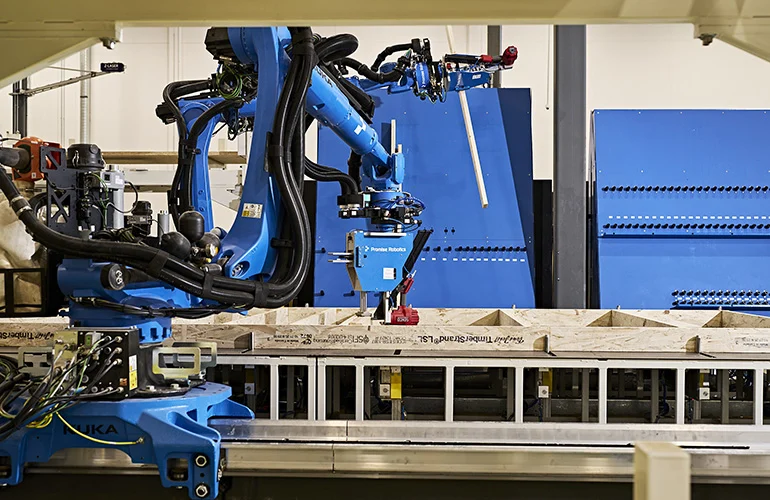
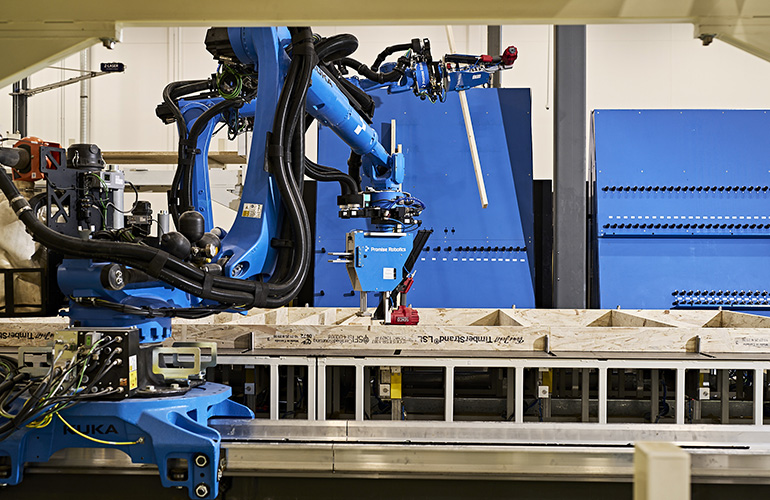
- The Core Technology: Promise Robotics deploys a proprietary tech stack that integrates computer vision, large language models (LLMs) for data flow preparation, and domain-specific reasoning models. This infrastructure operates robot-agnostic systems—predominantly utilizing KUKA industrial robot arms—to fabricate massive building components.
- Operational Footprint: Promise Robotics is initially deploying its microfactories in three strategic North American urban centers: Edmonton and Calgary in Canada, and Phoenix, Arizona.
- Speed and Efficiency: The company’s automated microfactories can manufacture robust structural elements—such as 45-foot floors, 20-foot walls with integrated windows and doors, and drop-in stair cages—enabling a two-story, multi-family home with a basement and garage to be structurally assembled in just a single day.
- The Business Model: Rather than acting as a traditional home designer or vertically integrated developer, Promise Robotics provides its FaaS platform as an infrastructure layer. This allows major builders to scale production without the capital expenditures and operational risks of building proprietary manufacturing plants.
Chronology: The Evolution of Promise Robotics and the Path to the D.R. Horton Deal
To understand how this partnership materialized, it is necessary to examine the trajectory of Promise Robotics since its inception and the methodical steps it took to ready the construction market for automation.
2021: Foundation and Initial Vision
Promise Robotics was founded in 2021 by a team recognizing that applying robotics to construction required an entirely different technical stack than traditional factory automation, such as automotive manufacturing. Co-founder and CEO Ramtin Attar and his team identified that while cars are mass-produced identically millions of times, every residential building, wall, and floor plan features unique architectural variables. The company initially focused its research and development on mechanical, electrical, and HVAC systems, laying the groundwork for automated building component manufacturing.
2023–2024: Securing Capital and Proving the Concept
As housing demands intensified and labor pools shrank, venture capital began recognizing the immense potential of construction technology. Promise Robotics secured a critical $15 million funding round to accelerate its automation capabilities. During this period, the company refined its software ecosystem, integrating computer vision and generative AI to translate architectural designs directly into machine-executable instructions. Instead of building monolithic, centralized gigafactories, the company pioneered a distributed "microfactory" model optimized for localized regional logistics.
2025: Expanding the Physical Footprint
Promise Robotics began establishing its physical infrastructure in key geographical nodes. By setting up operational microfactories in Edmonton, Calgary, and Phoenix, the company established a tight feedback loop where its own crews operated the machinery. This hands-on approach allowed the platform’s fastening algorithms and AI models to adapt dynamically to regional environmental regulations and climate-specific building codes—such as adapting framing density and bracing requirements between cold Canadian winters and the arid heat of Arizona.
Today: The D.R. Horton Partnership
The culmination of these developmental milestones is the multi-year agreement with D.R. Horton. By bridging the gap between digital design files and heavy-duty robotic fabrication, Promise Robotics has proven its model can scale to meet the demands of the nation’s largest residential developer, marking a watershed moment for the commercialization of physical AI in construction.
Supporting Data: The Mechanics of Automated Construction
The construction sector’s resistance to automation has historically stemmed from extreme variability. Unlike an automotive assembly line where vehicles roll down a fixed track, residential construction deals with localized design differences, varying site layouts, and strict regulatory codes that change from municipality to municipality.
Promise Robotics addresses this complexity through data abundance and software flexibility. According to company leadership, every home built through their pipeline generates roughly 300 new computer vision images and 5,000 distinct tactile data sources. This massive influx of operational telemetry feeds a reasoning model specifically tailored to construction engineering.
The Microfactory Advantage
Traditional offsite modular construction often fails economically due to high shipping costs and rigid design limitations. Standard over-the-road freight constraints limit the size of modular units, making long-distance transport cost-prohibitive. Promise Robotics circumvents this by deploying localized microfactories strategically placed near high-growth housing markets.
- Component Specialization: The microfactories do not build entire homes in a single box; rather, they specialize in high-precision structural components. Floors up to 45 feet long and walls up to 20 feet high are prefabricated with precise openings for windows and doors.
- Target Architecture: The company’s engineering sweet spot targets three-to-four-story townhomes, duplexes, fourplexes, and multi-family units. Taller structures introduce complex requirements for structural steelwork, bracing, and fire suppression systems that fall outside standard low-rise automation efficiency.
- Environmental Adaptability: The system’s foundational AI models automatically adjust structural blueprints to local building codes. For instance, algorithmic adjustments allowed production facilities to automatically reduce sheeting by 50% for homes built in Phoenix compared to those designed for harsh Canadian winters.
Official Responses: Perspectives from Industry Leaders
The collaboration has drawn significant praise from executives on both sides, highlighting the mutual alignment between technological capability and enterprise-level execution.
Ramtin Attar, co-founder and CEO of Promise Robotics, emphasized the historical deficits of the construction sector during the announcement:
"Homebuilding has long lacked the production infrastructure needed to scale with the speed, predictability, and efficiency of modern manufacturing. Physical AI changes that by creating a new production model that can expand capacity within and across markets. Our goal is to make that capability accessible to builders across North America and support the industry’s long-term growth."
Attar further elaborated on the company’s structural philosophy in statements to The Robot Report:

"Unlike traditional manufacturing, especially automotive, where there are five or six big players, the construction industry is large but fragmented… There’s no such thing as productization, in which the same car is built millions of times with small variations. Even in the same home, every floor or wall is different. To tackle this set of technical and business challenges, we take a distributed manufacturing approach. Microfactories are a good problem for AI to solve."
Speaking on behalf of the nation’s leading homebuilder, Brad Conlon, senior vice president for strategic growth and innovation at D.R. Horton, underscored the operational motivations driving the partnership:
"At D.R. Horton, we are always looking for innovations that can help us improve how we build. We are continuously focused on improving cycle times, increasing production capacity, and bringing greater consistency and predictability to our operations. Promise Robotics’ integrated platform gives us a new capability to support those goals."
Implications: What This Means for the Future of Housing and Robotics
The multi-year agreement between Promise Robotics and D.R. Horton carries profound implications for multiple sectors, ranging from real estate economics to advanced robotics engineering.
1. Easing the North American Housing Crisis
With millions of housing units needed to close the supply gap across the United States and Canada, traditional construction methods are fundamentally incapable of scaling quickly enough. By compressing the structural framing timeline of a multi-family home from weeks down to a single day, factory-automated building can drastically accelerate community development pipelines, helping to moderate home prices for everyday buyers.
2. Redefining the Role of Labor in Construction
Labor shortages have plagued the trades for over a decade. Rather than replacing human workers entirely, physical AI infrastructure shifts the labor paradigm. Dangerous, physically demanding heavy lifting and repetitive framing tasks are handed over to robotic systems like KUKA industrial arms, while human crews oversee quality control, precision digital design translation, and rapid on-site assembly. This repositioning can make construction careers safer, more technologically integrated, and more attractive to younger generations.
3. The Maturation of "Factory-as-a-Service" (FaaS)
The success of Promise Robotics validates the FaaS business model within heavy industries. By decoupling advanced automation hardware and software from the real estate development business, technology providers can empower regional and national builders to adopt cutting-edge manufacturing techniques without shouldering the prohibitive capital expenditures required to build and maintain robotic plants independently.
4. A New Standard for Enterprise PropTech
As D.R. Horton pioneers the integration of physical AI at scale, competing homebuilders will face mounting pressure to modernize their own supply chains. This partnership may well serve as the tipping point that transitions construction technology from experimental pilot programs to mandatory enterprise infrastructure, permanently altering the landscape of real estate development in the 21st century.