For longer than most automation engineers care to remember, random bin picking has hovered just on the horizon of mainstream industrial adoption. Over the past decade, the underlying technology has matured significantly. Today’s AI-powered, vision-guided systems are genuinely production-capable, boasting sophisticated neural networks that can parse chaotic, overlapping heaps of raw components in fractions of a second.
Yet, a chasm remains between a system that works in a controlled laboratory environment and one that operates reliably day in and day out on a bustling factory floor.
Drawing from extensive global deployments spanning more than 30 million successful production picks, industry experts have mapped out the realities of factory-floor implementation. This deep dive moves past idealized vendor demos to examine how variable lighting, inconsistent incoming parts, and routine maintenance variables impact real-world performance—and how manufacturers can engineer success from the ground up.
Main Facts: The State of Modern Bin Picking
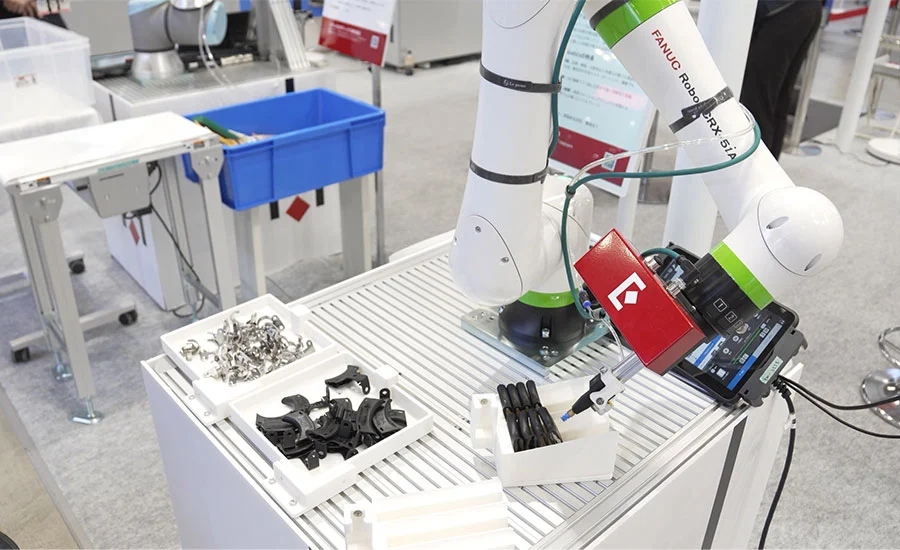
At its core, a vision-guided bin-picking cell is far more complex than a simple "camera-plus-robot" pairing. A fully integrated production-ready system comprises multiple critical subsystems:
- A high-precision industrial robot or collaborative robot (cobot);
- A 3D stereo or structured-light camera;
- An advanced controller equipped with AI capabilities to analyze scenes and compute collision-free pick trajectories;
- An end-effector (such as a vacuum suction cup or multi-finger parallel gripper);
- Customized gripper fingers and task-specific lighting arrays;
- Rigid support structures, source bins, destination containers, and comprehensive safety components.
Despite the elegance of modern software, deployment success is heavily dictated by physical engineering. When a problem has two potential solutions—one mechanical and one software-based—engineers consistently find that choosing the mechanical solution yields higher reliability and lower long-term costs. Software can compensate for many variables, but it rarely outperforms a robust physical setup.

Chronology of a Bin-Picking Project: From Feasibility to Production Ramp-Up
Understanding the timeline of a bin-picking integration is vital for accurate budgeting and scheduling. Most projects follow a structured trajectory from initial concept to full factory operation.
Phase 1: Feasibility and Application Screening (Months 0–1)
The journey begins not with software programming, but with an evaluation of whether bin picking is even the right solution. Engineers must assess part geometry, material properties, and cycle time requirements. Many suppliers offer complimentary lab trials, processing physical customer parts through demo hardware to establish a realistic baseline of pick difficulty.
Phase 2: Off-Site Engineering and Preparation (Weeks 1–2)
Once approved, the project moves to off-site preparation. This stage covers model training for AI vision systems, application logic development, camera-to-controller integration, and initial offline tuning.
Concurrently, mechanical and electrical design takes place. A standard baseline budget allows roughly one week for mechanical design and assembly (factoring in a 4-to-6-week fabrication lead time), alongside one week for electrical design and testing.
Phase 3: On-Site Installation and Integration (Weeks 3–4)
Physical installation on the factory floor introduces new variables. While getting a robot to execute its first pick on-site in a single afternoon is entirely realistic with modern plug-and-play vision systems, achieving stable, high-throughput production performance takes significantly longer.

Integration delays are most frequently driven by outdated robot or PLC software, proprietary developer-unfriendly interfaces, and sub-optimal network configurations (such as Wi-Fi congestion or latency issues). Robust integration relies on open architecture and wired CAT6 infrastructure throughout the cell.
Phase 4: Production Ramp-Up and Tuning (Weeks 5–6+)
On-site installation and production ramp-up typically span anywhere from a few days to two weeks. During this phase, engineers fine-tune pick success rates against real-world factory conditions—accounting for ambient light shifts, minor part variations, and mechanical settling inside source bins.
Supporting Data: Performance Metrics and Benchmarks
When evaluating the financial and operational viability of a bin-picking cell, data from large-scale deployments provides reliable benchmarks:
- Cycle Times: Well-designed cells typically achieve cycle times of 4 to 8 seconds. Simple parts picked rapidly with suction cups and dropped in bulk can run in around 5 seconds. Complex geometries requiring precise finger positioning and high-accuracy placement generally target 7 to 8 seconds.
- Pick Success Rates: Production-tuned cells consistently achieve success rates between 98% and 99.9%. Designing around a theoretical 100% success ceiling often introduces unnecessary complexity and diminishing returns.
- System Accuracy: A reliable rule of thumb for end-to-end system accuracy is approximately 0.5% of the container size. For instance, a tray measuring 10 centimeters long yields an accuracy of roughly 0.5 millimeters, whereas an 80-centimeter tray scales to roughly 4 millimeters.
- Return on Investment (ROI): In major manufacturing markets, a well-scoped bin-picking project generally delivers an ROI within 2 to 4 years, heavily dependent on part value, labor replacement rates, and the frequency of SKU transitions.
Official Perspectives: Evaluating Parts, Bins, and Vision Systems
Industry leaders emphasize that part and bin characteristics dictate up to 80% of an application’s feasibility before a single line of code is written.
What Makes Bin Picking Easy:
- Rigid, opaque components with matte or semi-matte surfaces.
- Simple geometric shapes that allow predictable gripping angles.
- Low part-density relative to container size (fewer, larger parts in a manageable workspace).
What Makes Bin Picking Difficult:
- High part-density and deep containers, which increase visual occlusion and localization complexity.
- Parts requiring high-precision placement, flipping between pick and place, or complex orientation patterns.
- Fully transparent components (such as glass), which confound standard optical sensors, or highly reflective metals that generate unpredictable glare.
- Heavy, irregularly shaped parts that strain standard gripper limitations.
Choosing the Right Vision Configuration
Navigating 3D vision requires understanding how depth perception is captured. While standard 2D cameras fail in multi-axis environments, modern 3D cameras utilize stereo vision paired with AI-based depth reconstruction.

Engineers must choose between fixed overhead mounting and in-hand (robot-mounted) cameras:
- Fixed Cameras: Mounted above the bin, these allow continuous robot motion with image capture occurring seamlessly between picks. They are generally 1 to 2 seconds faster than in-hand models.
- In-Hand Cameras: Mounted directly on the robot wrist, these are ideal for multi-bin coverage, ultra-close inspection of small parts, or varied locations across large areas. However, they add 1 to 2 seconds to the cycle time because the robot must pause above the target to capture an image.
Implications for Manufacturers: Avoiding Common Pitfalls
Deploying automation into complex manufacturing environments inevitably reveals hidden challenges. Long-term operational success depends on anticipating these failure modes.
The Dangers of Calibration Drift
One of the most insidious issues observed in the field is camera-to-robot calibration drift, typically caused by structural vibration or physical shocks to the camera mount. Because drift occurs gradually over weeks or months, it does not cause immediate catastrophic failure. Instead, it manifests as a slow creep in placement errors or intermittent pick failures.
A famous case study involved a routine cleaning crew wiping down a fixed camera housing, shifting its position by less than 0.1 degrees. Because the camera was mounted over a meter above the source bin, this microscopic shift generated a 1-millimeter localization error—causing precision-critical laser lenses to fail placement into coating jigs once every few hundred cycles.
Preventive Maintenance and Standard Operating Procedures (SOPs)
To prevent costly troubleshooting loops, forward-thinking facilities enforce strict operational protocols:

- Clear Maintenance SOPs: Explicitly document what on-floor staff can and cannot touch near the vision cell, incorporating camera inspections into routine maintenance checklists.
- Robust Stress Testing: Conduct multi-day stress testing under simulated factory load before final sign-off.
- Autonomous SKU Training: Invest in systems that empower internal staff to train new workpieces independently without relying on costly external vendor support or mandatory CAD submissions.
Ultimately, technology is only half the equation. The projects that achieve long-term profitability are those driven by collaborative ownership—where plant personnel and automation engineers work hand-in-hand to bridge the gap between theoretical laboratory demos and the dynamic realities of the modern factory floor.