MIAMI — In a significant leap forward for supply chain technology and logistics training, LATAM Cargo has officially launched a cutting-edge Virtual Reality (VR) training program at its primary cargo hub facility at Miami International Airport (MIA). The initiative represents a major evolution in how air cargo carriers prepare their ground handling operations, shifting away from traditional classroom sessions and basic on-the-floor shadowing toward immersive, risk-free digital environments.
By placing workers inside precise 3D digital twins of their actual daily work environments, the airline is redefining safety protocols, streamlining onboarding, and establishing new benchmarks for operational excellence within the air cargo sector.
Main Facts
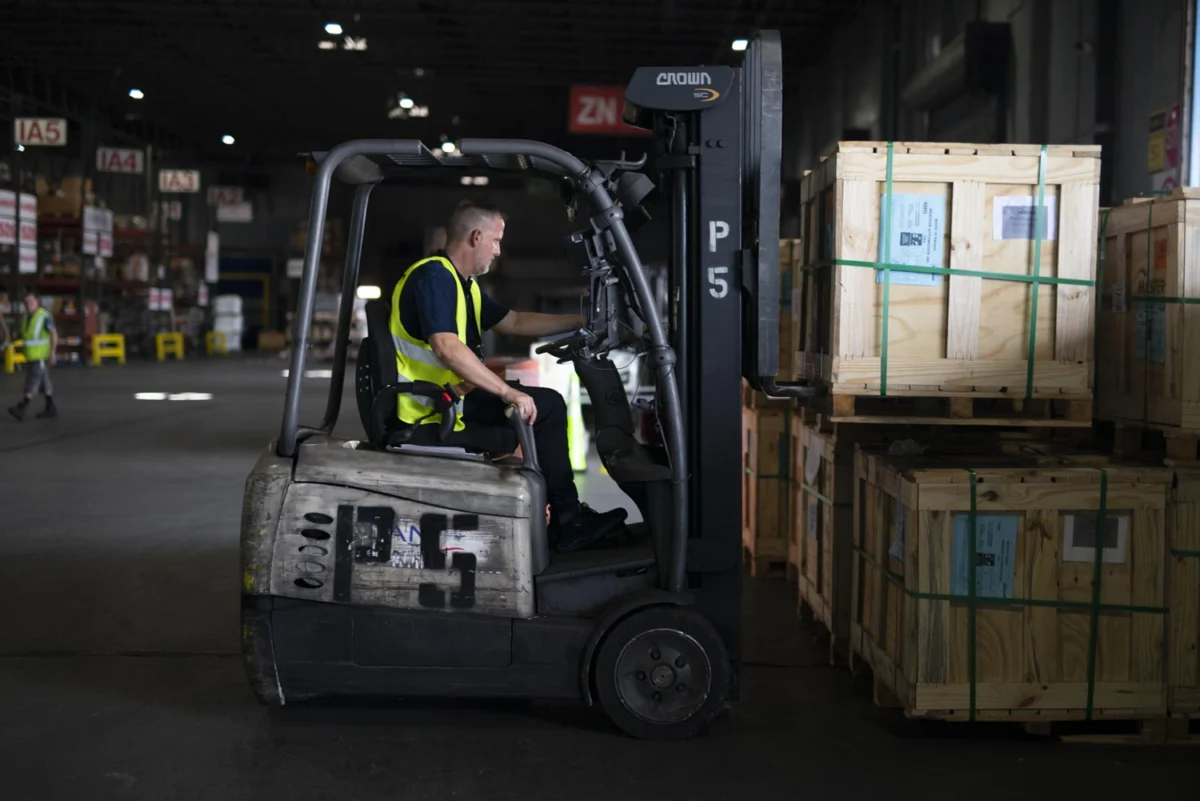
The newly deployed VR training initiative at Miami is designed to overhaul how warehouse personnel interact with high-stakes cargo environments. Initially targeting approximately 550 staff members—including a dedicated cohort of 250 forklift operators—the immersive platform allows employees to experience and react to complex, high-pressure operational scenarios without any physical risk to themselves, coworkers, or expensive freight.
Unlike conventional teaching methods that rely on slide decks, manuals, or standard video tutorials, the VR system captures precise behavioural metrics. It tracks contingency response times, procedural accuracy, and an individual’s ability to immediately identify and mitigate workplace hazards.
The software environment features comprehensive modules tailored to specific warehouse roles:
Three specialized modules dedicated exclusively to forklift drivers, focusing on spatial awareness, load stability, and navigation in tight spaces.
Scenarios mapped across six distinct warehouse pedestrian zones, helping ground crews master the complex dynamics of high-traffic cargo terminals.
High-risk operational protocols, including dangerous goods (DG) segregation, specialized cargo handling, pedestrian traffic flow management, and machinery-to-human separation protocols.
The Miami deployment follows a successful preliminary rollout at the Fast Air warehouse in Santiago, Chile. However, the introduction at MIA represents a massive scale-up, bringing broader, more intricate operational scenarios into the curriculum. Following the successful implementation in North America, LATAM Cargo is actively evaluating plans to expand the VR training framework to other critical strategic hubs across its expansive international network, with Brazil identified as a primary candidate for the next phase.
Chronology of Innovation: From Santiago to Miami
The integration of Virtual Reality into LATAM Cargo’s training matrix did not happen overnight; it is the result of a deliberate, phased strategy aimed at modernizing the carrier’s ground operations infrastructure.
Phase 1: Conceptualization and Initial Trials (2024–2025)
Recognizing the inherent risks associated with fast-paced air cargo warehousing—where heavy machinery, moving freight, and pedestrian ground crews constantly intersect—LATAM Cargo’s operations and safety teams began exploring immersive digital alternatives to traditional training. Traditional methods, while effective to a point, often suffered from a "theory-to-practice" gap, where employees struggled to translate classroom knowledge into fast reflexes on a chaotic warehouse ramp.
Phase 2: The Fast Air Pilot in Santiago
The airline first tested its virtual simulation concept at the Fast Air warehouse in Santiago, Chile. This initial pilot served as a proof-of-concept, evaluating whether staff could easily adapt to headset-based learning and whether the simulated environments accurately reflected real-world physical dynamics. The pilot yielded positive results, demonstrating high user engagement, improved knowledge retention, and a noticeable drop in simulated operational errors among early cohorts.
Phase 3: The Miami Hub Scale-Up (Late 2026)
Emboldened by the success in Santiago, LATAM Cargo initiated a major scale-up by deploying the technology at its crucial Miami International Airport facility—one of the carrier’s most vital gateways connecting North and South America. The Miami rollout expanded the scope of the training program exponentially, introducing more complex scenarios, multiple specialized modules for forklift operators, and deeper data-tracking capabilities to monitor the progress of 550 warehouse employees.
Phase 4: Future Network Expansion (2027 and Beyond)
With the Miami hub serving as the flagship implementation for the North American market, LATAM Cargo is already laying the groundwork for a broader regional rollout. Executive leadership is currently conducting feasibility studies to introduce the VR training architecture to key operational facilities in Brazil and other strategic Latin American hubs, cementing the technology as a core pillar of the airline’s global safety culture.
Supporting Data and Technical Metrics
The shift toward immersive learning is backed by rigorous operational data and advanced technological capabilities. Ground operations in the air cargo industry operate under tight turnaround times, leaving little room for error. LATAM Cargo’s VR system is engineered to address these pressures through quantifiable metrics.
550 Staff Members: The initial capacity of the Miami training rollout, ensuring a vast majority of the facility’s ground crew receives advanced simulation exposure.
250 Forklift Operators: A specialized sub-cohort receiving intensive training modules designed to mitigate the risks associated with heavy material-handling equipment.
6 Warehouse Pedestrian Zones: Distinct operational layouts simulated within the software to train staff on spatial awareness, blind spots, and safe transit routes.
3 Forklift Modules: Specialized training tracks focusing on heavy lifting, stacking precision, and emergency braking or evasive maneuvers.
Behavioral Metrics Tracked: The platform records micro-actions, including time-to-decision during unexpected safety hazards, correct identification of improperly labeled dangerous goods, and compliance with pedestrian right-of-way protocols.
By digitizing these interactions, training supervisors can pinpoint individual weaknesses—such as hesitation during a chemical spill simulation or failure to check blind spots when reversing a forklift—and provide targeted corrective coaching before the employee ever steps foot on the physical warehouse floor.
Official Responses and Executive Insights
Leadership within LATAM Cargo has emphasized that the adoption of Virtual Reality is much more than a gimmick; it is a foundational investment in human capital, safety, and operational resilience.
Daniel Leng, Chief Operating Officer at LATAM Cargo, highlighted the strategic importance of the rollout during the launch at the Miami hub:
"Integrating Virtual Reality at our Miami hub marks a key step in our operational safety strategy. By placing our teams in critical operational scenarios within an exact replica of their daily work environment, we significantly close the gap between classroom theory and ramp practice."
Leng further noted that the immersive nature of the technology commands the full attention of trainees, eliminating the distractions often found in traditional classroom settings.
"When an employee puts on a headset, they are no longer passively listening to a presentation; they are actively navigating a high-stakes, fast-moving cargo terminal. They must make split-second decisions regarding cargo segregation, machinery operation, and hazard avoidance. The muscle memory and situational awareness developed in this virtual space translate directly into safer, more efficient behaviors in the real world."
Safety managers at the Miami facility have similarly praised the system for its ability to simulate dangerous scenarios—such as a compromised container leaking hazardous materials or a sudden pedestrian incursion into a forklift lane—that could never be safely replicated during live operational hours.
Broader Implications for the Air Cargo Industry
LATAM Cargo’s implementation of VR training reflects a broader technological transformation sweeping the global air cargo and logistics sector. As warehouses become increasingly automated, integrated, and high-volume, the demand for highly skilled, safety-conscious ground personnel has never been higher.
1. Bridging the Skills Gap and Reducing Onboarding Time
The logistics sector has historically faced challenges with high turnover rates and lengthy onboarding processes for warehouse staff. Immersive VR training accelerates the learning curve, allowing new hires to experience months of "on-the-job" scenarios in a matter of hours or days. This reduces the time new employees spend under close supervision while ensuring they do not compromise operational flow.
2. Eliminating Training Hazards
Traditionally, training heavy machinery operators required cordoned-off areas of active warehouses, disrupting daily throughput and exposing trainees to real-world risks. Virtual Reality entirely removes this friction. Trainees can crash virtual forklifts, mishandle simulated hazardous materials, or misroute sensitive pharmaceutical shipments with zero financial loss, zero property damage, and zero personal injury.
3. Setting a New Industry Standard for Compliance and Safety
With regulatory bodies enforcing stringent guidelines on the handling of dangerous goods, pharmaceuticals, and perishable airfreight, airlines are under pressure to prove that their staff are thoroughly trained. The data-driven metrics captured by VR systems—such as precise reaction times and verifiable module completion records—provide carriers with an auditable safety trail that exceeds standard compliance requirements.
4. Future-Proofing Global Logistics Hubs
As supply chains grow increasingly complex, the successful integration of VR at major transit nodes like Santiago and Miami proves that immersive technologies are scalable across international borders. If LATAM Cargo successfully rolls out this architecture to Brazil and other key markets, it could prompt competing carriers and global ground handlers to accelerate their own digital transformation roadmaps, ultimately raising safety standards across the entire global air cargo ecosystem.