Main Facts
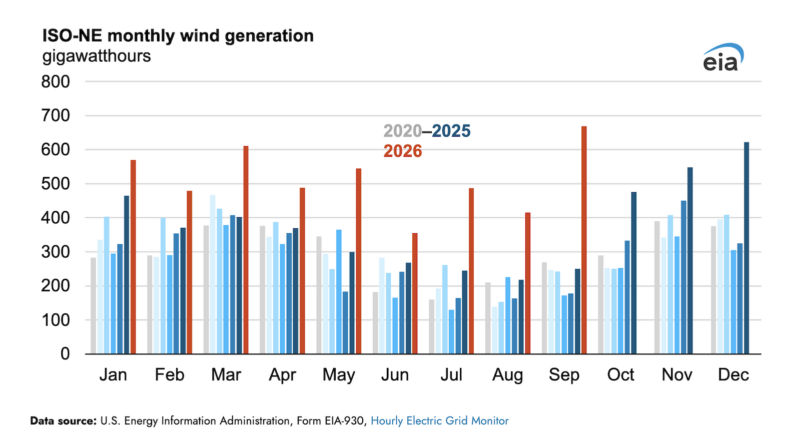
The landscape of American energy production is undergoing a rapid and visible transformation, particularly in regions historically reliant on imported fossil fuels for electricity generation. According to recent data released by the U.S. Energy Information Administration (EIA) and highlighted by regional grid operators, wind power generation in the territory managed by ISO New England (ISO-NE) experienced an unprecedented boom throughout the first nine months of 2026.
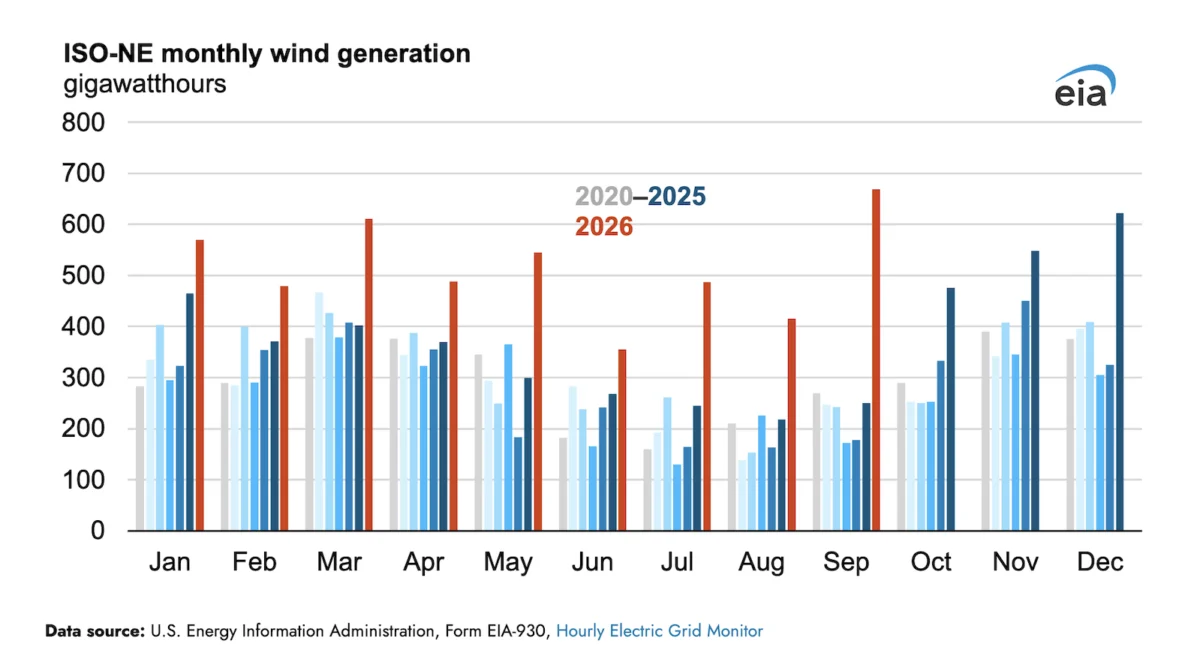
On average, monthly wind energy generation across New England spiked by a remarkable 68% during the January-through-September period compared to the exact same timeframe in 2025. This dramatic acceleration underscores a broader national trend toward decarbonization, driven by maturing technology, the expansion of both onshore and offshore capacity, and aggressive regional climate mandates.
ISO New England, the independent system operator responsible for overseeing the reliable operation of the bulk electric power generation system and transmission lines across Connecticut, Maine, Massachusetts, New Hampshire, Rhode Island, and Vermont, has found itself rapidly integrating intermittent renewable resources into a grid that was historically powered by natural gas, nuclear, and legacy hydro. The surge recorded in 2026 represents one of the steepest year-over-year percentage increases in renewable energy output in the region’s history, signaling that long-planned clean energy investments are finally coming online and delivering tangible results.
Chronology of Regional Wind Development
To understand how New England achieved a 68% leap in wind generation by 2026, it is necessary to look back at the arduous, deliberate chronology of policy shifts, regulatory milestones, and infrastructure milestones that paved the way.
The Foundation Years (2018–2021)
For much of the late 2010s, New England’s wind sector was characterized by modest onshore installations in rural Maine and parts of New Hampshire and Vermont. Large-scale offshore wind existed primarily on paper. State governments, recognizing their aggressive net-zero greenhouse gas emissions targets, began passing legislation requiring electric distribution companies to solicit long-term contracts for offshore wind energy. Massachusetts led the charge with ambitious procurement laws, soon followed by Connecticut and Rhode Island.
Obstacles and Supply Chain Realities (2022–2024)
The early 2020s were a turbulent period for the global wind energy industry. Surging inflation, post-pandemic supply chain bottlenecks, rising interest rates, and disrupted global logistics forced several major developers to renegotiate or even cancel legacy power purchase agreements (PPAs). Critics argued that the region’s offshore wind ambitions were stalling. However, state regulators showed flexibility, allowing utilities to re-bid contracts at economically viable rates, ensuring that projects deemed vital for regional resource adequacy did not disappear entirely.
Construction and Interconnection Sprints (2025)
By 2025, several major transmission upgrades and large-scale wind farm installations cleared regulatory hurdles and entered active construction or final commissioning phases. Grid operators began preparing for an influx of variable renewable power. Investments in advanced forecasting tools, battery energy storage systems (BESS), and regional transmission enhancements allowed ISO-NE to safely absorb higher volumes of wind-generated electricity without compromising grid stability.
The Breakout Year (2026)
Culminating these multi-year efforts, the first nine months of 2026 delivered the statistical proof of New England’s energy transition. As commercial operations commenced at several high-profile wind facilities—bolstered by favorable meteorological conditions—monthly generation figures routinely shattered previous regional records, culminating in the 68% year-over-year average increase highlighted by the EIA.
Supporting Data and Analysis
The data compiled by the EIA and analyzed by experts such as principal contributor Alex Mey paints a compelling picture of an energy grid in transition.
- The 68% Metric: Comparing the first three quarters of 2025 to the same period in 2026 reveals that New England’s wind fleet is producing significantly more gigawatt-hours (GWh) per month. While seasonal variations naturally cause swings in wind output—typically peaking during the windier spring and autumn shoulder months and dipping during calmer summer periods—the baseline floor for generation has shifted substantially upward.
- Capacity Additions: The surge is not merely a byproduct of unusually windy weather; it is fundamentally driven by structural additions to the region’s nameplate capacity. Every newly energized turbine adds cumulative muscle to the ISO-NE control area.
- The Role of Interconnection: Integrating these resources required sophisticated management of regional bottlenecks. ISO-NE’s dispatch protocols have adapted to handle rapid ramps in wind production, curtailing generation only when local transmission constraints temporarily prevent power from reaching load centers.
Official Responses and Stakeholder Perspectives
The dramatic rise in wind generation has elicited strong reactions from energy regulators, environmental advocates, and market participants across the Northeast.
Federal energy analysts have pointed to the New England data as a case study in how targeted state-level procurement mandates can successfully unlock private capital for renewable infrastructure, even in densely populated and geographically constrained regions.
Regional grid operators, while welcoming the clean generation, maintain a steadfast focus on reliability. In public briefings, ISO-NE officials have emphasized that as wind and solar penetration grows, the grid requires complementary flexible resources—such as fast-ramping natural gas plants, demand-response programs, and utility-scale battery storage—to maintain instantaneous balance between supply and demand when the wind slows down.
Environmental coalitions have lauded the milestone, noting that every megawatt-hour generated by wind directly displaces fossil fuel combustion, leading to immediate reductions in carbon dioxide emissions, nitrogen oxides, and particulate matter across the northeastern airshed. Consumer advocates, meanwhile, continue to monitor wholesale electricity market clearing prices closely, analyzing how the influx of zero-marginal-cost wind energy influences long-term consumer utility bills amidst broader market volatility.
Implications for the Future of New England’s Grid
The 68% surge in wind generation during the first nine months of 2026 carries profound implications for the future of New England’s energy economy, environmental policy, and infrastructure planning.
1. Acceleration of Decarbonization Targets
New England states have codified some of the most ambitious climate laws in the United States, aiming for deep economy-wide decarbonization by 2050, with interim milestones in 2030 and 2040. The rapid scaling of wind power proves that these targets are technically achievable, provided that project pipelines remain unhindered by bureaucratic delays or geopolitical trade friction.

2. Transmission and Storage Imperatives
The success of wind power in 2026 also highlights an urgent mandate: the region must continue upgrading its transmission backbone. Bringing offshore wind power ashore in coastal areas and moving it inland to major metropolitan load centers like Boston, Providence, and Hartford requires high-capacity transmission corridors. Without them, localized congestion could force wind farms to curtail production. Consequently, investments in both intra-state transmission lines and multi-day energy storage solutions are expected to accelerate over the remainder of the decade.
3. Economic and Job Market Shifts
The transition is reshaping the regional economy. Coastal ports transformed into staging and manufacturing hubs for offshore wind turbines are supporting thousands of well-paying union jobs in construction, maritime operations, engineering, and maintenance. As the 2026 data shows, these localized economic investments are now yielding measurable dividends in clean electricity production.
Conclusion
The EIA’s reporting on ISO-NE’s 68% wind generation increase marks a turning point for New England. What was once viewed as an aspirational, paper-heavy transition is now an operational reality humming off the coast and across the northern hills. As the region looks toward the close of 2026 and beyond, wind energy has firmly established itself as a cornerstone of New England’s modern, diversified, and low-carbon electric grid.