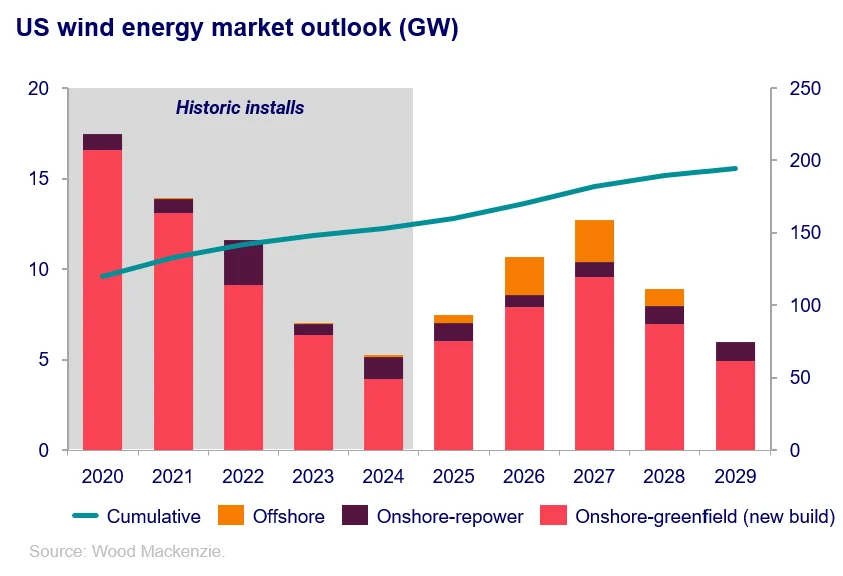
The United States wind energy sector is bracing for a pivotal year in 2025. According to the latest U.S. Wind Energy Monitor report, co-authored by Wood Mackenzie and the American Clean Power Association (ACP), the nation is on track to install more than 7 gigawatts (GW) of new wind capacity in 2025—a substantial 36% increase over the previous year. This growth arrives at a critical juncture, as the U.S. power grid faces mounting pressure from a surge in electricity demand, primarily driven by the rapid expansion of data centers and artificial intelligence infrastructure.
While the five-year outlook remains stable, the industry is navigating a complex landscape defined by shifting project timelines, rising logistical costs, and significant policy headwinds.
Main Facts: A Robust Pipeline Amidst Structural Shifts
The data reveals a resilient market that is increasingly back-loaded, reflecting the typical realities of large-scale infrastructure commissioning. While 2025 is set to see a sharp increase in capacity, the momentum is projected to carry forward, with the industry expected to add 46 GW of new wind capacity between 2025 and 2029.
Despite a slow third quarter in 2025—which saw installations fall 23% below forecasts at just 932 MW—the outlook remains optimistic. The industry is currently tracking 3.8 GW of capacity slated for the fourth quarter alone, which accounts for over half of the year’s total expected output. This "back-loaded" delivery schedule is not an indicator of failure, but rather a standard reflection of the long-cycle project commissioning process.
However, beneath the surface of these growth figures, the industry faces a nuanced challenge: visibility. Turbine order intake has rebounded to pre-OBBBA (One Big Beautiful Bill Act) levels, with over 2 GW of firm commitments recorded in the third quarter—a 79% jump quarter-over-quarter. Yet, tracking this progress is increasingly difficult. Original Equipment Manufacturers (OEMs) are becoming more guarded with their data, and a growing volume of "start-of-construction" activity is occurring through off-site component manufacturing, making it harder for analysts to pinpoint exact project completion dates.
Chronology: The Road to 2029
The trajectory of the U.S. wind market is marked by distinct phases of activity over the next five years.
- 2025 (The Acceleration): The industry expects to install 7+ GW, marking a definitive rebound from the sluggish installation pace of the previous year.
- 2026–2027 (The Peak): These years represent the "heavy lifting" phase of the current pipeline. Projections indicate 10.7 GW will come online in 2026, followed by a surge to 12.7 GW in 2027, as massive development assets—many of which are currently in the permitting and early construction phases—come to fruition.
- 2028–2029 (The Consolidation): The report warns of a noticeable decline in new capacity by 2029. This is largely due to project cancellations and the re-designation of late-decade capacity as "inactive." These setbacks are being driven by localized permitting bottlenecks and broader development challenges that are currently stifling the long-term pipeline.
Supporting Data: Economic Drivers and Geographical Expansion
The economic case for wind energy has never been stronger, even as costs fluctuate. The "Levelized Cost of Energy" (LCOE) for wind remains highly competitive, making it a natural candidate to fill the "baseload" gap.
Power Demand and the "Data Center Effect"
For the past decade, U.S. power demand remained largely flat. That era has ended. Researchers now project that power demand will grow at an average of 3% annually through 2029. Of the 90 GW in total peak demand growth expected, approximately 59 GW is tied directly to the massive energy appetite of data centers. Utilities have already committed to 160 GW of large-load additions, and wind energy is being positioned as a primary, cost-effective solution to satisfy this hunger.

Regional Leaders and Repowering
The geography of U.S. wind is evolving. Western states, specifically Wyoming and New Mexico, are leading the charge, expected to account for 34% of all activity through 2027.
- SunZia (New Mexico): Pattern Energy’s 3.5-GW project remains the anchor of the 2026 outlook.
- Towner Energy Center (Colorado): Invenergy’s 998-MW installation is slated to be the single largest project of 2027.
- New Frontiers: The expansion continues into unexpected territory, with Arkansas bringing its first utility-scale onshore wind project, Cordelio’s Crossover Wind, online.
Furthermore, the "repowering" market—replacing aging turbines with more efficient, modern technology—continues to be a reliable engine for the sector. Wood Mackenzie projects 18 major repowering projects will contribute 2.5 GW of capacity over the next three years.
Official Responses: Navigating Policy and Costs
Leila Garcia da Fonseca, Director of Research at Wood Mackenzie, notes that while the fundamentals are strong, the path forward is obstructed by policy and cost variables.
"The U.S. power market is facing mounting strain," Garcia da Fonseca stated. "Wind energy benefits from strengthened economic fundamentals and a compelling business case, but turbine costs remain elevated due to tariffs, and mid-term growth will depend on our ability to resolve permitting and policy uncertainty."
The Tariff Challenge
The industry is currently grappling with a "pricing paradox." While global manufacturing overcapacity should technically lower prices, the reality on the ground is the opposite. U.S. onshore wind capital expenditure (CAPEX) is projected to increase by 5% through 2029. This is primarily attributed to tariff exposure on raw material inputs and subcomponents, which is effectively canceling out the potential cost savings of a more mature supply chain.
Offshore Divergence
The offshore sector is experiencing its own unique set of pressures. While the Vineyard Wind project has shown successful execution, delivering 200 GWh through the first nine months of the year, the broader offshore outlook is mixed. Harsh winter conditions are expected to delay Q4 2025 installations, pushing that capacity into 2026. Looking further ahead, the scarcity of specialized Wind Turbine Installation Vessels (WTIVs) is causing contract terminations and project delays for any developments post-2027.
Implications: The Future of the Grid
The findings of the U.S. Wind Energy Monitor suggest that while the U.S. wind industry is technically and economically capable of meeting the nation’s soaring energy needs, it is currently "handicapped" by systemic frictions.
- Permitting as the Primary Bottleneck: The weakening of the 2029 outlook serves as a warning. Without structural reforms to the permitting process, the U.S. risks leaving gigawatts of potential clean energy on the table just as the grid enters its most demanding period in history.
- Tariff Sensitivity: The reliance on raw material imports leaves the industry vulnerable to trade policy. As the U.S. attempts to build a domestic supply chain, the short-term cost of tariffs is creating a "cost-push" inflation environment that developers are struggling to pass on to utilities.
- The Shift to Baseload: The transition of wind energy from a "supplemental" resource to a "baseload" partner for data centers is the most significant strategic shift in the report. If the industry can navigate the current cost and permitting hurdles, it is poised to become the bedrock of the 21st-century American electrical grid.
In summary, the wind industry is entering a "high-stakes" era. The projects are ready, the demand is record-breaking, and the economic fundamentals are sound. The challenge now rests with policymakers to ensure that the regulatory environment can match the pace of the engineers and developers who are building the infrastructure of tomorrow.