ZURICH, Switzerland — Swiss glaciers, which comprise the largest concentration of ice masses in the European Alps, have suffered their second-worst percentage drop in ice volume on record. Driven by persistent summer heat waves and critically low winter snowfall, Switzerland’s rapidly receding frozen reservoirs lost 5.5% of their total remaining ice volume this year alone.
According to findings released Thursday by the Swiss glacier monitoring service GLAMOS and the Swiss Academy of Sciences, the compounding crises facing the region’s alpine environments point to a bleak future.
"Alpine glaciers have no chance of surviving in the long term under such conditions," the monitoring services warned in a joint statement.
The report underscores mounting anxieties across Europe, widely recognized by climatologists as the fastest-warming continent on Earth. Experts emphasize that the accelerating degradation is not a natural fluctuation, but a direct consequence of human activity.
"The warming that we are experiencing now can be attributed 100% to anthropogenic climate change. It’s as simple as that," said Matthias Huss, head of GLAMOS and a glaciology professor at the Federal Polytechnic Institute ETH Zurich. "Without human emissions or fossil fuels, we wouldn’t have any warming at the moment."
Main Facts
The latest data from GLAMOS highlights the staggering scale of change occurring across Switzerland’s high-altitude regions:
- Severe Annual Loss: Swiss glaciers lost 5.5% of their remaining ice volume this year, marking the second-largest percentage decline ever recorded.
- The Five-Year Precipice: Over the past five years alone, Switzerland has shed nearly one-fifth of its total ice volume.
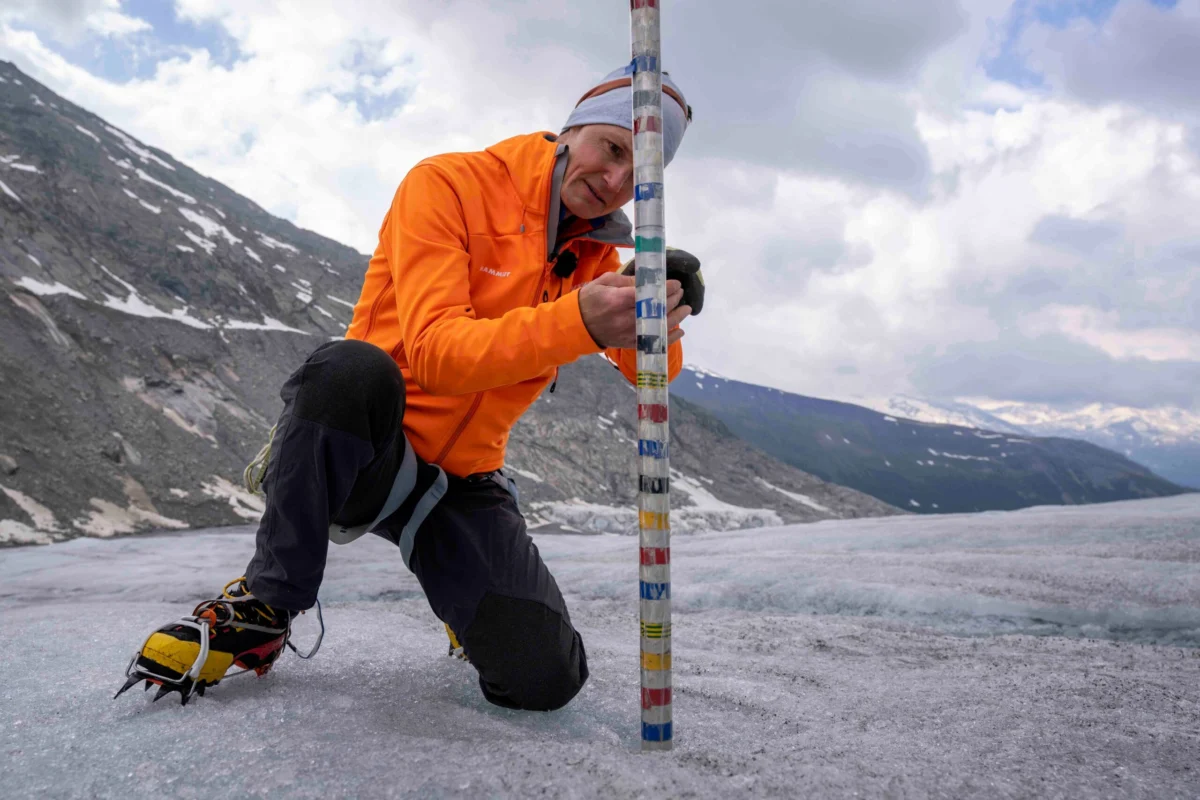
- Profound Thinning: Individual glaciers across the Swiss Alps experienced average thickness reductions ranging from 2.5 to 4 meters (8 to 13 feet), with certain glacier tongues thinning by up to 10 meters (33 feet).
- Iconic Ice Masses Hit Hard: Prominent formations—including the Allalin, Clarident, Rhone, and the Aletsch Glacier, the largest ice mass in the Alps—all recorded their most severe melting seasons on record.
- Water Loss Equivalent: Between July and September, the ice melt equated to a loss of 2.2 trillion liters (581 billion gallons) of water—four times the annual domestic consumption of Switzerland’s entire population of 9.1 million.
Chronology of a Crisis: From Historic Milestones to Present Retreat
The degradation of Switzerland’s glaciers has accelerated dramatically over the past two decades, transforming from a gradual climatic shift into an acute crisis.
The 2003 Benchmark
Prior to the modern era of extreme melting, the year 2003 stood as a stark warning. While the absolute volume of ice lost in 2003 was technically larger than this year’s figures, the percentage decline was lower. Back then, the relative loss amounted to 3.5% of the total ice volume. Because decades of continuous warming have already decimated the country’s frozen reserves, today’s glaciers represent roughly just one-third of the total volume they held 23 years ago, making percentage-based losses far more catastrophic.
The 2022 Record-Breaker
The absolute worst melting season in Swiss history occurred in 2022. That year was defined by a punishing combination of scorching summer temperatures, meager winter snowfall, and an atmospheric phenomenon that carried reddish dust particles from the Sahara Desert across Europe. When this dust settled on the pristine white snow, it drastically lowered the albedo (reflectivity) of the glaciers, causing them to absorb significantly more solar radiation and supercharging the melt rate.
The 2026 Reality
The current findings reveal that 2026 has cemented the grim trajectory initiated by previous decade extremes. With winter snowpacks arriving later, melting earlier, and failing to replenish high-elevation ice, the system has entered a negative feedback loop from which natural recovery is no longer mathematically possible under current climatic baselines.
Supporting Data and Hydrological Mechanics
To understand why this year’s melt is so devastating, glaciologists point to the critical dual role that winter snowpacks play in the lifecycle of a glacier.

Dr. Matthias Huss explains that winter snow functions as both a shield and a nursery:
- The Thermal Shield: "On the one hand, it protects the bare ice from melting," Huss said during an interview at ETH Zurich. "The longer you have snow, the longer you avoid the loss of old ice." Snow reflects sunlight far more efficiently than dark, exposed glacial ice or underlying bedrock.
- The Ice Generator: "On the other hand, the snow is important also for generating new food for the glacier," Huss added. "The more snow you have, the higher the potential to keep some of the snow at high elevation and to form new ice."
When winter snowfall is insufficient, the protective blanket vanishes early in the spring, exposing the vulnerable, centuries-old blue ice underneath to months of relentless summer heat.
This mechanical failure has triggered a massive redistribution of water across Central Europe. The 2.2 trillion liters of meltwater lost during the peak summer months represent an immense hydrological shock. While Switzerland relies on hydropower for more than half of its electricity generation, the rapid loss of solid-state water storage threatens long-term energy security.
Furthermore, Switzerland is frequently described as the "water tower of Europe." The nation’s alpine watersheds feed several of the continent’s most economically and ecologically vital river arteries, including the Rhine, the Rhone, the Po, and the Danube. As these natural reservoirs shrink, downstream agricultural, industrial, and municipal users across multiple countries face severe water security risks during dry summer months.
Official Responses and Global Context
The crisis in the Swiss Alps is not an isolated phenomenon; it mirrors a planetary breakdown of the cryosphere. Satellite observations over the past half-century confirm massive ice sheet shrinkage in Greenland and Antarctica, while high-altitude warming has destabilized fragile mountain slopes globally. Most notably, extreme glacial melting and permafrost thawing helped destabilize a Himalayan slope in August, unleashing catastrophic and deadly flooding across Nepal.
Scientific bodies and international climate advocates are renewing urgent calls for systemic policy overhauls. Researchers from GLAMOS and the Swiss Academy of Sciences stress that regional adaptations—such as covering small tourist glaciers with reflective geotextile blankets—are merely localized band-aids unable to stop macro-scale atmospheric warming.
"We just need to stabilize the climate by reducing CO2 emissions, and this will help the glaciers," Huss urged.
However, he delivered a sobering assessment regarding the immediate future of the European landscape. According to Huss, it is now "almost too late" to save the glaciers residing within the Swiss Alps; their disappearance over the coming decades is largely baked into current climatic projections.
Despite the grim outlook for European alpine ice, Huss maintains that aggressive global mitigation efforts remain vital. "For the ice in the polar regions like the ice sheets, there it’s not yet too late," he emphasized. "There, we can make a difference, and we need to make a difference in order to limit sea level rise, for example, a factor that is a fundamental threat to billions of people living along the coast."
Broader Implications for Europe and Beyond
As scientific teams fan out across the Swiss landscape—deploying red dye into glacial streams to trace subterranean meltwater channels, map hidden crevices, and assess structural collapses—the socio-economic fallout of a glacier-free Alps comes into sharper focus.
- Ecotourism and Economy: Alpine tourism, a cornerstone of regional economies in cantons like Valais and Grisons, faces an uncertain future. Iconic landscapes are visibly transforming from fields of permanent white ice into barren rock and scree, altering regional identities and threatening local hospitality industries.
- Geopolitical Water Stress: As the Rhine and Rhone experience unprecedented low-flow periods during drought years, commercial shipping, river transport, and cross-border cooling water supplies for nuclear and thermal power plants in France and Germany are increasingly compromised.
- Ecosystem Disruption: Aquatic ecosystems within alpine and sub-alpine river systems are struggling to adapt to fluctuating water temperatures and altered sediment loads, threatening native fish species and altering downstream biodiversity.
Ultimately, the plight of Switzerland’s glaciers serves as an undeniable barometric reading of global climate health. As the ice vanishes at historic rates, scientists reiterate that the warnings inscribed in the retreating Rhone and Aletsch glaciers extend far beyond Swiss borders, carrying consequences that will ripple across human societies worldwide for generations to come.