The rapid acceleration of artificial intelligence has triggered a massive, capital-intensive scramble to construct the physical infrastructure required to power the digital future. Utilities across the United States are currently recalibrating their long-term generation and transmission master plans to accommodate astronomical projections for data center demand. However, a widening chasm is emerging between the "announced megawatts" that dominate corporate press releases and the actual, operational load that hits the power grid.
According to data from geospatial analytics firm SynMax, nearly 40% of U.S. data center projects slated for completion in 2026 risk missing their original targets by more than three months. This isn’t merely a construction delay; it is a systemic bottleneck driven by a trifecta of labor shortages, equipment procurement constraints, and, most critically, the increasingly difficult task of securing reliable, high-voltage electricity.
The Mirage of Announced Capacity
The gap between intent and execution has become a point of friction between big tech companies and the utility sector. While tech giants like Oracle and Microsoft announce multi-gigawatt campuses, the reality of grid interconnection is governed by physics, regulatory permitting, and the slow, linear progress of traditional infrastructure development.
As of this summer, TD Economics reported that out of 16 gigawatts (GW) of data center capacity announced for delivery in 2026, only about 5 GW was under actual construction. This discrepancy suggests that "ghost demand"—speculative or overly optimistic power requests—is cluttering interconnection queues, complicating the planning process for regional transmission organizations (RTOs) and local utilities alike.

Case Studies in Bottlenecks: A Chronology of Delays
Wisconsin: The Transmission Tug-of-War
Oracle’s Project Lighthouse in Port Washington, Wisconsin, serves as a textbook example of the friction between digital ambitions and electrical realities. Developed by Vantage Data Centers, the campus is projected to require 1.3 GW of electricity—enough to power a medium-sized city.
The project’s timeline hit a significant snag in September 2025, when American Transmission Co. (ATC) filed for approval of over $1 billion in necessary transmission upgrades. Following extensive revisions and regulatory pushback, Wisconsin regulators withdrew their determination that the application was complete, forcing ATC to restart the complex approval process. While Oracle maintains that customer delivery is expected in the second half of 2027, independent analysis from Aterio suggests a more tempered outlook: partial power may arrive by December 2027, with the full 1.3 GW capacity not expected until October 2028.
New Mexico: The Fuel Supply Hurdle
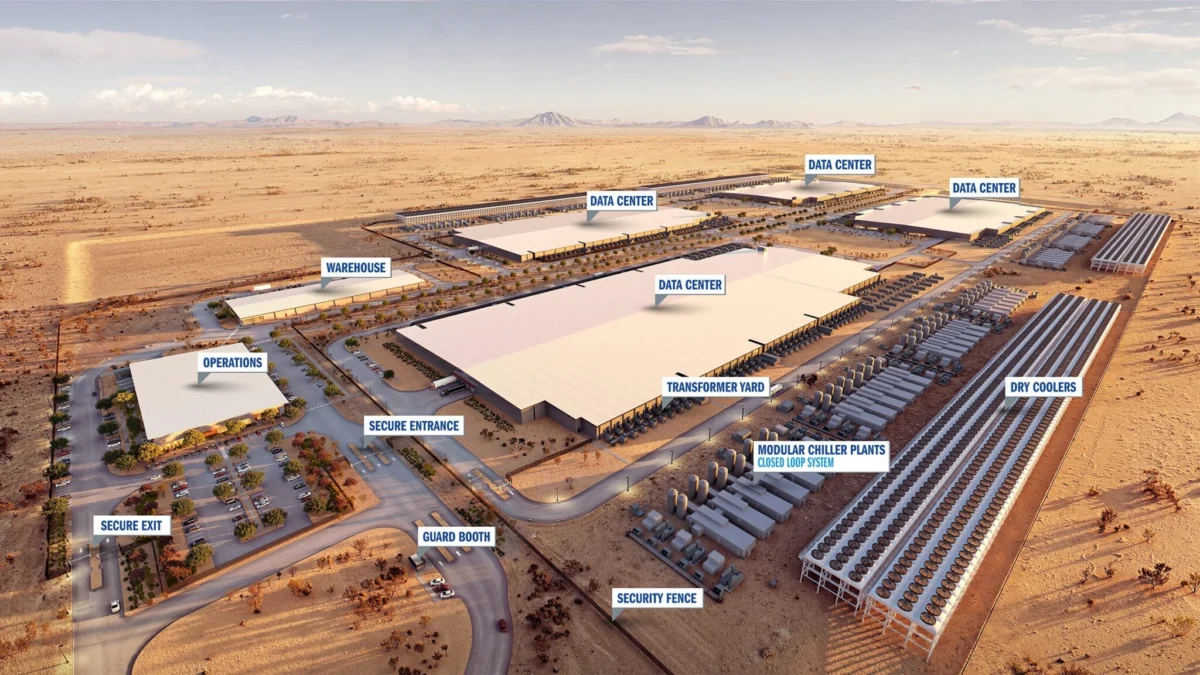
Even when a project attempts to circumvent the grid via behind-the-meter generation, it remains vulnerable to supply chain issues. Oracle’s 2.45-GW Project Jupiter in Doña Ana County is designed to rely heavily on natural gas-powered fuel cells provided by Bloom Energy.
However, the supporting infrastructure—specifically the natural gas pipeline intended to fuel the campus—has faced severe permitting delays. Currently running roughly six months behind schedule, the pipeline is now expected to finish in February 2027. While Oracle has invoked force majeure clauses to protect itself against potential contractual penalties, the project highlights a sobering lesson: AI data centers are only as reliable as the fuel or transmission lines feeding them.

Texas: The Ramp-Up Realities
The Stargate campus in Abilene, Texas, backed by a consortium including OpenAI, Oracle, SoftBank, and MGX, provides a look at the "ramp-up" phase. While the facility is partially operational, the transition to full capacity has been slower than market analysts initially predicted.
Samaritan Research had initially forecasted 600 MW would be online earlier in the year. However, disclosures from Oracle later confirmed that only about 200 MW were operational as of April 2026. While the project is steadily scaling, the distinction between "building completion" and "full compute load" is a crucial nuance that is often lost in market hype. Utilities are learning that a data center’s ribbon-cutting ceremony does not equate to the immediate arrival of full-scale electricity demand.
Ohio: Weathering the Midwest
In Licking County, Ohio, Microsoft has faced a different set of challenges. The company’s massive buildout, which saw a temporary cancellation in 2025 before being resurrected, has been hindered by the unpredictable nature of Midwestern spring weather. Construction on the five-building, 264-MW campus in Heath and the six-building, 317-MW campus in Hebron has necessitated aggressive work schedules—including Sunday shifts—to keep pace with targets. Despite these efforts, analysts at Aterio continue to monitor key commissioning milestones, noting that the transition from site grading to fully operational compute environments is a multi-year gauntlet.
Supporting Data: The Scale of the Disconnect
The sheer volume of requested capacity has created a state of administrative gridlock. Currently, proposed U.S. data center power requests have exceeded 700 GW. To put this in perspective, that figure is more than ten times the total electricity currently consumed by all U.S. data centers combined.

This volume has led to drastic measures in states like Texas, where regulators have taken the unprecedented step of halting new data center grid connections to audit the requests. The goal is to separate legitimate, high-priority projects from speculative or duplicate filings that are clogging the queue. In Northern Virginia, arguably the world’s data center hub, interconnection timelines have ballooned to as long as seven years, far outstripping the 18-to-24-month hardware deployment cycles of the AI industry.
Official Responses and Regulatory Shifts
The utility sector is responding to this uncertainty by shifting its risk profile. Historically, utilities provided "just-in-time" grid connections. Today, they are increasingly demanding "take-or-pay" contracts, significant upfront capital contributions for transmission upgrades, and, in some cases, requiring data center operators to build their own generation assets.
"The grid is not a bottomless well of power," noted one industry analyst. "We are seeing a move away from the ‘connect now, pay later’ model. Regulators are now forcing developers to prove the viability of their projects before utilities commit to multi-billion-dollar transmission projects that may end up as stranded assets if a data center project fails to materialize."
Strategic Implications for the AI Boom
The implications of these delays are profound. First, the cost of power is rising. As utilities invest in the massive infrastructure upgrades required to support these hubs, those costs are inevitably being passed on to the broader rate base.

Second, the geographic dispersion of data centers is changing. Companies are no longer choosing locations solely based on proximity to talent or fiber-optic backbones; they are choosing locations based on the "path of least resistance" for power. This is leading to a migration toward regions with excess generation capacity and streamlined regulatory environments, effectively creating "power-centric" tech hubs.
Finally, the gap between the speed of software innovation and the speed of electrical infrastructure is the defining bottleneck of the 2020s. AI developers iterate in weeks; transmission line permitting and construction take years. Until this timeline mismatch is resolved, the "AI power boom" will likely continue to manifest as a series of starts, stops, and rolling revisions rather than the smooth, vertical trajectory predicted by Wall Street.
As the industry moves toward 2027 and 2028, the market will likely see a "shakeout" phase. Projects that have secured both land and reliable power will proceed, while those built on speculative demand or flimsy power purchase agreements will likely face cancellation or long-term stagnation. For the power sector, the lesson is clear: in the race to build the future of AI, the grid is the ultimate speed limit.