Main Facts
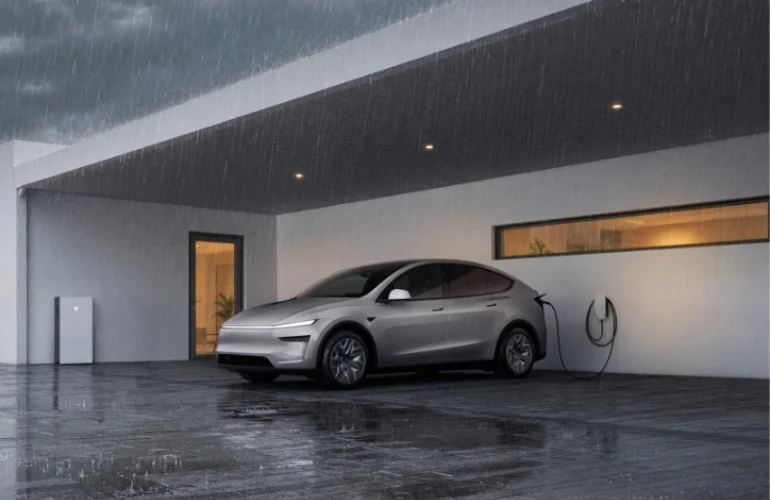
In a significant milestone for both the electric vehicle and residential energy sectors, Tesla has officially announced the expansion of its AC bidirectional charging capabilities. Previously exclusive to the polarizing and futuristic Cybertruck, the coveted "Powershare Home Backup" program is now available for new buyers of the Tesla Model 3 and Model Y.
By pairing these mainstream passenger electric vehicles with the company’s latest-generation home energy storage system—the Powerwall 3—Tesla owners can now transform their daily drivers into mobile generators capable of keeping the lights on during grid failures. According to the company, the system can significantly extend household energy resilience, providing up to two days of additional backup power for an average U.S. household consuming roughly 30 kilowatt-hours (kWh) per day. The Cybertruck, owing to its massive battery pack, continues to offer up to three days of supplemental power.
To participate in the newly expanded Powershare Home Backup ecosystem, customers must meet specific hardware criteria. Eligible participants are required to own a Powerwall 3, either a Wall Connector 3 or a Universal Wall Connector, and must have purchased a brand-new Model 3 or Model Y built or ordered after October 1, 2026. For existing Cybertruck owners, the integration with Powerwall 3 remains fully supported.
Perhaps most appealing to consumers wary of expensive home renovation projects, Tesla states that enabling the feature on new installations requires no additional hardware or invasive electrical work. Existing setups may require a brief review by a certified installer to ensure the Wall Connector is correctly wired into the home’s backup circuit and compliant with local electrical codes, though Tesla notes that in most instances, activation can be handled remotely.
Chronology of Vehicle-to-Home Integration
The journey toward mainstream vehicle-to-home (V2H) and vehicle-to-grid (V2G) integration has been a long-anticipated evolution within the automotive and energy industries. For years, skeptics pointed out the irony of driving a massive battery pack around every day while sitting completely helpless in a home during a blackout.
The Early Resistance and Paradigm Shift
In the early days of the Tesla ecosystem, Chief Executive Officer Elon Musk was famously non-committal about bidirectional charging. For years, Tesla argued that the wear and tear on vehicle batteries caused by cycling energy back into a home or the grid outweighed the consumer benefits. Furthermore, the company historically favored a stationary home battery—the Powerwall—as the ideal, dedicated solution for residential backup power.
However, competitive pressures from rival automakers and shifting consumer demands began to change the narrative. Other EV manufacturers started introducing bidirectional charging features, and the frequency of extreme weather events—ranging from winter storms in Texas to wildfires in California—heightened consumer demand for multi-layered energy security.
The Cybertruck Breakthrough
The turning point for Tesla arrived with the commercial rollout of the Cybertruck. Built on a revolutionary 800-volt electrical architecture, the Cybertruck debuted with native bidirectional charging hardware designed from the ground up to support "Powershare." This allowed the heavy-duty electric pickup to act as a high-capacity mobile power plant, capable of powering not just tools on a job site, but entire households through a home integration system paired with the Powerwall.
The Mainstream Pivot
Following the successful deployment of Powershare on the Cybertruck, Tesla engineering teams focused on scaling the technology down to its highest-volume global sellers: the Model 3 sedan and the Model Y crossover. By standardizing the necessary internal inverter and software capabilities across its vehicle lineup, Tesla has crossed the threshold from niche feature to mass-market standard. The October 2026 cutoff date for new vehicle purchases marks the official commercial deployment of this capability to the wider public, signaling that bidirectional charging is no longer a luxury reserved for specialty trucks.
Supporting Data and Technical Specifications
To truly understand the impact of Tesla’s latest announcement, it is necessary to examine the hard data surrounding household energy consumption, battery capacities, and hardware integration.
Energy Demands and Backup Duration
According to the U.S. Energy Information Administration (EIA), the average American household consumes approximately 30 kWh of electricity per day. During a grid outage, this figure can fluctuate wildly depending on the season, geographic location, and whether the home relies on electricity for heating and cooling.
The Powerwall 3 on its own is a formidable residential energy storage unit, but pairing it with a Tesla EV creates a multi-tiered defense against blackouts:
- Powerwall 3 Standalone: Provides baseline overnight and emergency power.
- Model 3 and Model Y Integration: Extends the total backup window by an estimated two additional days of standard U.S. household consumption.
- Cybertruck Integration: Extends the backup window by an estimated three additional days.
When combined, a fully charged Powerwall 3 and a connected Tesla EV can comfortably bridge multi-day power outages without the noise, pollution, and maintenance hassles associated with traditional gasoline or diesel-powered backup generators.
Hardware Ecosystem Requirements
The Powershare Home Backup system is tightly integrated within Tesla’s proprietary hardware ecosystem. To utilize the feature, a consumer’s setup must comprise three core components:
- The Energy Storage Unit: A Powerwall 3, which manages the home’s electrical load, solar generation (if present), and grid interaction.
- The Delivery Mechanism: A Wall Connector 3 or a Universal Wall Connector. Unlike older generation chargers, these units are engineered to facilitate the two-way flow of alternating current (AC) power between the car and the home.
- The Vehicle: A Model 3 or Model Y purchased after October 1, 2026, or any model year Cybertruck.
Installation and Retrofitting Dynamics
One of the most praised aspects of the system’s technical rollout is its minimalist hardware footprint. For new builds where the Powerwall 3 and Wall Connector 3 are installed simultaneously, the system operates out of the box with zero additional equipment.
For homeowners who already possess a Powerwall 3 and Wall Connector setup, the process is streamlined to minimize friction:
- An authorized installer must verify that the Wall Connector is physically wired into the home’s backup sub-panel (rather than a non-backed-up circuit).
- The installation site must comply with National Electrical Code (NEC) standards and local utility interconnect regulations regarding bidirectional power flows.
- Once physical and code verifications are complete, Tesla can frequently execute the final system activation remotely via a software update, sparing the homeowner from protracted on-site engineering visits.
Official Responses and Industry Perspectives
Tesla’s executive leadership has framed the Powershare expansion not merely as a convenient gadget upgrade, but as a fundamental redefinition of what an electric vehicle is.
Redefining the Value Proposition of an EV
Colby Hastings, Tesla’s Senior Director of Residential Energy, highlighted the strategic shift during the product rollout announcement.
"With Powershare Home Backup, choosing a Tesla is no longer just a decision to buy an EV. It’s a decision to invest in home energy resilience," Hastings stated. "Our vehicles and Powerwall are even better when used together — each increases the value of the other."
This sentiment underscores a broader marketing strategy: Tesla is positioning its ecosystem as a unified lifestyle choice rather than a collection of disparate products. By linking automotive ownership to household infrastructure, the company creates a powerful psychological and practical lock-in effect for consumers. A customer looking to replace their home backup battery or their primary family car is now incentivized to purchase both from the same brand to maximize utility.
Industry Reception and Competitive Pressures
Energy analysts and automotive journalists have reacted warmly to the announcement, noting that Tesla is catching up to—and in some ways streamlining—a space that competitors like Ford (with the F-150 Lightning and Intelligent Backup Power) and Hyundai/Kia (with Vehicle-to-Load technologies) have been exploring for years.
However, industry experts point out that Tesla’s primary advantage lies in its proprietary integration. While other automakers require complex third-party inverters or cumbersome transfer switches (such as Ford’s partnership with Sunrun), Tesla’s seamless marriage of the Powerwall 3, Wall Connector, and vehicle software creates one of the most frictionless user experiences on the market.
Utility companies are also watching closely. As bidirectional charging gains mainstream adoption, progressive utilities are beginning to look at Virtual Power Plants (VPPs). While Powershare Home Backup is currently focused on emergency resilience during blackouts, the underlying bidirectional infrastructure paves the way for future vehicle-to-grid (V2G) participation. This would allow consumers to discharge their vehicle and home batteries back to the local grid during peak demand hours, earning credits or cash payments from utilities.
Implications for Consumers, the Grid, and the Energy Market
The rollout of AC bidirectional charging across Tesla’s entire high-volume vehicle lineup carries profound implications across multiple sectors, reshaping how everyday consumers think about energy, how residential architecture is planned, and how the electrical grid absorbs shocks.
1. Consumer Empowerment and Peace of Mind
For the average homeowner, the specter of severe weather—hurricanes, ice storms, heatwaves, and aging grid infrastructure—presents a persistent anxiety. Standby home generators are expensive, noisy, require fuel storage, and sit idle for 99% of the year.
By contrast, an electric vehicle is an asset the consumer already utilizes daily for commuting, errands, and road trips. Utilizing the vehicle’s massive traction battery as an emergency backup resource monetizes an asset that would otherwise sit parked in a garage during a grid failure. The peace of mind offered by knowing a family can maintain heating, refrigeration, and lighting for up to five combined days (Powerwall + Model 3/Y) represents a massive leap forward in household safety.
2. Evolving Residential Architecture and Real Estate
As V2H technologies become standard features rather than expensive anomalies, real estate developers and homebuilders are beginning to take notice. New residential construction projects are increasingly factoring EV chargers and home battery storage into standard electrical blueprints.
Homebuyers are expected to increasingly value properties that come pre-wired for bidirectional energy systems. A home equipped with a Powerwall 3 and a compatible Wall Connector will possess a distinct market advantage, viewed by prospective buyers as a "future-proofed" asset capable of weathering environmental and economic uncertainties.
3. Relief for Strained Electrical Grids
National electrical grids are under unprecedented strain. The transition toward electrification—driven by the adoption of EVs, heat pumps, and data-center-heavy digital economies—is colliding with aging transmission lines and extreme weather events driven by climate change.
While Powershare Home Backup is primarily designed for islanded (off-grid) emergency operation during outages, the proliferation of millions of bidirectional vehicles establishes a massive distributed energy resource (DER) network. If regulatory frameworks evolve to safely permit large-scale V2G interactions, parked Teslas could collectively absorb excess renewable energy (such as solar during midday spikes) and discharge it during evening peaks. This capability could radically reduce the need for fossil-fuel-peaker plants and stabilize regional grids against catastrophic blackouts.
4. A New Standard for the Automotive Industry
Finally, Tesla’s move forces the hand of the broader automotive industry. When the market leader standardizes bidirectional charging across its high-volume sedans and crossovers, it ceases to be a novelty checklist item and becomes an expected consumer baseline. Competing manufacturers who previously dragged their feet on implementing V2H hardware due to cost or battery degradation concerns will now be forced to accelerate their own bidirectional integration roadmaps.
Conclusion
Tesla’s expansion of the Powershare Home Backup program to the Model 3 and Model Y represents more than just a software unlock or a hardware compatibility update. It is a structural shift in how personal transportation and home energy intersect. By transforming everyday commuter cars into mobile emergency power stations, Tesla has bridged the gap between mobility and residential resilience, setting a new benchmark that the rest of the automotive and energy markets will be forced to follow.