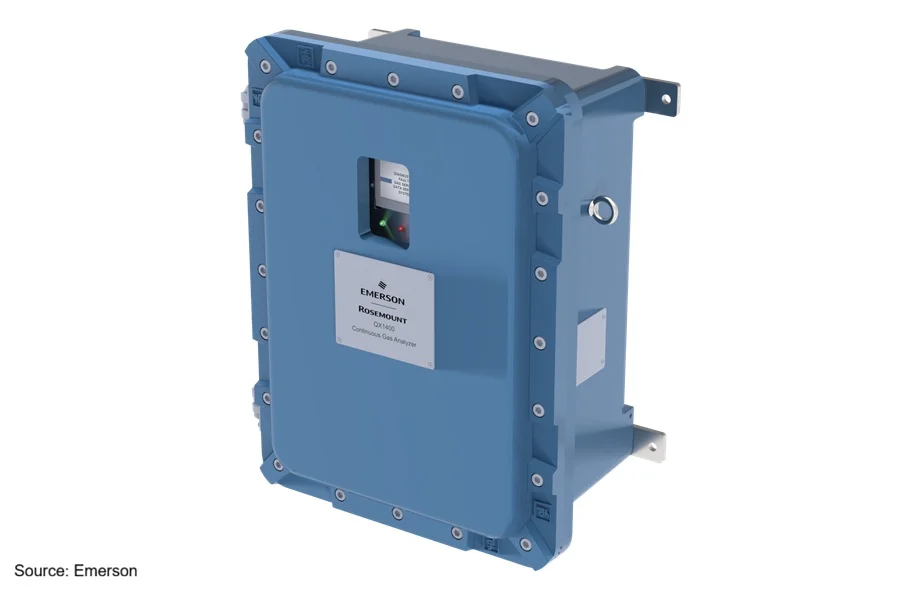
ST. LOUIS — In an industrial landscape increasingly defined by stringent environmental regulations, decarbonization mandates, and the relentless pursuit of operational efficiency, Emerson has announced a significant expansion of its industrial analytics portfolio. The global technology and engineering leader has officially launched the Rosemount™ QX1400 Continuous Gas Analyzer, a rugged, high-performance analytical instrument engineered specifically for natural gas quality monitoring, continuous emissions monitoring systems (CEMS), and other extreme, safety-critical applications.
Building upon the proven architecture of its predecessor—the Rosemount QX1000—the new QX1400 integrates advanced laser-based spectroscopy with paramagnetic measurement technologies. However, the defining breakthrough of this latest iteration lies in its comprehensive safety ratings. By securing rigorous international certifications for explosive atmospheres, the Rosemount QX1400 bridges the historical gap between high-fidelity gas measurement and compliance-driven installation flexibility, offering plant operators a powerful new tool for hazardous areas.
Main Facts
The Rosemount QX1400 is an advanced continuous gas analyzer designed to deliver real-time, highly selective, and multi-component gas measurements in some of the world’s most demanding industrial environments.
At its core, the analyzer utilizes a sophisticated hybrid measurement methodology. It pairs quantum cascade laser (QCL) direct absorption spectroscopy for the majority of target gases with paramagnetic detection specifically for oxygen ($O_2$). This dual-technology approach ensures that the analyzer meets or exceeds the strict performance requirements mandated across diverse sectors, including chemical processing, petrochemical manufacturing, liquefied natural gas (LNG) production, carbon capture and underground storage (CCUS), and industrial emissions compliance.
The most critical differentiator for the QX1400 is its hazardous-area certification profile. The analyzer is designed to be installed directly into explosive environments without requiring secondary protective measures, such as complex explosion-proof or purged external enclosures.
- European and International Markets: The analyzer has achieved ATEX II 2G Ex d IIB H2 T4 certifications for Europe and IECEx Ex db IIB+H2 T4 Gb certifications for the rest of the world (R.O.W.).
- North American Markets: Emerson anticipates securing North American certifications by the end of 2026 for Class 1, Division 2, Groups B, C, D, and T4 classifications.
Off the shelf, the modular design of the Rosemount QX1400 supports the simultaneous multi-component measurement of key regulatory and process gases, typically configured to track between one and four gases at a time. Standard configurations easily monitor carbon monoxide ($CO$), carbon dioxide ($CO_2$), oxygen ($O_2$), nitric oxide ($NO$), nitrogen dioxide ($NO_2$), and sulfur dioxide ($SO_2$). Furthermore, extended configuration options allow for the precise detection of additional compounds, such as methane ($CH_4$) and nitrous oxide ($N_2O$).
Chronology
The introduction of the Rosemount QX1400 is the result of a multi-year engineering trajectory focused on scaling high-precision laboratory-grade analytics into rugged, field-deployable industrial hardware.
- Pre-Launch Foundation (The QX1000 Era): Emerson initially established its footing in advanced hybrid continuous gas analysis with the rollout of the Rosemount QX1000. While widely praised for its exceptional selectivity and low maintenance profile, the QX1000 was primarily targeted at standard industrial zones. Plant operators working in classified hazardous zones often had to rely on cumbersome auxiliary safety housings.
- Engineering and Certification Phase: Recognizing the heavy capital and engineering overhead associated with purged and explosion-proof enclosures, Emerson’s R&D teams set out to redesign the core electronics, optical benches, and housing tolerances of the platform. This engineering push culminated in the attainment of ATEX and IECEx ratings for explosive gas atmospheres containing hydrogen ($H_2$).
- Global Market Rollout (Current Phase): Emerson officially announced the commercial release of the Rosemount QX1400, rolling out initial availability in European and international markets where ATEX and IECEx standards are foundational.
- Future Roadmap (Through 2026): Emerson has laid out a clear timeline for North American market penetration, with full Class 1, Division 2 certifications slated for completion by the end of 2026, opening up deployment pathways across North American refineries, chemical corridors, and LNG export terminals.
Supporting Data and Technical Architecture
The technical superiority of the Rosemount QX1400 stems from its unique fusion of optical and physical detection principles, engineered to eliminate cross-interferences and drastically reduce instrument drift.
The Hybrid Measurement Advantage
Traditional gas analyzers often struggle with cross-interference—where the presence of one background gas masks or distorts the reading of another target analyte. The QX1400 bypasses this limitation by leveraging the intrinsic high selectivity of laser-based measurement.
- Quantum Cascade Laser (QCL) Direct Absorption Spectroscopy: QCL technology targets the unique fundamental vibrational absorption lines of gases in the mid-infrared spectrum. This provides ultra-high resolution, enabling the analyzer to isolate and quantify complex gas streams with minimal interference, even in fluctuating process conditions.
- Paramagnetic Detection: Because laser-based techniques can face challenges with specific diatomic molecules like oxygen under certain conditions, Emerson integrated a dedicated paramagnetic sensor. Paramagnetic detection relies on the unique physical property of oxygen being strongly attracted to a magnetic field. This ensures highly linear, reliable, and precise $O_2$ measurements.
Application Breadth: From LNG to CCUS
Precise oxygen and multi-gas detection are non-negotiable in emerging and traditional high-stakes sectors:
- Liquefied Natural Gas (LNG): Monitoring trace oxygen and moisture is vital to prevent freeze-ups, pipeline corrosion, and catastrophic safety hazards during liquefaction and regasification.
- Carbon Capture and Underground Storage (CCUS): As industrial emitters race to capture carbon dioxide, the purity of the captured $CO_2$ stream must be meticulously monitored to meet pipeline tariff specifications and permanent geological storage standards.
- Hydrogen Purity and Chemical Synthesis: With hydrogen rapidly scaling as a clean energy carrier, detecting impurities like oxygen and carbon monoxide in hydrogen fuel streams is critical to prevent catalyst poisoning in fuel cells and downstream chemical reactors.
Economic and Operational Impact
Beyond raw analytical precision, the architecture of the QX1400 directly targets total cost of ownership (TCO). By eliminating the need for bulky, expensive purge systems and heavy explosion-proof junction boxes, the analyzer slashes material costs during the engineering and procurement phases.
Furthermore, its modular design and robust internal components translate to extended calibration intervals and minimal routine maintenance. This reduction in hands-on service requirements directly correlates with decreased operational downtime and lower lifecycle costs.
Official Responses
Industry reaction to the launch has highlighted how the QX1400 solves a persistent engineering compromise between safety compliance and analytical placement.
Dr. Beth Livingstone, Global Product Manager for Process Gas at Emerson, underscored the philosophy driving the new product development:
"Gas analysis applications should not require users to choose between the measurement technology they need and the hazardous-area installation their site demands," Dr. Livingstone explained. "The Rosemount QX1400 brings complementary technologies together in one certified platform to simplify system design, while providing the measurements required for critical emissions, quality and purity applications."
Industry analysts note that Dr. Livingstone’s remarks strike at the heart of modern plant engineering challenges. For decades, instrument engineers were forced to compromise: either place a high-precision analyzer far away from the sample point—thereby introducing transport time delays and measurement lag—or install less capable, ruggedized sensors closer to the process to satisfy hazardous-area restrictions. The QX1400 explicitly removes this compromise.
Implications for Industry
The introduction of the Rosemount QX1400 carries profound implications for multiple industrial sectors, touching everything from regulatory compliance to plant safety architecture.
1. Enhanced Safety and Simplified Engineering
In hazardous areas—such as oil refineries, petrochemical processing units, and offshore platforms—electrical equipment must be strictly managed to prevent ignition sources. Historically, housing a delicate analytical instrument in a Zone 1 or Zone 2 hazardous location required massive, heavy purged enclosures fed by clean instrument air, or thick-walled explosion-proof cast iron boxes.
Because the Rosemount QX1400 carries ATEX and IECEx certifications for explosive atmospheres (including hydrogen-rich environments), it can be mounted directly into these classified zones. This drastically reduces structural engineering burdens, lowers the physical weight load on plant racks and gantries, and simplifies maintenance access for technicians.
2. Improved Measurement Accuracy via Proximity
Proximity to the sample tap is a golden rule in process gas analytics. Long sample lines introduce time delays, risk sample degradation, and can lead to adsorption or desorption of reactive gases along the tube walls.
Because the QX1400 can be installed much closer to the actual sampling point safely, response times are accelerated. Plant operators gain real-time, instantaneous visibility into process upsets, enabling tighter closed-loop control, faster quality adjustments, and immediate mitigation of environmental excursions.
3. Future-Proofing Compliance and Sustainability
Environmental regulatory bodies worldwide are tightening limits on industrial stack emissions ($NO_x$, $SO_x$, $CO$, and $CO_2$). At the same time, the global pivot toward clean energy sources—such as blue and green hydrogen, sustainable aviation fuels (SAF), and carbon capture—demands hyper-pure process streams.
The QX1400 positions industrial facilities to meet these overlapping demands. Its multi-component measurement capability ensures that a single device can satisfy complex CEMS mandates while simultaneously verifying product quality. As facilities navigate the multi-decade transition toward net-zero operations, deploying adaptable, highly accurate, and safety-certified analytical infrastructure will remain a cornerstone of industrial resilience.
About Emerson
Emerson (NYSE: EMR) is a global technology and engineering company providing innovative solutions for customers in industrial, commercial, and residential markets. Through its industry-leading automation solutions, including the Rosemount brand, Emerson helps process, hybrid, and discrete manufacturers maximize production, protect personnel and the environment, and optimize their energy and operating costs.
For more information on the Rosemount QX1400 Continuous Gas Analyzer, technical specifications, and global regional availability, visit Emerson.com/RosemountQX1400.