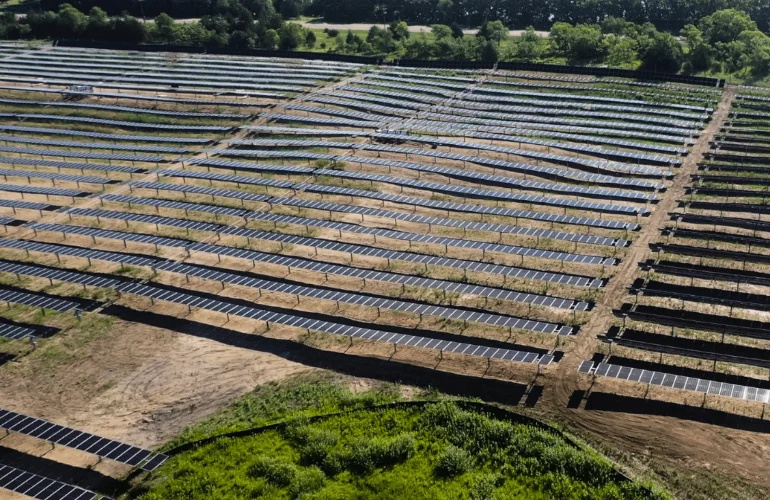
RAMSEY, Minnesota — In a milestone achievement that bridges environmental remediation with renewable energy expansion, Cedar Creek Energy has officially completed the construction of the Ramsey II Renewable Station. Spanning nearly 25 acres of buffer land adjacent to the Anoka-Ramsey Closed Landfill, the 5.046-megawatt (MW) solar installation represents a triumph of modern engineering, multi-agency cooperation, and regulatory persistence.
The project brings together a consortium of key players in the upper Midwest energy sector. Cedar Creek Energy served as the engineering, procurement, and construction (EPC) contractor for the project owner, Kearsarge Energy. Meanwhile, local electric cooperative Connexus Energy is slated to purchase all the electricity generated by the array under a robust 30-year power purchase agreement (PPA), securing a long-term, stable source of clean energy for its member-owners.
Main Facts
The Ramsey II Renewable Station is a state-of-the-art photovoltaic (PV) facility engineered to maximize energy harvest while respecting the environmental sensitivities of a closed landfill site.
- Capacity: 5.046 MW of clean, renewable solar generation.
- Footprint: Approximately 25 acres of buffer land situated adjacent to the state-administered Anoka-Ramsey Closed Landfill.
- Technology: The array features roughly 8,700 high-efficiency bifacial solar panels paired with advanced terrain-following single-axis trackers.
- Key Stakeholders: Developed by Kearsarge Energy, engineered and constructed by Cedar Creek Energy, and off-taken by Connexus Energy via a 30-year PPA. The site itself is leased from the State of Minnesota.
- Environmental Milestone: This installation marks Cedar Creek Energy’s inaugural project executed within the Minnesota Pollution Control Agency (MPCA) Closed Landfill Program.
The deployment of bifacial panels—which capture sunlight from both the front side and the reflected light (albedo) on the backside—combined with terrain-following trackers, ensures that the facility operates at peak efficiency despite the undulating topography typical of landfill buffer zones.
Chronology of Development
The successful energization of the Ramsey II Renewable Station is the culmination of a decade-long endeavor, defying complex regulatory hurdles and logistical constraints.
A Decade in the Making (2013–2021)
The journey toward utilizing the Anoka-Ramsey site for solar energy began over ten years ago. Connexus Energy, in close coordination with the State of Minnesota, the City of Ramsey, and various regulatory stakeholders, initiated discussions to explore the redevelopment potential of the closed landfill’s periphery. However, progress was slow due to strict state bonding restrictions that legally barred commercial renewable energy development on properties tied to state-funded environmental bonds.
Legislative Breakthrough (2021)
A pivotal moment arrived in 2021 when the Minnesota state legislature passed targeted statutory updates. These legislative actions successfully removed the bonding restrictions that had historically stalled clean energy redevelopment on state-regulated closed landfill sites, effectively unlocking the door for projects like Ramsey II.
Groundbreaking and Rapid Construction (March 2026 – October 2026)
Following years of site evaluation, design refinement, and lease agreements with the state, actual construction on the Ramsey II project commenced in March. Despite the specialized engineering required for the undulating terrain and the strict safety protocols mandated for landfill-adjacent builds, construction crews wrapped up the project within a remarkably swift six-month window. Impressively, the entire construction phase was completed with zero recordable safety incidents.
Supporting Data and Technical Specifications
Constructing solar arrays on or near closed landfills presents unique technical challenges. Traditional grading—flattening the earth to create a uniform surface—is often strictly prohibited or heavily restricted to avoid compromising the underlying landfill caps, liners, and methane gas mitigation systems.
To overcome these obstacles without extensive earthmoving, Cedar Creek Energy deployed specialized technologies:
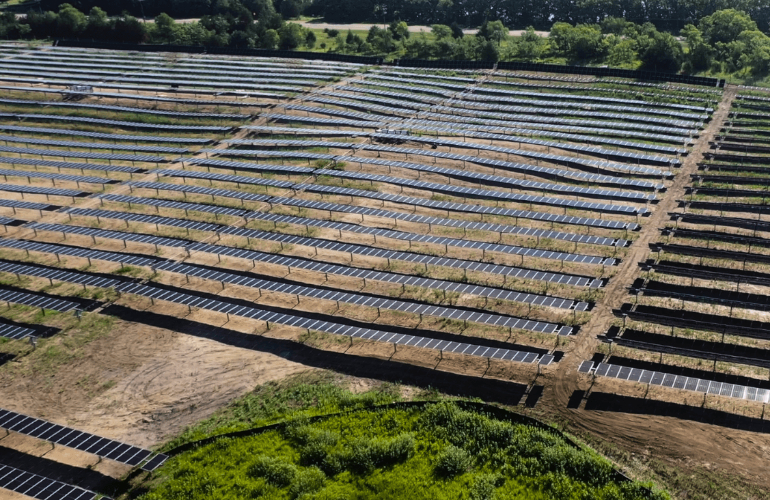
- Terrain-Following Single-Axis Trackers: Unlike standard flat-ground trackers that require uniform leveling, these specialized trackers articulate independently to follow the natural contours of the rolling landscape. This innovation minimized civil engineering costs, prevented soil erosion, and preserved the structural integrity of the site’s buffer zones.
- Bifacial Solar Modules: The approximately 8,700 bifacial panels utilized at the site maximize energy yield by absorbing direct sunlight from above while simultaneously harnessing diffuse and reflected light bouncing off the ground below.
- Long-Term Operations and Maintenance (O&M): To ensure optimal performance over the lifespan of the 30-year PPA, Cedar Creek Energy has committed to an ongoing O&M agreement, providing continuous monitoring, preventative maintenance, and rapid response capabilities.
Official Responses and Industry Perspectives
The successful realization of the Ramsey II Renewable Station has drawn high praise from executives across the public and private sectors, who view the project as a blueprint for future brownfield and landfill solar developments.
Alex Gast, Chief Operating Officer of Cedar Creek Energy, emphasized the collaborative spirit required to bring the project to fruition.
“This project represents what’s possible when utilities, developers, regulators, and state leaders work together toward long-term energy solutions,” Gast stated. “Landfill and brownfield solar projects inherently come with unique design and regulatory hurdles. Overcoming them requires immense trust, technical ingenuity, and a shared vision for a sustainable energy future.”
Industry analysts note that projects of this nature validate the viability of utilizing underutilized, non-arable lands for clean energy generation. By keeping solar arrays off prime agricultural farmland and instead siting them on buffer lands associated with waste management facilities, developers can bypass "food vs. fuel" land-use debates while simultaneously putting dormant property back onto the economic and ecological grid.
Implications for Minnesota’s Clean Energy Future
The completion of the Ramsey II Renewable Station carries significant implications for the state of Minnesota, local municipalities, and the broader U.S. renewable energy market.
Expanding the MPCA Closed Landfill Program’s Potential
Minnesota is home to dozens of closed landfills managed under the Minnesota Pollution Control Agency’s Closed Landfill Program. Historically, these sites were viewed purely as environmental liabilities requiring perpetual monitoring and maintenance. The successful deployment at Anoka-Ramsey demonstrates that these properties can be co-developed to generate local property tax revenue, lease income for the state, and substantial clean megawatt-hours. Industry observers expect Ramsey II to serve as a catalytic case study, paving the way for dozens of similar installations across Minnesota’s remaining closed landfills.
Strengthening Cooperative Energy Portfolios
For Connexus Energy—Minnesota’s largest electric cooperative—the 30-year PPA locks in predictable, long-term pricing for clean electricity. As cooperatives face increasing pressure from member-owners to decarbonize while maintaining grid reliability and rate stability, localized solar resources connected directly to distribution grids help reduce transmission congestion and wholesale market exposure.
A Model for Brownfield Redevelopment Nationwide
Nationwide, the EPA estimates there are tens of thousands of acres of closed landfills and brownfields capable of hosting renewable energy infrastructure. However, regulatory red tape and financing complexities frequently kill these initiatives before ground is broken. The Ramsey II project highlights how legislative modernization—specifically updating state bonding laws to permit commercial leases on public environmental sites—can unlock gigawatts of dormant potential across the United States.
As Cedar Creek Energy transitions into its long-term O&M role and Connexus Energy begins drawing power from the array, the Ramsey II Renewable Station stands as a shining example of ecological rehabilitation meeting the clean energy transition. What was once viewed solely as a capped waste site is now a powerhouse of modern, sustainable engineering, generating clean electricity for generations to come.