By CleanTechnica Analysis
Published: October 2026
Main Facts
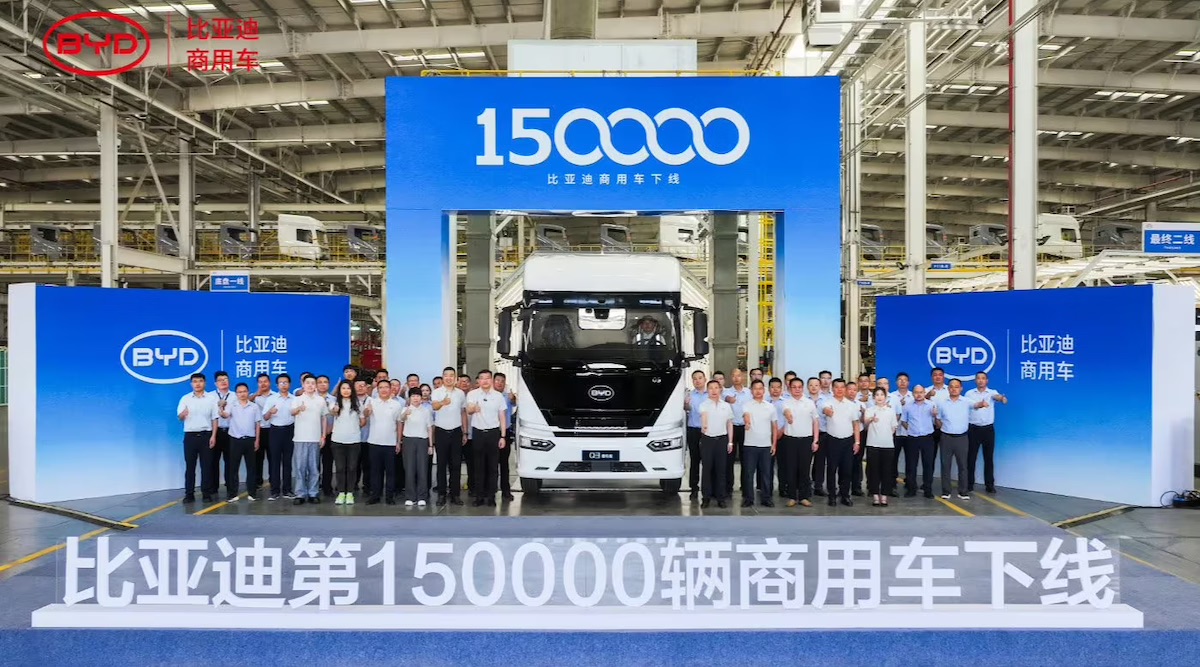
Global electric vehicle giant BYD has officially crossed a major manufacturing milestone, rolling its 150,000th commercial new energy vehicle (NEV) off the production line. The milestone vehicle, a heavy-duty Q3 electric semi-truck, was manufactured at BYD’s advanced production facility located in Huai’an, within China’s economically vibrant Jiangsu province.
This achievement underscores a period of explosive growth for BYD’s commercial vehicle division. Recent sales figures highlight a staggering 113% year-over-year surge in commercial NEV sales for September alone. Furthermore, cumulative sales for the first nine months of the year reached 48,492 units—a robust 29% increase compared to the 37,578 units sold during the same period in 2025.
To put the 150,000-unit production milestone into perspective, the nearly 48,500 commercial vehicles sold in just the first three quarters of this year account for roughly one-third (33%) of BYD’s entire historical commercial vehicle production volume. This extraordinary concentration of output highlights how rapidly global logistics and transportation sectors are pivoting toward fleet electrification, with BYD positioning itself at the vanguard of this industrial transformation.
Chronology of BYD’s Commercial EV Evolution
BYD’s journey into the commercial new energy vehicle space did not happen overnight; it is the result of a deliberate, multi-decade corporate strategy that evolved alongside battery technology improvements and shifting global climate policies.
The City Bus Era (Early Beginnings)
When BYD first entered the commercial vehicle market, its focus was almost exclusively on urban public transit. Recognizing that city buses ran predictable daily routes, returned to central depots nightly, and produced high volumes of localized urban emissions, BYD targeted municipal fleet operators. The company pioneered the large-scale deployment of battery-electric buses, securing high-profile contracts in cities across China and eventually expanding to international markets in Europe, the Americas, and Asia-Pacific.
Expanding into Urban Logistics and Cold-Chain Transport (2012–2020)
Building upon the battery, motor, and electronic control (e-platform) expertise gained from its bus division, BYD formally initiated truck research and development in 2012. Over the remainder of the decade, the company methodically diversified its product portfolio. It introduced light- and medium-duty trucks tailored for urban delivery services—where strict municipal emissions zones and low-noise requirements favored electric propulsion. Additionally, BYD targeted cold-chain logistics, providing refrigerated electric trucks designed to decarbonize temperature-sensitive supply chains.
The Long-Haul Pivot and the Q3 Semi-Truck (2021–Present)
Having conquered urban delivery and regional distribution niches, BYD turned its sights toward the most challenging segment of road transport: long-haul, heavy-duty logistics. The unveiling and production of the Q3 electric semi-truck at the Huai’an facility mark the physical realization of this long-term strategy. The Q3 represents a generational leap forward in battery density, thermal management, and high-voltage fast-charging capabilities, allowing heavy freight operators to tackle interstate and intercity shipping routes without relying on fossil fuels.

Supporting Data and Market Performance
The numbers behind BYD’s commercial vehicle division tell a compelling story of accelerating market adoption. While the passenger car segment often garners the majority of media attention, BYD’s commercial wing is expanding at a pace that is rapidly reshaping industrial transport.
- September Surge: Commercial NEV sales leaped by 113% year-over-year in September, demonstrating exceptional short-term momentum.
- Three-Quarter Totals: Across the first three quarters of the year, BYD delivered 48,492 commercial vehicles, up from 37,578 units in the corresponding period of 2025 (a 29% year-over-year increase).
- Production Milestone: The completion of the 150,000th commercial NEV cements BYD’s status as a high-volume manufacturer capable of scaling heavy industrial platforms. Notably, the sales achieved in the first nine months of this year alone represent approximately 33% of the company’s cumulative historical production volume.
- Geographic and Sectoral Footprint: Manufacturing operations are anchored by key regional hubs, such as the Huai’an plant in Jiangsu province, which specializes in heavy-duty platforms like the Q3 semi.
These metrics indicate that fleet operators are moving past the pilot-project phase. Commercial transport companies are now committing to large-scale fleet renewals, prioritizing total cost of ownership (TCO) advantages—such as lower operational, maintenance, and energy costs—over traditional diesel alternatives.
Official Responses and Corporate Strategy
In official statements released alongside the rollout of the 150,000th commercial vehicle, BYD representatives emphasized that the Q3 is not merely an incremental addition to their catalogue, but rather a foundational cornerstone for the company’s future expansion.
According to industry reports from CnEVPost, BYD corporate leadership explicitly noted that the Q3 is a key model in its push into long-haul transport. To capitalize on this momentum, the automaker intends to significantly increase capital expenditure and research investments targeting the long-heavy-duty truck market.

By scaling up production of the Q3, BYD aims to capture a dominant market share in a sector traditionally dominated by legacy diesel truck manufacturers. Management believes that as charging infrastructure matures along major global trade corridors, heavy transport will undergo the same rapid electrification curve previously witnessed in the urban bus and passenger car markets. BYD’s strategic intent is clear: transform from a regional player in urban transit solutions into a global titan capable of decarbonizing the world’s heaviest freight supply chains.
Broader Implications for the Global Transport Sector
The milestone achieved at the Huai’an manufacturing plant carries profound implications for the global transition toward sustainable energy and clean transportation.
1. Decarbonizing the Hard-to-Abate Sectors
While passenger cars are electrifying at a swift pace, heavy-duty commercial transport has historically been classified as a "hard-to-abate" sector due to the sheer energy density required to move massive payloads over long distances. BYD’s successful production and deployment of the Q3 semi-truck proves that battery-electric technology is no longer constrained to light-duty urban use cases. It is fully capable of meeting the rigorous demands of heavy freight.
2. Supply Chain and Logistics Transformation
Global corporations facing intense regulatory scrutiny and voluntary carbon-reduction targets are under pressure to clean up their Scope 3 emissions—those generated by third-party logistics and freight partners. The availability of high-capacity electric semi-trucks gives enterprise shippers a viable tool to hit net-zero targets without sacrificing operational efficiency.

3. Increased Competitive Pressure on Legacy Truckmakers
The rapid scaling of BYD’s commercial vehicle division sends a clear warning shot to traditional legacy truck manufacturers in North America, Europe, and Asia. Companies that have been slow to transition their heavy-duty platforms to electric architectures risk losing significant market share to agile, vertically integrated EV pioneers who can leverage massive economies of scale in battery and powertrain manufacturing.
Conclusion
BYD’s production of its 150,000th commercial new energy vehicle—highlighted by the Q3 electric semi-truck—marks a defining moment in the electrification of global transport. With surging year-over-year sales, deepening investments in long-haul heavy-duty platforms, and an ever-expanding manufacturing footprint, BYD is proving that a sustainable, zero-emission future for heavy commercial freight is not a distant aspiration, but an unfolding reality.